Showing posts with label Idaho. Show all posts

Wednesday, February 20, 2019

State-by-State Conversation by Report

State-level automated vehicle (AV) task forces and their reports vary a great deal, with some examining scenarios of a wholesale transition of the roadway space or the transportation system, while others appear to presume a static, mostly auto-based transportation system, similar to what we have now in most of the US.

Most of these reports, such as Wisconsin's, serve as AV primers for state legislators, government agencies, and others who work on transportation-related issues within a given state. They explain basic AV concepts, levels of automation, and how AVs differ from connected vehicles. Some explain well the traditional federal-state division of responsibilities over regulation and oversight of vehicle manufacturing, driver licensing, insurance, and infrastructure design. The Utah report does a nice job of describing the federal-state division of responsibilities, as well as which federal concerns are monitored by which federal agencies.

Progressive, inclusive, and geographically correct

These reports reflect the culture of each state, especially in terms of the scope of topics explored. Minnesota's report is a good example. This report emphasized equity and accessibility concerns, even describing the inclusiveness of the meetings that the Governor's advisory council in charge of the report conducted to discuss AV issues with people around the state.


The fear of an inequitable lack of balance between urban and rural areas was evident throughout the Minnesota report and, reflecting the concern with public perception, public engagement was a major priority for the advisory council.
Each meeting included remote participation. In addition to the public meetings, individuals could participate online, by survey, or share their feedback directly with the CAV-X office. To ensure transparency for the process, MnDOT placed all materials on its public website, including dates and times for each meeting. MnDOT conducted additional outreach activities for those unable to attend meetings, including individual meetings and calls, public events, presentations at various conferences and events, and a demonstration at the Minnesota State Fair. MnDOT also participated in intergovernmental consultation with tribal governments through the Advocacy Council on Tribal Transportation, the Minnesota Indian Affairs Council, and individual meetings with tribal executives. The final recommendations considered input from all of these outreach efforts.
Unlike most such bodies, the Minnesota advisory council did not include any AV companies or car manufacturers. Instead the advisory council included staff from government, non-profit organizations, labor, the insurance industry, and the energy sector.

Transportation modes besides cars and trucks? What are those?

On the other end of the spectrum is the report from Idaho, which mostly ignores the possibility of shifting transportation modal choices, and explores the usual concerns of cybersecurity, privacy, licensing and insurance. This might be due to the fact that members of the Autonomous and Connected Vehicle Testing and Deployment Committee - that's a mouthful - were auto dealers, representatives of various vehicle associations, and lots of law enforcement staff. Transit was not represented.

Indeed, though none of the recommendations mention transit, walking, or biking, a subcommittee that included transit, biking, and walking advocates managed to include some interesting text in the report - just not in the executive summary or in the recommendations.
The predictable routes, limited number of vehicles, fixed infrastructure in the public right-of-way, and public oversight place public transit in a unique position to pilot AV/CV technology. By piloting AV/CV for transit, the public could become more familiar and comfortable with the technology. Enabling and deploying AV/CV technology for public transit would also provide operational benefits to transit agencies by providing more consistent operations at potentially lower costs.
...      ...      ...
In the future, most vehicles using Idaho’s transportation infrastructure may not be individually owned, as they are today. The Mobility as a Service (MaaS) model predicts that most vehicles would be owned by corporations or collectives, and dispatched to users on demand. This model already exists with services like UBER and Lyft that currently use human drivers. These services have pilot projects testing the use of AVs. 
AV technology is accelerating faster in urban areas than rural areas. If state policies fail to address the needs of rural and local jurisdictions, the state could develop a disconnected network for AV/CV operations. 
Garden State: Not exactly innovative

Photo from Hyundai. https://www.motor1.com/news/300142/hyundai-elevate-concept-revealed/
The New Jersey joint resolution to establish a task force requires the task force to evaluate existing state and federal law, consider whether to pass AV legislation, whether to allow AVs to operate on public roads, whether to enact AV safety standards. Also looking at the other usual topics of licensing, registration, and liability. This is a completely typical state AV task force. It basically allows a state to appear to be doing something while hedging for time, and it also allows various transportation players in a state to come together, learn, and have an AV-focused conversation that will result in a public report.

*[In New Jersey, a joint resolution is defined as "a formal action adopted by both Houses (of the legislature) and approved by the Governor. A joint resolution has the effect of a law and is often used instead of a bill when the purpose is of a temporary nature, or to establish a commission or express an opinion."] As of Feb. 20, 2019, the Governor has not yet approved of this joint resolution.

While across the pond, if it's required for a 16 year old ...
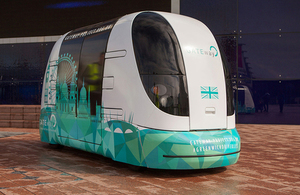
Meanwhile, Britain surges ahead in a much more organized fashion than we are seeing from the US federal government. The UK automotive minister and - love this title - future of mobility minister have announced that passing a stringent test, using the term "rigorous safety assessment," is required before an AV is permitted to be tested on UK roads.

The UK also has an AV report out of its Law Commission (jointly with the Scottish Law Commission) that provides a much more complete assessment of the legal issues surrounding AV laws and regulations. First, it examines the legal rules in other countries; second, it makes a distinction between partially automated vehicles (such as the Tesla autopilot system) and highly automated vehicles; third, it looks at local versus national control and whether new government agencies should be created or not. The report also raises the issue, in tort liability terms, of what a reasonable AV manufacturer or software updating company would do in terms of an obligation to update sensors, cameras, software, and other technology.


Friday, January 11, 2019

Lots of AV Reports, But Little on Accessibility

Automated vehicle (AV) development is not just about the technology that would allow for driver-free operation. AVs are partly advancing under the assumption that they will be electronic - EVs - and connected - CVs or CAVs. On the other hand, most of the legal studies and policy development is mode neutral and either gives lip service to, or ignores, people with disabilities. Accessibility embedded in the interfaces and the vehicles - whether for the benefit of people with disabilities, people with strollers, or people with luggage and grocery carts - is left out of the equation.

Considering that the touting of AVs highlights how wonderful they would be for current transportation-challenged populations, little ink or anything else has been spilled, so to speak, to guarantee that this promise will be fulfilled.

What do we mean by accessibility?


I will defer to the Consortium for Citizens with Disabilities (CCD) about their standard for accessibility in the context of AVs, taken from the CCD Task Force Autonomous Vehicle Principles.
AVs have the potential to drastically improve access for people with disabilities, including members of the blind and low vision, Deaf and hard of hearing, intellectual, developmental and cognitive disability communities, people with physical disabilities, including wheelchair users, and people with neurological conditions including epilepsy and seizure disorders. However, the promise and safety of AVs will only be realized if the vehicles and the surrounding infrastructure are fully accessible, and the safety elements consider the needs of people with disabilities
The CCD recommendations that particularly pertain to people with disabilities include:
  • Accessibility of human-machine interfaces,
  • AVs with lifts, ramps, and wheelchair securements,
  • No requirement of an operator on board who is licensed,
  • AV transit and pedestrian infrastructure that complies with the "Americans with Disabilities Act (ADA) accessibility requirements must be strictly adhered to in order for cities and states to work towards meeting goals of zero traffic deaths and serious injuries,"
  • An ADA or expansion that mandates "full accessibility for all types of common and public use AVs,"
  • "[L]egislation requiring that, as a matter of civil rights, all new technology incorporate the needs of people with disabilities at the earliest possible point, and 
  • "Congress should require that people with disabilities are part of the design and testing of new technologies in order to ensure the accessibility and usability of the technology." 
There is more, but you get the picture. Unfortunately, little or no mention of this sizable sector of the population and their needs is mentioned in reports about AVs. These reports, whatever they examine, are focused elsewhere.

Statements without supporting details


Two recent reports mention or refer vaguely to people with disabilities, but offer nothing more. These are the Human Factors and Ergonomics Society (HFES) Policy Statement on Autonomous and Semiautonomous Vehicles (Approved Sept. 30, 2018) and the Transportation Research Board (TRB) Forum on Preparing for Automated Vehicles and Shared Mobility (Sept. 2018). The HFES policy statement says: "Fully autonomous vehicles should accomodate people with disabilities." The document, while brief at five pages, mostly looks at safety; accessibility is not one of its main concerns. The TRB forum speaks globally about research needs that go from data to safety to business models for AV deployment, but it never uses the word accessibility. It mentions a research need addressing equity and another addressing "[h]ow best to serve those with special needs."

The Idaho 2018 Report to the Governor (Nov. 2018) from the Autonomous and Connected Vehicle Testing and Deployment Committee, like the Wisconsin Report of theGovernor’s Steering CommitteeonAutonomous and Connected VehicleTesting and Deployment, never uses any version of the word accessibility. The Wisconsin report does mention "underserved populations" and both address all users of the roadway, specifically including bicyclists and pedestrians. The Washington State Transportation Commission Autonomous Vehicle Work Group, like its counterparts in other states, is looking at AV developments from such a mode-neutral perspective that there is no weighing or consideration of how to steer AVs to serve everyone better and how to include people with disabilities in the next iteration of our transportation system.

State and other AV-related task forces typically examine insurance, licensing, registration, definitions, liability, and responsibility for maintenance. Maybe they consider policing and roadway management.

A whole different approach comes from the Scottish Law Commission, which produced a comprehensive paper - Automated Vehicles: A joint preliminary consultation paper (Nov. 8, 2018). It discusses both fully and partially AVs in terms of operations, reaching minimal risk condition, and liability. It explores different ways transportation is and could be delivered, including Mobility as a Service (MaaS). BUT, in terms of accessibility and providing an equitable transportation system to people with disabilities, nothing in the report goes beyond bare statements. We are talking lip service.

And the private sector?


The private sector is not rushing to provide accessibility - with the exception of Local Motors and others that aim to provide transit shuttle vehicles. And that would be current ADA accessibility that is not self-enforcing (as many lawsuits to enforce it demonstrate). But for taxi-like ridehailing service, no one is jumping up with any promises. Take Uber; in its report, A Principle Approach to Safety (Nov. 2, 2018), the only words related to transportation-challenged populations were these.
More equitable than existing transportation options 
Shared, automated mobility can work to extend the reach of public transit and bridge the first/last mile gap in areas typically underserved by transit systems, and for certain populations like people with disabilities, youth, and seniors. 
Aspirational, yes, but, as my mother used to say, that and (now) $2.75 will get you on the subway. $3 if you buy a single ride ticket. Referring, of course, to NYC, my mother's sole frame of reference.

Anxiety, of course, because lip service is not enough


My worry, and certainly the fear of the disability community (and some in the older adult community), is that lack of a mandate and/or concerted effort to embed accessibility now - during development of AVs and infrastructure (virtual and real) to support them - will put us in the same situation we were in, and in some respects continue to inhabit, which is attempting to retrofit a very inaccessible transportation system for people who are not the norm. The Americans with Disabilities Act (ADA) was a good first step almost 30 years ago, but, in any place without fabulous transit and even there (think elevators to subways in New York City and San Fransisco), people with disabilities continue to be second-class transportation citizens.

With the current House, Senate, and Administration, no one is pushing for ADA 2.0. If anything, there is fear of accessibility retrenchment. At three weeks into a government shutdown, one begins to wonder whether the dream of bipartisan action on infrastructure and transportation can even happen. Any progress is happening in large cities, such as Boston and New York, which are taking to heart transit accessibility concerns and commitments. (Sorry for the lack of links here.)

From the Navy Yard - possible home run hit right before the shutdown


The USDOT building in Washington, DC, is barely a walk away from the DC major league baseball stadium. That US agency building, which spans two large city blocks, was, hours before the government closed up, the site of a hopeful development that AVs will serve everyone. I imagine a government employee, in the dark, hovering over his or her computer in a rush to click "upload" before the shutdown announcement to step away from the building and all government-funded devices.

The Notice of Funding Opportunity - or NOFO, in acronym land - issued from the US Department of Transportation just a few hours before the government shutdown, expresses a commitment to transportation-challenged populations in general and to people with disabilities and older adults in particular. One of the prime goals of the USDOT project - entitled Automated Driving System (ADS) Demonstration Grants - is to "fund projects that test applications with the greatest potential to service transportation-challenged populations, including older adults and individuals with disabilities.” Additionally, "Each demonstration must include input/output user interfaces on the ADS [automated driving system] and related applications that are accessible and allow users with varied abilities to input a new destination or communicate route information and to access information generated by the ADS.”

The deadline for proposed demonstration projects is Mar. 21, 2019 - assuming that the federal government is back to work by then.