Showing posts with label People with Disabilities. Show all posts

Monday, March 29, 2021

#6 Comments on Draft Strategic Plan on Accessible Transportation

This is the last post about comments submitted in response to the Draft Strategic Plan on Accessible Transportation. The comments discussed below were all submitted by individuals speaking on their own behalf, though represented in that group is one well-connected professor and a strident activist among the group. There were a total of 28 comments, pretty meagre considering that approximately 15-20 percent of the US population has a disability.

For me, it's a privilege to read the comments. Picture the black-and-white fact of voting results and imagine every person explaining why they are showing up to vote. That added color, as it were, is what we get to read in these comments.

Comment from Louise Shawkat

This comment states that not all people are able to drive and everyone needs to access medical care, voting, and houses of worship.

This comment expresses full support for frequent and reliable public transportation
[S]o we wheelchair users can get to school, work, groceries, friends and of course doctor appointments. Paratransit is universally terrible and actively dehumanizing - you have to allow a 3 hour window for pickup and then the way back and on the drive, they may go out of the way to drop off someone else.

This is so sad because Ms. Henry compares what anyone would consider mediocre bus service in DC or New York to be heaven because she would be able to reduce her harrowing three-hour wait and trek to an hour and a half.

Comment from Walter Park

This comment implores the USDOT that now is the time to take big steps and those steps, in the opinion of Mr. Park, are to support a robust, multimodal public transportation system. "Accessible transit can also be a huge benefit to the environment and a clean energy job-maker. Accessible high speed rail can transform California's economy and its communities."

This comment is from a civil engineering professor emeritus at the University of London. 
I am also a member of the Disabled Persons Transport Advisory Committee (DPTAC) which is an expert committee established by the Transport Act 1985, providing advice to the UK  government on the transport needs of disabled people. I chair the DPTAC Research and  Evidence subgroup. I am also a member of the US TRB Accessible Transportation and  Mobility Committee. 
I have been actively involved in the development of the Inclusive Transport Strategy (ITS) which is an equivalent document to the US Strategic Plan on Accessible Transportation. The ITS can be downloaded from https://www.gov.uk/government/publications/inclusive-transport-strategy
This person has credentials. Prof. Mackett's first point is that the Draft Strategic Plan on Accessible Transportation is missing both a timeline and a plan for how to monitor progress. The professor offers contrasting policies in the UK as well. For instance, he discusses e-scooters, which are permitted to operate in the US, sometimes even on sidewalks. In the UK, in contrast, due to the risk that these devices pose to blind pedestrians, they can only be used on private land or as part of ongoing research trials. Prof. Mackett also provides a link to information about lawsuits brought by rail passengers who use wheelchairs. He asks that research be done on access to trains, looking at the spacial difference between train platform and rail car.

Prof. Mackett also refers to the seminal work done in the UK to review laws and regulations related to autonomous vehicles (AVs), including, specifically, for people with disabilities and older adults. For anyone seriously interested in legal frameworks for AVs, that multipart series (probably coming to over 700 pages in full) is a tremendous resource. 

Comment from Zach Karnazes

We have here a comment from a knowledgeable disability activist. Here is a link to Zacthivism, which goes into detail about Mr. Karnazes' disability work and info, which is very San Francisco centric, but quite informative and thorough. I will just say that Mr. Karnazes is also quite pro-equity and pro-transit union. Indeed, his first point is exactly what I keep saying, that the Americans with Disabilities Act (ADA) should itself be complemented with or changed to allow for constant monitoring and enforcement rather than relying on passenger complaints. He suggests a federal civil rights enforcement body.

What Mr. Karnazes really wants is a new, better version of the ADA. I agree, but I doubt it will happen even if the filibuster were thrown out the window. Between COVID, vaccinations, saving democracy, and perhaps fixing or replacing crumbling infrastructure, no disability organizations are pushing for a wholesale refurbishing of the ADA. Mr. Karnazes, I salute you for speaking truth to power.

This comment is well worth the read, opinionated and with heart; here is a cursory look at Mr. Karnazes' wish list.
  • New ADA Title II, which removes "vague language around denials of access" based on administrative and financial burdens (which goes beyond transportation).
  • Increased funding for public transportation. Mr. Karnazes here cites the inherent conflict of interest for the bus driver when attempting to remain on schedule while taking the time to secure a person in a wheelchair.
  • Create an ombudsman office to help people with disabilities. "New York State has a program like this (https://aging.ny.gov/long-term-care-ombudsman-program), but California and most all other states do not."
  • Stop relying on disability organizations, "so-called "stakeholders" and corrupt "non-profits" that do not represent our community well and are afraid to make bold claims for fear of losing their federal funding." Instead, Mr. Karnazes suggests policy based on polling or other data collection that reflects the lived experience of people with disabilities. I will not offer my own commentary except to say that this gets complicated.
  • Make public transportation fare free for people with disabilities who are living in poverty. Mr. Karnazes refers the reader to videos in which people with disabilities describe the difficulties of living on Social Security assistance.
  • "Create a non-biased Grievance oversight procedure for ADA access issues with transportation, with the hearing judge that is not employed by or working at the office where the complaint is filed." Having worked at a local transportation administrative agency in a large city, I will remark that this recommendation has merit. However, I do not have knowledge of other agencies in this respect.
  • Support the bus drivers in their work and through their union.
This comment advocates briefly and without specifics for much improved public transportation systems in the US. The goals are accessibility, abundance of transit, and environmental friendliness. "Also, when you make public transit more accessible for one group of people, it ends up helping us all." Amen.

Monday, March 22, 2021

#5 Comments on Draft Strategic Plan on Accessible Transportation - Disability Organizations

This post features organizations that represent, protect, and promote the rights and lives of people with disabilities. The overall framing of the conversation is where the value of these comments to the Draft Strategic Plan on Accessible Transportation begin, but what I did not expect from these organizations was the variety among the comments sent. There was not a coalition-type decision for every group to send the identical or nearly identical comment. These comments give a feel for the meaning for people with disabilities of the obstacles that continue to obstruct their path in using our transportation network on an equal footing with all others.

What is missing in this record of comments are many organizations that work with and on behalf people with disabilities, those who represent seniors, and those who provide transit and transportation services for them.

The comment of the Consortium for Citizens with Disabilities (CCD) comes from the CCD Transportation Task Force. Please be aware that I have met most of the co-chairs of the task force, some multiple times, and I respect and support their work. One of the co-chairs has been very active on work related to accessibility of autonomous vehicles (AVs) and others have participated to a lesser degree. 

The CCD comment puts disability in American life and life in the US with a disability into perspective. One fifth of Americans have a disability; many are either unable to drive or cannot afford a retrofitted vehicle. A significant percentage live on an income of $25,000 or less, problematic for anyone, but more so for people who need extra support. Therefore, CCD points out, affordability is as much as an issue as accessibility. In a nutshell, CCD desires that "[t[he rights of people with disabilities must be prioritized, infrastructure drastically improved and accessibility baked in to any innovation."

CCD is pleased with "DOT’s inclusion of spontaneous and independent travel as a facet of the principles."
 
CCD seeks to:
  • "[I]ncentivize the expansion of accessibility in all parts of the transportation system"
  • Embed accessibility in innovation
  • Promote geographic equity, including rural and tribal
  • Add racial equity to the framework principles
  • Change the language from removal of unnecessary transportation barriers to "reframing and setting as a goal removal of all barriers to people with disabilities"
  • "Elevate concerns about affordability and digital inclusion when considering the deployment of new technologies that empower new networks, operational models, and vehicle types" (going beyond the embedding of accessibility into AVs)
  • Incorporate safety for people with disabilities as passengers and pedestrians into the Federal Motor Vehicle Safety Standards (FMVSS)
  • Fully staff "NHTSA research programs and its Office of Civil Rights ... with a budget for fully qualified expert full time employees for compliance reviews on a continuous basis, and research and regulation reform to ensure inclusivity now and in the future."
  • Establish "[v]igorous complaint and remediation processes, and compliance with the ADA," including discrimination in driver licensing and commercial driver licensing,
  • Ensure audits of sidewalk and curb ramps
  • Fund "repair and expansion" of the sidewalk accessible network
  • Redirect funding from police enforcement, which disproportionately affects people with disabilities, towards "infrastructure improvements and ADA compliance"
  • "[E]ncourage education of micromobility providers on the dangers of scooters and bikes which block PROW [public right of way], and solutions, including provider in-app penalization options for micromobility abusers"
  • Strategize to fully include people with disabilities into transportation surveys
  • "Encouraging inclusivity and reminding state and local DOTs of ADA obligations"
  • Conduct a "survey of all inaccessible Amtrak and legal rail stations, and a detailed plan with deadlines to ensure full accessibility in the future"
  • Ensure accessible on-demand transportation that is part of programs to complement transit services
  • Designing federal programs so that on-demand transportation does not supplant transit service*
  • Accessible rail cars, including bathrooms, redundant announcement systems, and entry-level boarding.
Hand lettering of "spicy."
A long section of the comment is devoted to air travel, which I will not summarize except that it speaks in more detail about the quite insufficient, sometimes harmful, measures provided to enable people with disabilities to ride on commercial airplanes. Beyond transportation, but related to it in our Internet and app-based world, is a request that USDOT cooperate to expand broadband access and affordability. CCD also requests that the phrase "people with ‘differing abilities’" not be used and that better language would be either people with disabilities or disabled travelers.

* This point is one with which I disagree. I fully support all-accessible on-demand transportation, whether that be taxi, ridehailing, or microtransit service (leaving aside for the moment micromobility options), but there are often occasions where an on-demand option can better serve a route or an area than retaining or supplementing existing transit service, particularly infrequent and often unreliable service. I think that CCD's fear is that the replacement will not serve people with disabilities as well even while it might be an improvement for others.

The American Association of People with Disabilities (AAPD) is a member of CCD. AAPD's comment is pretty global in its suggestions, making broad suggestions on (1) stakeholder engagement when issuing regulations, guidance, and funding announcements; (2) the role of regulation, urging appropriate regulation instead of knee-jerk (my word) anti-regulation bias; (3) enlarging the scope of the "complete trip" definition to include digital access for booking rides; and (4) geographic equity, particularly for communities of color and low-income populations. 

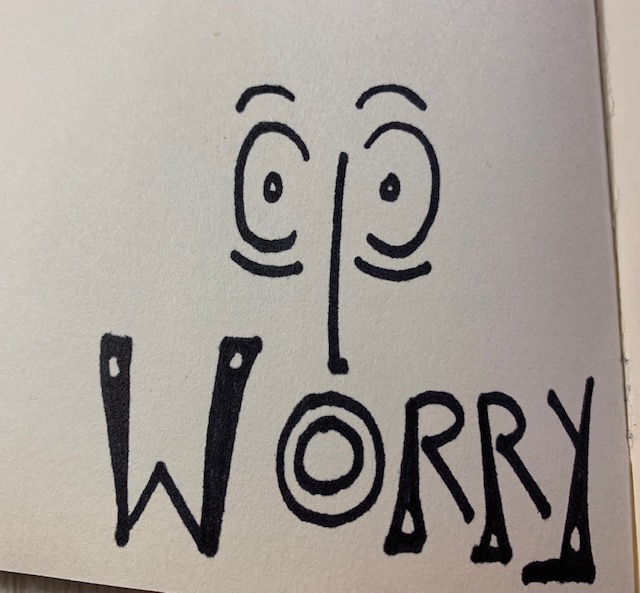
Hand lettering of "worry."

AAPD saves its specificity for AVs. It asks that the USDOT expressly include organizations representing people with disabilities in the stakeholder engagement section of the proposed framework. AAPD also suggests that people with multiple disabilities be included in AV design: "Advance solutions that can further enable people with physical, sensory, and cognitive disabilities, [including those that live with multiple disabilities] to use automated vehicles." [Emphasis on AAPD's suggested additional language.]

United Spinal Association organization is a member of CCD. United Spinal applauds the attitude of universal design in the framework and "respectfully request[s] that the next iteration of the Draft Strategic Plan on Accessible Transportation consistently pursue a universal audience approach at every opportunity." This organization calls the draft plan "embryonic," as though it expects significant changes before the draft plan reaches final form. Clearly, United Spinal is banking on the change in presidential administration because a bold request is made now, not when a final plan is issued, to appoint a specific person at the USDOT to focus on accessibility and universal design, and to meet with the CCD transportation leaders, USDOT modal administrators, and the Secretary of Transportation on a regular basis.

It is not that United Spinal is asking for anything different than what the draft plan envisions, it is that this organization wants a commitment to realizing the goals enunciated in the draft plan. 
DOT must take a comprehensive approach to strengthen coordinating its accessibility efforts with the tremendous knowledge base and institutional resources of the U.S. Access Board. DOT must be ever cognizant though of the Access Board’s severely limited budget and that optimal partnerships will depend upon DOT’s significantly larger and therefore more flexible budgetary resources to be committed to coordinating initiatives.

...

United Spinal respectfully requests that DOT convene a series of workshops to further operationalize the complete trip concept in the next iteration of the Draft. While the Draft addresses multiple aspects of complete trips primarily through examples of existing work the DOT is conducting, a more comprehensive analysis of the concept is truly needed. 

...

Future iterations of the Draft must include a timeline of realistic goals and achievable benchmarks to increase accessibility for all Americans. 

What the USDOT offers in the draft plan, United Spinal says, is a start. In terms of AVs, United Spinal sees the possibilities and the very real risk that an accessible transportation network might not be realized. 
United Spinal supports: 
• a separate objective be established in the Draft to further AV safety, testing, research and design and above all, accessibility exclusively. 
• An AV Federal Advisory Committee. 
Until [then,] Spinal wants to reiterate its support for the recommendations made by the Consortium for CitizensTransportation Task Force regarding DOT’s AV 4.0, including formation of an AV Advisory Committee with an accessibility subcommittee, and any grants funding autonomous vehicle projects requiring that people with disabilities are part of the design and testing of new technologies in order to ensure the accessibility and usability of the technology from the start.
United Spinal lends its support to expansion of broadband access.

Hand lettering with drawing of "meditate."

In its comment, the Hearing Loss Association of America (HLAA) speaks about the unrealized guarantees of the ADA and need for redundancy in communication throughout the transportation system. HLAA is not a member of CCD. The technologies are already here and HLAA suggests which ones would help people with hearing loss. These would provide redundancy for announcements on buses, planes, and trains, and at stations, sometimes to note last-minute changes or emergencies.

Likewise, HLAA asks that AVs be accessible, which would include technology that provides "hearing loops, visual and text information ... whenever verbal information or audible prompts are used." Again, redundancy is featured in its recommendations. 

  • Assistive listening systems, including hearing loop systems in stations, rail cars, at information points and any other place that requires understanding speech, whether via broadcast announcements or person-to-person communication. 
  • Tablets, iPads, computers, and/or smart phones with speech to text software applications and with lapel microphones for person-to-person interactions. 
  • Captions for videos or on-line communication. 
  • Public information boards that simultaneously display audible announcements in text.
Similar to other comments from disability organizations, HLAA speaks about more and better integrated stakeholder participation.

The American Foundation for the Blind (AFB) appreciates the multimodal approach that the USDOT takes in the Draft Strategic Plan on Accessible Transportation. The AFB comment begins by pointing out the large size of the population it represents and its sheds a spotlight on the importance of access to transportation in terms of getting to vaccination sites. The organization is also a member of CCD. 

AFB raises the issue, not discussed previously in the comments, of people who are deafblind. AFB suggests expanded use of tactile wayfinding for this population, as well as education (I think they mean travel training) for people who are blind or have low vision navigating at transportation hubs and in the pedestrian environment.

Hand lettering of "mobility smorgasbord."
Day 28 of 100 days of hand lettering.
The blind community has been especially active and excited about the development of AVs and AFB "appreciates the goal of eliminating barriers to licensing, operating, and riding in passenger and commercial motor vehicles. Automated vehicles in particular offer promising solutions to many barriers if manufacturers commit to designing fully accessible vehicles." AFB asks that accessibility be prioritized when considering regulation and to embed accessibility experts at each of the modal administrations at the USDOT. AFB expressly refers to the Access Board guidelines and to digital accessibility for compliance with Section 508.

AFB takes a holistic, multimodal approach and thanks the USDOT for considering all of the modes beyond automotive travel. It mentions wayfinding in some detail as this is an important aspect of trip navigation. In this vein, AFB asks for improvements in shared-use modes.
AFB strongly applauds a commitment to expanding and maintaining accessible public transit infrastructure. We encourage the department to consider ways to incentivize more convenient paratransit service, including by implementing modern scheduling systems, reducing how far ahead individuals must schedule trips, and reducing barriers to traveling across jurisdictional boundaries. We encourage improved collaboration between Federal aid recipients and secondary providers. New mobility, including ridesharing, offers ample opportunity for improving services for people who are blind and has proven successful in several pilots, but such collaborations must provide accessibility to all people with disabilities, including wheelchair users.

For long-distance travel, AFB refers to the CCD comment. 


As this comment focuses on and goes into detail only about accessible air travel, I will not be writing about the details. If one is interested in the weaker accessibility requirements for airplanes than for public transit, this is a good comment to read.

New York Lawyers for the Public Interest (NYLPI) lauds the USDOT for developing the Draft Strategic Plan on Accessible Transportation and it offers practical suggestions that would add to accessible transportation in urban settings. This New York refers to the city and not the state, though the website never actually states that. 

NYLPI wants to see vastly expanded accessible ridehailing (I take issue with the term "ridesharing," as used in the comment), specifically mentioning Uber and Lyft. "Ride-sharing companies collect record profits, and yet are woefully coming up short in promoting social equity through the provision of accessible vehicles." The former is not actually true; as it stands, Uber and Lyft lose money on every ride. This is the reason why each company invested early in AVs.

NYLPI asks that micromobility companies - bikeshare, scooter share, etc. - be required to develop and make available accessible options. And NYLPI's comment reads like a pedestrian rights manifesto.
[T]he importance of accessible sidewalks and streets must be emphasized in the Strategic  Plan. In accordance with the goal of providing for the “complete trip” of people with  disabilities, sidewalks must be fully accessible. Full accessibility includes proper curb cuts  and Accessible Pedestrians Signals. Moreover, with the rise of outdoor dining, clear protocols  and enforcement guidelines must be promulgated to ensure that sidewalks are not obstructed  by private businesses. Lastly, protocols and guidelines should be provided for clearing debris  and snow from sidewalks, as impassable sidewalks violate disability laws.
Regarding public transit, the accessibility of which is a huge issue for New York City's subways, NYPLI makes clear something that should be shouted from the rooftop of every discussion on this issue: "[F]ull accessibility of rail and bus stations entails more than working elevators." And let me just say that the word "working" here should not be assumed or considered redundant. ADA lawsuits in major cities have revolved around the issue of poor elevator maintenance and repair. Full accessibility also includes safety features that are both tactile and visually noticeable.

And I have to love my fellow New Yorkers for this, even though I am in exile, that NYPLI proudly touts the importance of the city's economy to the nation and its public transportation to the city and the region's commuters. 


[Video is Liza Minelli singing New York, New York in the movie of the same name.

And this next video was why youtube was created. Here is Judy Garland and Liza Minnelli onstage together in London. 


Sustain Charlotte (which only has a Facebook page) offers a brief comment to support robust, accessible, well-funded public transportation.

Friday, March 5, 2021

#3 Comments on Draft Strategic Plan on Accessible Transportation

We have 28 comments to the Draft Strategic Plan on Accessible Transportation and, now that the deadline has passed, I am grouping the rest into categories. In this post are two summaries of comments submitted by cities, in fact, the only cities to share their responses to the draft plan. People with disabilities live in every city, every county and every state. Yet the two comments submitted represent a mere two municipalities of any kind. According to the Census Bureau, there are just over 89,000 municipalities in the US.

Engagement ≠ Opportunity, Engagement = > Opportunity

I would guess that accessibility is important to every city and town. Indeed I am certain that many city mayors and staff would agree. But I wonder that many lack the staff to monitor Federal Register notices, which is a nice public engagement tool if you are from the 19th century rather than the 21st century. To be fair, the Federal Register does allow one to monitor notices with keywords of one's choice, which prompts an email to be sent every time those keywords appear in any kind of notice. 


So maybe it isn't the opportunity itself that is hidden, but the Federal Register doesn't actively reach out to stakeholders on any particular topic. That falls to whomever wishes to do so, mainly non-profit advocacy groups that are themselves stretched thin. Advice to those advocacy groups representing people with disabilities: Do better outreach for comment submitting campaigns. I will be having a post on that topic at some point. 

I am guessing that any city responding to the draft plan is going to come out in favor of expanding accessibility because it would be like opposing apple pie to say otherwise, at least publicly. This guess turns out to be correct, but these cities that have submitted comments are offering concrete guidance about routes to that end.


Comment from Portland Bureau of Transportation

This comment is from PBOT, the Bureau of Transportation in Portland, OR. Portland suggests engaging municipalities more to expand accessibility through city accessibility plans. "State ADA Transition Plans focus on state highways, which in many cases, run through cities and operate as city streets, but only as a small part of a city’s transportation system. A much bigger impact to accessibility can be accomplished by implementation of city ADA Transition Plans."

In case you are unaware, different streets have different designations. In my state of Maryland, any main thoroughfare is a state road, with some county roads, and then local roads. This really messes with local control and becomes even worse in those states where state legislatures and governors are very anti-city, notably Texas. The letter explains, "City transition plans focus entirely on transportation system elements: streets, sidewalks, pedestrian signals, transit stops, accessible parking, and curb ramps that are used by pedestrians every day. Implementing these plans will get people to school, work, medical appointments, the market, and provide opportunities for healthy activities like biking, running, and walking." 

Quite rightly, PBOT points out that despite the 30-year-old Americans with Disabilities Act (ADA), there is much to be done to fulfill its mandate. PBOT suggests an economic stimulus that includes implementation of local accessibility plans, with opportunities given to historically underrepresented contractors (such as minority-owned businesses).

In terms of guidance, PBOT asks for advice concerning service animals on public transit and on shared on-demand transportation, such as taxis. 

I am going to be a bit critical here, not of the comment itself, but of affixing the equivalent of a bunch of sticky notes to the source document. Yes, this "comment" is actually notes thrown on the margins of the draft plan. Harumph. 😠


The comment requests funding increases or creation of funding to increase geographic equity beyond rural areas by expanding accessibility in underserved neighborhoods; and funding to support complaint processing to enforce the ADA, thus decreasing backlogs and processing time.

San Diego suggests national standards and technical assistance for several aspects of broadening accessibility, specifically requesting: 
  • Design guidelines for the right of way
  • Development of national standards of accessibility and training
  • Adoption of public rights-of-way accessibility guidelines (PROWAG)
  • Outreach and education about ADA enforcement for people with disabilities
Sidewalks are another area of concern. San Diego is argues in favor of adding sidewalk maintenance to the list of barriers to accessibility and including sidewalk design to the necessary steps to accessibility.

On another note


Thinking of topics of history that can guide us - positively or negatively - toward a better transportation future. Pondering a podcast about these. Feel free to send a note via LinkedIn, email or twitter - @DriverlessRev or at grossglaser@gmail.com. Whatever.

  • Roman roads/early American roads
  • Union Stations
  • History of Braille 
  • Rebuilding of DC Union Station
  • Polio and the ADA
  • Disappearance of streetcars 
  • History of the American suburb and racism
  • Transportation in the Constitution
  • Why Isn't there a DC subway station in Georgetown?
  • Thriving Buses in the Midwest
  • Rural versus Urban in Colonial and Early America 
  • History of planning and why we elevate public meetings

Monday, February 22, 2021

#9 Comments in Response to NHTSA ANPRM - One Institute, One Engineer

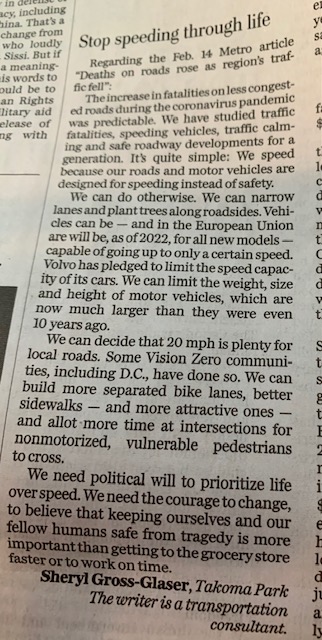
A little bragging - The Washington Post published my letter to the editor on Friday, Feb. 19, 2021. Just including it in case anyone is in need of a transportation rant about safer roads.


Acronyms for today


ADS - Automated Driver System (sometimes referred to as ADAS for Advanced Driver Assistance System), which requires a human driver to monitor and at points take over operation of the vehicle
ANPRM - Advanced Notice of Proposed Rule Making
AV - Autonomous Vehicle
GAO - Government Accountability Office
GAO is a legislative branch government agency that provides auditing, evaluation, and investigative services for the United States Congress. It is the supreme audit institution of the federal government of the United States.
NCAP - New Car Assessment Program
NCSL - National Conference of State Legislatures
NHTSA - National Highway Transportation Safety Administration (an agency within the US Department of Transportation)
NTSB - National Transportation Safety Board
SUV - Sport Utility Vehicle
USDOT - US Department of Transportation

Comments tally

Disclaimer/Explanation: Please note that anonymous comments and ones where the author's background is undeclared or not easily discovered are counted as "regular people" unless it becomes apparent that the commenter has professional expertise, which then shifts the comment into that category. Also note that the comments tally includes those comments summarized below in this blog post. All categorizations are my own and might seem random or wrong to someone else.  I am not an engineer, an automotive geek, or a software expert.

Comments are due by Feb. 1, 2021

Total comments to the Framework for Automated Driving System Safety (Framework) Advance Notice of Proposed Rule Making (ANPRM) issued by NHTSA that I have studied - 18 

Total comments as of Feb. 15, 2021 - 649 - The math comes to a difference of 631 unread comments. 🤯😲 😨😱

This is a tally of those comments I have read. Needless to say, I have a year or more of reading ahead or I can forget this. What keeps needling me, though, is the thought that no one but a bored, overworked, government functionary is reading these. I am respecting those who have submitted comments by giving them a thoughtful read and summarizing them.  

Anonymous - 2

Companies or Organizations - 8

Individuals with professional expertise - 6

Cybersecurity -2  

Regular people - 6 

Regular people who want increased safety - 5

Regular people who do not believe AVs will be safer than human drivers - 1

Regular people who do not want regulation to constrain innovation - 1

Spam comments - 1

Instructions for submitting comments can be found in the ANPRM.

Please note that these comments are not necessarily representative of the opinions of the US population; rather they come from corporate or non-profit entities or professionals with an interest in AVs, or people with the time, energy, and space in their lives attend public meetings - in this case to devote attention to Federal Register notices. The regulation-making process is, if not hidden, then placed out of the way in the bowels of federal agencies, and is oft forgotten when we vote or choose where we participate in our democracy.  

David DeVeau - Comments

I will get a guest blogger for this one. This guy is obviously an engineer who only writes in engineer speak. It does seem like he has something valuable to say.  I will ask around.

Humanetics - Comments

Humanetics is the leading crash dummies manufacturer, at least according to itself. I will be frank that the whole point of an AV, in terms of safety, is to avoid a crash, leaving the crash dummies to ride along and check their fake smartphones and drink their pretend lattes. That said, there's no reason to get rid of the crash dummies. 

Humanetics requests that we retain the particular FMVSS regulatory frameworks and certain equirements, such as gender-based crash dummy tests. 

Humanetics encourages the agency to implement a regulatory framework soon. It is not too soon and would not inhibit the advancement of technology. There are clearly certain basic driving scenarios which are anticipated to be very common, and all manufacturers would recognize these as critical and it is not too soon to implement a regulatory framework. As previously mentioned, these regulatory protocols could be supplemented with voluntary measures to control and manage a broader range of driving / test scenarios. Those voluntary scenarios / tests should remain fluid as the technology evolves.

Though Humanetics favors employment of the FMVSS, it does suggest an avenue for using alternative protocols. It envisions "a parallel path with regulatory testing with an option for a manufacturer to provide evidence supporting an alternate test protocol based on their technology is appropriate. Both the regulatory protocol and any alternate path should both utilize physical testing to ensure the performance of the  vehicle."

Now only 629 comments, give or take, to read. Why does that song 100 Bottles of Beer on the Wall, sung on every middle school trip, come to mind?

Write-In Campaign


Love this! We have a write-in campaign from members of the League of American Bicyclists. Identical comments, very brief, from avid bikers. Nice. I am going to collate all of these later in one post. Two of these are already included in the tally. Maybe there are more among the 600-plus comments left for me to read. Why do I complain about insomnia when there is a cure if I keep my laptop beside the bed?


Comment from Mollie D'Agostino on behalf of the UC Davis Policy Institute for Energy, Environment, and the Economy


This comment is submitted by Mollie, D'Agostino, whom I know personally, but not well. She submits this comment on behalf of the UC Davis Policy Institute for Energy, Environment, and the Economy (Policy Institute). DAgostino is the Policy Director of the 3 Revolutions Future Mobility Program at the Institute of Transportation Studies at UC Davis. This is a well-thought out comment that turns the safety framework on its head by essentially asking what is safety and is it more than preventing crashes or reducing their harm.
The narrow scoping of this ANPRM may be counter to a more comprehensive AV framework that might holistically address safety in such a way that it also tackles other DOT priorities, including climate resilience, mobility for underserved individuals and communities, and accessibility for all, including people with physical or cognitive disabilities. A narrow AV or ADS framework may obscure or even impinge on the Department’s broader transportation, mobility and sustainability objectives. 
The Policy Institute points to the state of California as an example of AV leadership from a government that has chosen to prioritize safety, environmental sustainability, equity, and accessibility.  And to make it better, the California goals include data collection to ensure we can judge where the state and the industry are in terms of reaching the goals.

Specific requests in this comment include:

  • Clarify terminology - The Policy Institute asks NHTSA what safety means exactly and does it include security, shared-use vehicles, as noted examples. 
  • Consider the possible safety benefits of fleet-based, shared-use AV transportation service. The comment posits that reliable maintenance might increase reliable performance and safety. 
  • Establish a continuous monitoring system through data collection - The comment states that there are examples at the USDOT, specifically the DOT Secure Data Commons, and in the private sector.
  • Set required performance standards - "Binding (rather than voluntary) performance-based ADS safety standards within the FMVSS will likely result in more consistent and improved safety outcomes. Performance-based standards, rather than design-based standards, such as safety benchmarks, will be more flexible and allow the industry to evolve in a manner that preserves safety and consistency."
  • Research to ensure business models that increase safety - The comment states, "more research is needed to assess safety outcomes for these different business models and to understand the expanded role of AV manufacturers in ensuring reliable ongoing performance of the ADS and vehicles whether they are operated by individuals or fleets."
  • Research to identify or set standards for emergency communications, a "panic button."
  • Collaborate with the Federal Transit Administration (FTA) - The Policy Institute includes passenger interfaces in this request. "NHTSA should work with FTA to consider how public transit applications will impact safety, and whether AVs for transit use will meet requirements under the Americans With Disability Act [(ADA)]. ... Both safety and security performance standards could be considered for shared AVs to encourage consistency among commercial service operators, so passengers can become familiar with security practices."
  • Define safety and test for it to include people with disabilities, whom are, the comment points out, 17 percent of the population. Even now, testing performed reflects average sizes . The comment offers a list of examples of specific metrics that might ensure AV safety for people with disabilities. These include physical access, such as wheelchair ramps and securement, as well as communications access. For a petite woman and an advocate for accessible transportation for people with disabilities, this comment is very significant. In my opinion, this deserves a long quote from the comment: 

The AV Safety Framework should consider the safety considerations for passengers with disabilities, including those who may use wheelchairs for personal mobility, or whom currently require aids or drivers to assist them with many aspects of travel. Care must also be taken to consider the needs of riders with other disabilities who are not in wheelchairs. More information is needed to build a concrete and qualitative understanding of the needs of people with all types of disabilities, and DOT should convene NHTSA, FHWA, FTA, and other relevant agencies to consider how a proposed AV safety framework might improve mobility for disabled passengers. 
In this vein the comment requests that we consider everyone, not merely those affluent or able enough to own a vehicle and maintain it. The comment integrates into its requests for research that we examine ramifications for people of color, people with disabilities, and people who bike and walk (pedestrians, yes). 

Tuesday, February 2, 2021

#1 Comments on Draft Strategic Plan on Accessible Transportation

This post reviews the comments submitted thus far in response to the US Department of Transportation Draft Strategic Plan on Accessible Transportation. Only one comment, thus far, from Julie Withers, discusses anything about the accessibility of autonomous vehicles (AVs). All of the comments summarized below are brief, sometimes briefer than my mix of summary and remarks.

Reading these comments is a privilege. People write in with private thoughts, ones not captured in a polling booth or in polished statements of advocacy organizations, about how government policy matters very personally to them. Even, and, sometimes especially, the comments that are clearly from individuals unfamiliar with government agencies and how they operate are the most moving. Somehow these people have discovered a relevant agency notice and they are sharing with the seemingly anonymous bureaucratic-sphere their unvarnished thoughts.

Comment from John Brown

Comment does not address the strategic plan; it remarks on a particular transit service in Texas.

Mr. Temple says in his comment that he has been in a wheelchair for 27 years, after being injured in the first Gulf War. He has suggestions for how to better retrofit vehicles so that people with particular physical disabilities can use them. "Basically I’m asking to help. I understand the limitations people in wheelchairs have. I understand what is needed for the very wide rang of injuries. I have understanding of the different lifts and their limitations as well. I have been exposed to all the new and old techniques used in Accessibility. The wildest one was a friend of mine who had barely any use of his arms and drove by joystick. It’s amazing what the US can do when we put our minds to it."

Despite the name given, this is not a completely offensive comment and not violently threatening. What the comment does convey beyond anger is frustration with federal efforts to expand accessibility.
Repeat: I cannot call myself an outdoor cat when I
refuse to go out in the snow.
"'Quarterly webinars" as the "innovative" solution to fix the problem is a joke. We know the answers of how to build safe, accessible roadways for a wide range of users - use your powers to properly define and demand them from DOTs.
While USDOT employees sit at their desks or telework from kitchen tables, it is helpful for them to remember that accessibility is a real-life issue for many people, and that the lack of access is extremely unfair and frustrating, creating a huge barrier to living a normal life. But what the angry commenter does not realize is that the authority of the USDOT to affect change is limited to the powers that Congress has granted. So now I have spent more words than Florida person used.

When someone starts discussing the mechanics and implications of local matching fund requirements, this is someone who might know how the federal administrative sausage is made, but then the commenter proceeds to call for a requirement that states supply matching local funds for "sidewalks, cross walks, safe to school routes etc along State and Federal Roadways." Mr. Hager's state, Indiana, is remiss in this regard, he states. However, this comment does not discuss accessibility or the USDOT draft strategic plan.

Also, it would be up to the state, rather than the federal government, to decide whether the state will contribute those matching funds. My advice is to start talking to your state legislators and get others to do so as well.

This brief comment focuses on the lack of requirements or even discussion in the USDOT draft strategic plan regarding service animals. The comment requests additional regulation to ensure that regulation fully enables this type of accessibility aide to provide assistance to those who need it. The commenter is concerned with those who "fake" their animals as service animals. 

This comment presumes the continued dominance of the privately-owned vehicle well into the AV age, as well as their less well-known and more expensive counterparts for people with disabilities, the retrofitted vehicle. That said, this comment is about lack of choice, and within car culture, people with disabilities have severely limited choices, IF they are able to drive or have someone available to drive. 


Off topic: People with disabilities and older adults are the foundation, sometimes the only ridership, of many, many small transit systems that barely provide what one in a major city would consider transit - sometimes only demand-response and not even a fixed-route service. Those transit or non-profit services often require reservations at least a day in advance. To be a person with a disability in small city, small town, or rural America is to be a second-class citizen.

Back to comment: This comment makes design suggestions for accessible AVs that come out of the lived experience of a customer who happens to have a disability and is longing for an alternative in accessible vehicle design that existed 40 to 50 years ago, she maintains. The lingering sad sentiment of this comment stays with me because it shows how desperate it is to be someone whose preferences are ignored in the marketplace. "The car seat should extend closer to the door for easier transfer for a person who cannot stand. The height of the car seat should be approximately 21" from the ground up. Having to lift body weight either up or down can be difficult. Thank you for paying attention to these issues."

Thursday, January 28, 2021

Panda videos and lots of AV comment opportunities, reports, events

All those months when nothing came from the Federal Register about autonomous vehicles (AVs) are in the rear view mirror and a few weeks ago the outgoing US Department of Transportation (USDOT) leadership released a flurry of documents - and thereby opened comment periods - charting a course for a road to accessible AVs. 

My small brain has been having a hard time keeping this all straight, so I am making the virtual effort of straightening out the piles, the dates, and the entities involved. To keep sane and smiling, enjoy the three panda cub videos sprinkled among the AV info.

Best in-a-nutshell AV resource 

Before we get to all that good stuff that has popped up in the Federal Register, here is a big treat: Eric Dennis of the Center for Automotive Research has just updated his excellent table of AV state laws. Warning - Not all of the laws within each category are the same, so this is not a deep dive, but it is a fabulous snapshot and an excellent resource. Also note that sources of regulations for a given state might be a law or an executive order of a governor. Dennis also maintains maps of state laws. Follow him on Twitter @EricPaulDennis for notices of his updates.

A database of state AV legislation and laws is available from the National Conference of State Legislatures. Dennis also maintains his own resource.

You didn't have to - lots of AV comment opportunities

Really, Elaine (Chao), you did not have to feel the need to leave so many parting gifts and all with open comment periods. I am sure this work will be helpful to USDOT staff, and I mean that sincerely, but it is also a gift to all of us who care about expanding transportation access and equity because the Chao USDOT made clear where exactly we are and how much we can expect if we do not alter the current public-private transportation divide. Of course, the staff who will be tasked with reading, interpreting, classifying, and preparing a document in response to each document might not be so happy.

  • Framework for Automated Driving System Safety - The National Highway Transportation Safety Administration (NHTSA) seeks comments about various aspects of AV safety, testing, and standards development in terms of NHTSA's role. There are over 20 specific questions posed. The comment deadline has been extended to Apr. 1, 2021. This is an Advance Notice of Proposed Rule Making (ANPRM). I have several posts about comments submitted, though, as of today the number is well north of 613 and I am just at the beginning of reading all of those. 😟  Now well over 500 behind. 🤔 Maybe time to clone myself.
  • Request for Information: Inclusive Design Reference Hub - The Office of the Secretary (OST) at the USDOT issued this request for information (RFI), which seeks ideas for collating inclusive design research with the goal to "establish a library of resources for accessibility in automation, and work with outside experts to study voluntary best practices for ensuring accessibility in automated vehicles." An RFI is not a commitment; it's a much less formal counterpart to a request for proposals. The comment period ends Feb. 19, 2021. The original comment period, which ended on Jan. 20, 2021, was officially extended. Thus far, there are seven comments and these are summarized in previous posts.*
  • Draft Strategic Plan on Accessible Transportation - The USDOT is seeking comments on its draft plan, which aims toward "mak[ing] America's transportation system accessible to all travelers." That is a tall order and I am just beginning to read this document. (Nothing thus far about requirements or legislation that mandate production of accessible vehicles.) Comments are due on or before Feb. 16, 2021. Six comments submitted so far.
  • See safety and cybersecurity section below for one more open comment period.

* Please note that as of the publication date that the USDOT website is not making available an OST page.

Events

Inclusive Design of Autonomous Vehicles - Mar. 10 - Apr. 21, 2021, every two weeks. Hosted by the US Access Board.

A four-part series of public forums to discuss different aspects of accessibility and the transportation needs posed by particular groups of disabilities. Links to the forum are not posted yet.

African American Conference on Disabilities - Sessions throughout February 2021. Hosted by the  Arizona Center for Disability Law and the Arizona Center for African American Resources.

This is an event with speakers from across the US. There are no transportation panels; the conference focuses on housing, accommodations, education and the effects of the pandemic. 

Plea to AV report writers: Take a vacation

To make it worse, on top of trying to keep abreast of AV work at the USDOT, I am also trying to keep track of and read all of the excellent AV reports that have been issued recently. There's a list below. I have to admit a certain personal conundrum of figuring out what exactly I want to read and focus on these days. I am supposed to be starting a podcast and a book, but, instead, I am treading through virtual piles of AV reading just to remain up to date. 🏊  (That's a swimmer emoji, in case it's not obvious. No frantic, treading water emojis were available.)

  • Inspiring Autonomy: How Auto Insurers Will Lead Through Changing Risks - This is an updated 2018 report from Travelers Insurance about AV developments, how the auto insurance industry should continue as AVs roll out, and the best strategy for quickly compensating crash victims. 
  • Autonomous Vehicles and the Future of Auto Insurance - This is a report from RAND Corporation, which has done excellent research and reports on AVs. It explores different AV ownership and insurance regulation possibilities, with recommendations to investigate international models and public-private collaboration.
  • Low-Speed Automated Vehicles (LSAVs) in Public Transportation - This report is from the Transit Cooperative Research Program (TCRP) (within the Transportation Research Board (TRB)). It provides an overview of slow-speed AV shuttles, where they have been used, and factors that contribute to success. This is a practical report, with checklists for procurement, evaluation, and monitoring, among others. There are also a few detailed case studies provided.
  • Automated Vehicle and Shared Mobility Forum (AVSM Forum) - This TRB website hosts a library of brief reports of research summaries and discussion workshops with invited speakers and forum members, an A-list of AV and shared-use mobility thinkers (with professionals from state, local, and federal agencies, the private and non-profit sectors, and academia). The issues covered are wide ranging, but often in the form of articulating research needs and concerns around data, equity, and accessibility, among others. 

Goodies for safety and cybersecurity experts

  • Cybersecurity Best Practices for the Safety of Modern Vehicles - This is NHTSA's draft update of its 2016 (Obama administration) cybersecurity document. Comments are due on or before Mar. 15, 2021.
  • Notice Regarding the Applicability of NHTSA FMVSS Test Procedures to Certifying Manufacturers - The comment period is closed. This document essentially reverses (using judicial terminology) the 2016 statement of the Obama-era USDOT that required AV compliance with the NHTSA-issued federal motor vehicle safety standards (FMVSS). This document basically declares that FMVSS are not themselves performance standards. I am not a safety engineer, so I will offer a quote here. "While the manufacturer of a motor vehicle must produce vehicles that comply with all applicable FMVSS and must exercise reasonable care in certifying compliance, the Safety Act does not require that a manufacturer ensure that NHTSA can validate the manufacturer's certification through the FMVSS test conditions and procedures when it certifies the vehicle." This document has nothing directly to do with accessibility. There were 12 comments submitted and it will be interesting to read these as major organizations and businesses are among those who responded to the notice.
  • Safe Enough: Approaches to Assessing Acceptable Safety for Automated Vehicles - This RAND report is a dive into different ways to measure safety. 
For more panda time, visit the Giant Panda Cam

Request to Congress: Please concentrate on other topics until I am up to date, maybe in four months, before you all circle back to AVs. Thank you. 

Since I am not on the top of anyone's list for that magical vaccine, I can stay home and read official documents and comments.

Tuesday, January 26, 2021

#2 Comments in Response to USDOT OST RFI

Acronyms for today

Americans with Disabilities Act - ADA

Office of the Secretary - OST, located at the USDOT (see acronym in this list)

Request for Information - RFI

US Department of Transportation - USDOT


Which comment opportunity are we talking about?

This comment opportunity should not be confused with the embarrassment of riches of other open comment periods concerning documents related to AVs and/or accessibility. I am covering those as well. I keep getting the image in my head of very busy, almost frenzied workdays at USDOT in the weeks preceding the change in presidential administrations. 

In the next few days I will post a current list of the AV-related requests for comments and recent AV resources. Right now, I need to look at the sweet, formerly-outdoor cat sleeping next to me. He is one cute officemate.

Information hub that addresses broad range of different disabilities.  

In this next set of comments submitted in response to the late release (in the tenure of Secretary of Transportation Elaine Chao) from the USDOT OST, of an RFI for an Inclusive Design Reference Hub, we continue to see comments that emphasize the diversity of disability challenges by type of disability and accessibility accommodation.

The comment period open for another 24 days, or until about Feb. 18, 2021. Please do your own counting because my calculation could be slightly off.

1. Comment of Jenny Anonymous: This commenter self identifies as an ADA coordinator and the comment speaks briefly, but wisely, about ensuring that accessibility for all types of disabilities, be they physical, sensory, or cognitive, are included under the accessibility umbrella. This person points out the lack of accessible infrastructure (such as curb cuts and sidewalks) that impede travel for many persons with disabilities. The comment also calls for more accessible shared-use vehicles, which is especially limited for those who are unable to transfer out of their wheelchairs into a seat.

[I]t makes sense that auto manufacturers would have to have a certain percentage of their line designed with ramps, which can be deployed when the vehicle arrives at the destination. That way, individuals with mobility disabilities wouldn't need to worry about whether there is an access ramp where they are going.

2. Comment of Brad Dicianno - This commenter is, if a Google search has landed on the correct person, a doctor of rehabilitative medicine at the University of Pittsburgh School of Medicine. He requests that the information hub be established and maintained with an inclusive notion of what the person with a disability deals with when traveling. He envisions an information hub with materials about the "entire trip experience to include planning, communication, vehicle design, system design, standards, and ideally data. The Hub should include peer-reviewed publications, industry reports, government reports, technical standards, conceptual models/designs, and forums for stakeholders." This comment also advocates for high standards in terms of hosting, managing, and disseminating the information, "a place for stakeholders to provide feedback.," "[s]patial and geographic mapping, and "using natural language processing" as a possible "component to analyze consumer feedback."

3. Comment of Anonymous (submitted Jan. 13, 2021) - This commenter is pleased that information will be collected about the many variables involved with providing accessible AV transportation and the comment argues in favor of frequent updating once the hub has been created. Like a few other comments, this one calls for a classification system to organize the information. The comment also suggests that further research be conducted related to different disabilities.

4. Comment of John Kazanchy - This commenter, if that Google machine is correct, is a consultant who provides services related to wheelchair accessible vehicles. The comment argues that individuals with real-world experience providing transportation to people with disabilities should be included somehow in the research and that not all research be university based. 

Some simple examples are as follows:
1. Is there anybody on the chosen teams that has had to go and rescue a stranded physically disabled person in the snow at 1 am when their equipment failed?
2. Is there anyone who has installed and modified vehicle for the disabled that is aware of the complexities that are involved.
3. Has anyone had to investigate the charred remains of a disabled consumer that died while their vehicle burned?
4. Has anyone had hands on interaction with training disabled users on the proper usage of adaptive equipment in vehicles and understands the challenges?

The comment proceeds to discuss briefly the complexities, dangers, and profit motives involved in retrofitting vehicles so that they become accessible.

I am up to date on these comments, for the moment, but far behind on others. 

Monday, January 11, 2021

#1 Comments in Response to OST RFI

Today's acronyms


ANPRM = Advance Notice of Proposed Rule Making

NHTSA = National Highway Transportation Safety Administration

OST =  Office of the Secretary at the US Department of Transportation

RFI = Request for Information

USDOT =  US Department of Transportation

Update: Still at 14 comments submitted in response to the NHTSA ANPRM. No additional comments have been added since New Year's. I will keep checking and reviewing those. 

RFI Comment Tally

Comments - 3

  • Positive response to RFI - 3
  • Responses from regular people - 1
  • Responses from professionals - 2
    • Suggested substantive changes to the RFI - 1
    • Suggested organizational elements of Inclusive Design Hub - 1
Comments are due on or before Jan. 20, 2021. Comments to this RFI can be submitted and found at Regulations.gov.  Just as a reminder, the RFI comes from the OST at USDOT.

Now to the RFI Comments

Inclusive Design Reference Hub RFI

Comment #1 was submitted anonymously and, possibly, with the assistance of some type of software program or special equipment because almost every word is capitalized and most are followed by periods. The gist of this one comment, which barely eeks out to be four lines of text, is that we need updated standards or regulations for accessibility and inclusion that will result in a better transportation system. To read something that likely was written from the heart is a privilege and demonstrates why nothing-about-us-without-us is indeed a wise course. Perhaps this is one occasion where grammar rule adherence would get in the way of the message. "To. Better. Services. A. Disability Community. So. People. With. Disabilities. Can be. Involved. In. This. Layout. For. A. Better. Transportation. System." 

Comment #2 was submitted by Steve Yaffe, whom I know through professional transportation circles and whom I respect. Mr. Yaffe has decades of experience providing paratransit, he has participated in related TRB work, and he is currently a consultant. He also has an educated and inclusive perspective when it comes to issues of transit, mobility as a service (MaaS), and shared-use transportation. 

Mr. Yaffe makes four suggestions to improve the RFI:

  1. Explicitly discuss the curb cut effect, a term used to mean the benefit of accessibility features for people without disabilities. Think of the thousands of people pulling luggage up a curb cut or ramp where that feature was put in place for the purpose of helping someone in a wheelchair. There are lots of examples, but, Mr. Yaffe states - and I would agree - that infrastructure or other features available to provide accessibility for people with usually also benefit people without disabilities. He points out that the private sector should discover and reap the benefits of the profitability from providing accessibility.
  2. Include a question about whether small, shared AVs should have pull-down infant or child seats. Mr. Yaffe specifically mentions very small AVs with only a couple of seats.
  3. Include a question about securing one's wheelchair (if one prefers and is able to switch into a provided seat) or luggage if one is unable to do so on one's own.
  4. Include an inquiry into "the minimum length and width of a wheelchair-accessible flat-floor passenger compartment that allows the rider to be secured facing-forward." 

I like how Mr. Yaffe goes to those devils in the details because accessibility is not magic; it depends upon whether and what standards are established and then enforced. He does not comment on the library aspect of the RFI.

Comment #3 was submitted by Greg Vanderheiden. He is an engineer, university professor (now at University of Maryland, College Park), and a specialist in assistive technologies for communications and software accessibility. Please note that I am guessing that this is indeed the Greg Vanderheiden who submitted this comment because biographical and professional details have not been submitted in the comment. I also apologize to the professor if I have mischaracterized anything.

Prof. Vanderheiden makes some valuable, practical suggestions for the planned Inclusive Design Reference Hub in terms of how it should be organized and he welcomes the prospect of an AV accessibility knowledge library. The basic theme of this comment is advice for ensuring a good classification system. He also suggests tagging, and, specifically, tagging by date.

Prof. Vanderheiden "suggest[s] that the groups consider organizing the results into:"

>Highlighted Items (documents, standards, videos); 
>Summary Items (things the review or summarize many other documents or sources); 
>Full collection of items (a searchable general collection of everything that might be useful)

Editorial note: I really have to take more photos of our outdoor-turned-halfway-indoor cat. During COVID, he is a welcome distraction. But a panda playing in the snow is a good substitute.