Showing posts with label Japan. Show all posts

Tuesday, January 29, 2019

Warning: Analogies Concerning AV Future

After a brief stop at low-speed shuttles, which are popping up everywhere, a few listed below, and likely more to come with the USDOT AV grants, I shift gears, so to speak, and go off on a tangent. I make an analogy, actually several, that will take time to be revealed as apt or poor.

Like raking leaves under a huge maple tree

Just from this week's newsfeed, showing that I hardly have to scroll down to find announcements related to AV shuttles:

Jacksonville, FL, plans AV network in its downtown and incorporating its Skyway
Denver about to launch AV shuttle by transit and business center.
Tokyo airport testing AV buses in preparation to serve travelers and to meet goal of providing AV transportation during the 2020 Olympics.
Manchester Airport (UK) to test AV airport shuttle that will hold four-six travelers and expected to be called Pods on Demand.
Michigan VA medical center to get AV shuttle to transport veterans and others around campus.

How bikesharing changed biking - at least in DC

Before bikeshare arrived in the Washington, DC area, the speed of biking was high - scary for pedestrians - and bikers routinely violated traffic rules. Both downtown and on the edges of DC, into Maryland, this changed when bikeshare arrived. Almost overnight, the heavy, clunky, bikeshare bikes, ridden often by people in business clothes (who did not want to get dirty or wet en route) significantly slowed the speed of biking generally and had a similar calming affect that reduced traffic-rule-violating behavior.

In those years between DC bikeshare's start and when Citibike appeared in NYC, I would be shocked when I returned to the city to see that the bike culture there was as unruly, as Wild West, as biking had been in DC prior to bikeshare. Friends and relations were afraid of those speedy bikers because they would appear out of nowhere and skirt extremely close to pedestrians. It feels like there has been a change in NYC since Citibike, but, due to the massive changes in pedestrian and bike infrastructure in the city, it is less possible to attribute any shifts there to bikesharing.

Actual topic of post - analogy warning - Will AV shuttles be like bikeshare? 

Here is where I veer off into an analogy, which is dangerous territory because my analogies do not always work for other people. Apparently some, maybe most, brains work differently from mine.

AVs are being promoted in large part due to safety. AV technology will mean robotic/machine operation according to the rules of the road. No speeding, no stop sign running, no drunk or otherwise intoxicated driving, etc. will save lives and prevent crashes and near misses. Those near misses cause anxiety at the very least. 
Off topic for a second - Hint: If we add safer road design and road design that promotes safe walking, biking, and scooter - or whatever - use, we can improve both safety and public health. Sitting in a vehicle as the only transportation option is not healthy.
If we have, I am presuming, slower-moving AVs, even as 10 percent of traffic at first, whether these are shared-use ridehailing, transit, or whatever, is it unreasonable that AVs will have a calming - law-and-order - effect on the rest of traffic, the human-driven vehicles?

Jury still out

With the AV story du jour being human attacks on robots, drones, and AVs, it is possible that AVs will not calm down any drivers. I suspect that is wrong, just as I suspect that most people will not be getting drunk all the time in AVs or having sex constantly in them. Mostly we will play mindless video games or watch poor-quality entertainment (at least from the perspective of someone whose junk TV and movie watching tends to romantic comedies or Masterpiece Theatre-type fare. Can't wait to get into the current season of Schitt's Creek.)

It is possible that if AVs are relatively slow, but traffic proceeds more smoothly, that the human drivers will become accustomed to them and slow down around them.

Warning: another analogy. After all, in my area of work and residence, drivers have become accustomed in the last 10 years to bikers sharing the road. I still hear complaints, but they are fewer, and, even with the complaints, those drivers have adjusted.
Again off-topic: Even as habits are changing, not everyone is a convert. I must admit that I gave a friend a lecture recently when he complained about his local bike lanes and traffic-calming infrastructure. Incredible how many people do not consider that speeding is unsafe and contributes greatly to very bad outcomes. This friend would not intentionally hurt a fly, but he thinks nothing of speeding and violating other traffic laws. This was not the first driving-related lecture. 
The proof will be in the pudding. We can study, we can speculate, but we will not know for a long time. I am hopeful. I'll go completely out on a limb on other unrelated topics. Not many foresaw the changes that smartphone have brought. Add to that the Amazon business model. Who in 1965 would predict the sharp reductions in smoking with education in schools and public service ads? Behavior change is possible.

Where I would differ from many - as I go way more off-topic - is that we cannot expect change to happen just because it has happened elsewhere or that it will happen because it makes sense. We can't just say something is bad, for example, operating one's own car every single day; citing public health and safety statistics whatever they might be to dissuade people. No, we have to show that something else is good, available, even fun. Look at how Uber attracted rides. I have lots to say about Uber, but people did not have to be convinced to use it. It gives them a viable, reliable option. Let's do that with AVs. 

That's it. I'm ranting here. Hope it's been food for thought and that the analogies were not awful.

Friday, December 14, 2018

AV constants: New Shuttle Pilots and Senate Bill in Play

AV transit on a roll

In the US, more medium-sized cities and suburbs have taken the lead on AV shuttles, notably ones without what this native New Yorker would call robust transit systems. That trend continues.

Providence, RIProvidence will be using cute AV shuttles from May Mobility for its AV pilot program, set to start in the spring of 2019. This is a Rhode Island DOT project. The shuttles will seat six passengers and will travel in a place that does not currently have a fixed route bus "and is being eyed for new development."

Columbus, OH: Columbus, Ohio, a pretty car-centric city with pockets of walkability, is working hard to become and to tout itself as a smart city. Now it has a cute AV shuttle for its downtown, where most people are driving to, that has a fixed route with four stops. This is another May Mobility coup and the vehicle is different than the usual cute shuttle. It looks like a cross between a car, which it is often called, and a shuttle. There's a separate driver area and then a passenger area with four seats that face each other.

True ambition lies elsewhere

Forget limiting AV thoughts to ridehailing and cute shuttle vehicles, Japan is thinking AV transit, as in BRT - bus rapid transit. After all, fixed route seems to make for easier AV programming and operations than even geofenced AV transportation. Also, why limit to 4, 10, or 15 passengers on a route that is better suited for 60 to get on board? Japan's Mobility Innovation Consortium, which includes several partners, the national railway company among them, is ready to test AV buses "to evaluate self-driving technologies for bus transit applications, including automated lane-maintenance control, speed control, parking assist, and alternating passage tests on JR East’s Bus Rapid Transit lines."

It's a long story, but suffice it to say that the 2011 earthquake and tsunami had a role in shifting from a rail line to BRT in the area being discussed.

Proceeding with caution is wise PR move

Yes, Waymo is permitted to send out AVs in Arizona without backup drivers. Instead this AV leader continues to use backup driver/safety engineers even in Arizona.

I've seen criticism of the decision to hold onto backup drivers. What's wrong with proceeding with caution? As a critic of companies that seek to innovate without taking responsibility for safety, I am glad to see Waymo continue to take baby steps.

Now in California, where Waymo is the only company allowed to operate AVs without a backup driver, Waymo has hosted public meetings in Silicon Valley, where it plans to expand testing of its AV cars. People with disabilities are showing up, actually the blind community, and so are seemingly affluent neighbors, some of whom are supportive of the technology and the company, while others remain skeptical. Honestly, it is difficult to tell from the news coverage where the local public opinion percentages fall on the spectrum from support to total NIMBY (not in my backyard).

Senate still mulling over recipe for safety vs innovation, as if they are opposite sides of the coin

An Uber internal memo warned of insufficient safety training, procedures, incentives, and enforcement right before the Arizona crash that killed Elaine Herzberg. The Uber employee who penned the memo sent it to top Uber executives and company lawyers. Perhaps a complaint to the bar of whatever states where those lawyers are licensed to practice law is in order. [Editor's note: Since I do not pay for The Information, which published the Uber memo, I have not read the actual words about the Uber employee's concerns.]

This leads me to chat for a moment about the AV START Act negotiations to make the bill palatable to its longtime opponents so that it can quickly pass by the end of the month, when the current Congress finishes its session. A major theme of the opposition is that government's role - in this case NHTSA - is to create an even and safe playing field for partially and fully AV technology. Proponents of the legislation do not want laws or regulations standing in the way of corporate and startup innovation.

Tell that to the family of Elaine Herzberg and the people who have perished in their expensive Teslas. The fact that Elon Musk can get away with his misleading statements about what is required of drivers operating one of his Autopilot cars is beyond me. Lawyers take note: That 60 Minutes interview of Musk is just one good piece of evidence against Tesla.

Watch at 12 minutes, 30 seconds into the interview to see Musk in the driver's seat - his hands are not on the wheel. He's having a conversation and his hands are resting in his lap.

Tesla and Elon Musk represent a perfect example of why we need government regulation. No one wants a corporation testing them in a potentially deadly game that involves a machine not designed to comport with human nature. Tesla owners might be willing to be test subjects, but not the rest of us. After the fact is too late, no matter how big the settlement. I much prefer having a government that makes sure that safety is assessed prior to sale and operation on public roads. We can't guarantee safety, but we can do way better than the roadway violence numbers we see on roads around the world.

Thursday, November 29, 2018

Announcements of AVs Coming - Popping Up Like Weeds

Companies and cities, sometimes countries, are announcing that AVs, whether shuttles or conventional passenger cars, are coming and they will arrive by a date certain. Those dates differ, but still, such certainty makes one wonder whether the technology is essentially ready or whether engineers are being encouraged to improve the technology fast enough to lend credence to the hype.

Tough, but sweet, outdoor cat taking a break from mouse patrol.
A snarky person like me could wonder whether these bold declarations might encourage companies to suppress, a la Lion Air and Uber (with Herzberg killing), any safety concerns. Perhaps an AV "drivers test" and/or continuous performance monitoring might be in order. After all, auto companies will be combining the driver with the vehicle, and recalls show that those vehicles have sometimes been far from perfectly safe.

UK OK with AVs

London, England, UK - AV testing will begin this month in the London borough of Hounslow. The software is from Oxbotica. Addison Lee, a taxi and limousine fleet management company, will be providing the taxis to be outfitted with AV technology. Nominet, the UK's domain name registrar, will be in charge of data transfer and the protection of data from hacking.

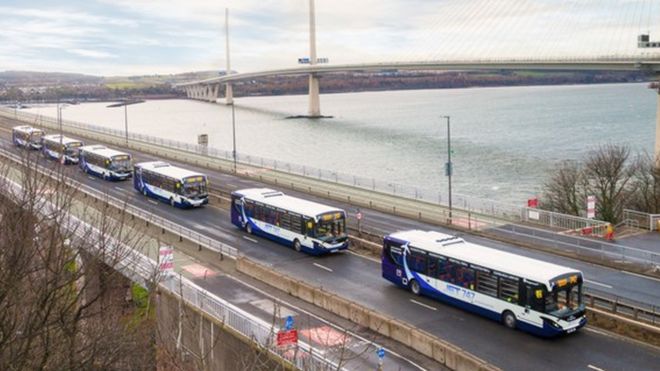
Scotland buses on bridge. Photo from BBC post.
Edinburgh, Scotland - AV full-size transit buses will be piloted on a 14-mile route between a commuter parking lot in Fife and a commuter train station . The buses will use the "the dedicated public transportation corridor across the Forth Road Bridge that also allows buses and taxis."

Across a landmass and over water

Japan - Though Japanese automaker Toyota has been relatively quiet about its AV activities, the plan declared a few years ago, and which continues to be repeated, is that AV service will be available for the 2020 Olympics. So where are we?

Toyota is saying it will shuttle athletes around the Olympic village in its e-Palette AV configured for human shared rides. The e-Palette is basically a shell that can be configured for different uses, such as deliveries, pop-up cafes, offices, mini-hotel rooms, or crowded mini-buses. That's my translation of reports on corporate statements.

Plans are also moving ahead for AV robotaxis to ferry visitors around in Tokyo during the Olympics. Reports from the summer stated that AV vans were being tested as a step toward service during the Olympics. Partners are a Japanese taxi company and a Japanese AV tech company. Toyota is also an investor.

In contrast to bravado or openness?

Miami, Florida - Ford has invited journalists to ride along on trips in its AVs in the traffic mess of Miami (though what US city is not a traffic mess?). These rides are taking place on actual busy streets with bikers and pedestrians and other drivers, all who arbitrarily violate the law and otherwise act in unexpected ways on  a regular basis. Ford is basically using the city traffic as a test bed, though with careful backup drivers. The carmaker has a clear goal - AV ridehailing service on the street in Miami and Dade County in 2021.

Sunday, June 24, 2018

Not Actually Too Long Blog Post #2

The second of two kitchen sink posts slammed between a major conference and a vacation.

Asia and down under


Transit in Japan - By 2020, Japan will be introducing regular AV transit service in rural and other areas where transit buses have been discontinued. Regulatory policies must first be put in place.

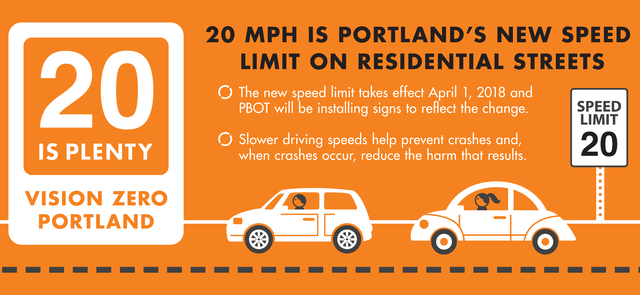
Showing the successful adoption of 20 Is Plenty in Portland, OR
Another transit bus for Australia - Australia has embraced AV transit service, with Perth having the oldest continuous AV transit route in the world. Australia also has a large city, Liverpool (no kidding), that is planning for an AV bus rapid transit route, with a dedicated lane, to an airport.

Now Australia can boast the fastest AV shuttle in the world. It goes a whopping 30 km per hour, which is just about 18 mph for you Americans and English. Actually, for the 20 Is Plenty crowd, this is perfect. (20 Is Plenty is a strategy for complete streets and vision zero to decrease road speed to a level that is safer for pedestrians in terms of drivers noticing them and in terms of reducing fatalities and lessening levels of injury when pedestrians are hit.) By the way, the vehicle is capable of reaching speeds up to 40 km per hour.

The speedy AV shuttle is operating on public roads and will be tested as a South Australian university commuter bus. "Flinders Express, or FLEX, was unveiled in Adelaide on Tuesday to launch a five-year trial, transporting university students in southern suburbs." Another, more detailed, article from CIO, reports:
Members of the public can book a ride on the electric shuttle bus this week, which will initially provide ‘first mile–last mile’ services between Adelaide’s Clovelly Park Train Station and Tonsley Innovation District Main Assembly Building (MAB). It will then continue to bus stops on the main South Road and businesses within the Tonsley precinct.
The AV shuttle bus is from Navya. Not to be outdone, New South Wales (NSW) is putting more money on the table to allow for AV pilots.

Russia Wants In


Putin, basically the decider in chief for all of Russia, has turned his attention to AV transit. Quite the scary guy, he seems to get what he wants. Now he wants AV buses. Though cautious and not willing to allow AV transit in mixed traffic, the buses were used near some of the World Soccer games. "The buses traveled just 2,132 feet (650 meters) from Kazan’s “fan zone” meeting point, along a dedicated road empty of other traffic and surrounded by a light fence to keep away pedestrians and animals. It stopped well before the Kazan Arena, leaving fans to walk the rest of the way." Notable is that the AV bus was loaded with 5G capability.

Thursday, April 19, 2018

Demos, Pilots, Airports, and Street Sweepers

Autonomous Vehicle Trip to Big 10 and Beyond the Midwest 


Wisconsin - AV shuttle to operate on the University of Wisconsin campus in Madison next week on Apr. 24 and 25. Wisconsin is one of 10 autonomous vehicles testing grounds. And by "Wisconsin" I mean the big 10 school. There is lots of AV and connected vehicle technology development and testing happening there.

Michigan - The University of Michigan in Ann Arbor will have an AV shuttle in operation by the end of April. It will be free for students, faculty, and staff to ride on a 3/4 mile route on North Campus. Finally, because this AV shuttle pilot has been in the works forever, or at least since October 2017.

Minnesota - Minneapolis is about to host its second AV demo. The first was a pilot that took place before and during the Super Bowl festivities early this year. The second will be a weekend AV shuttle open to the public on the Midtown Greenway. Not set in stone, but it looks like the shuttle will operate on Apr. 27-29. The public will be permitted to ride that Sunday, Apr. 29.

Further south and then west ...


Texas - Officials in Houston are considering AV buses. The city hosts an AV testing ground. From a press report, the idea is that a first step would be a three-month AV shuttle pilot "on the campus of Texas Southern University."

Washington - Bellevue officials are in talks with companies to do the usual downtown AV shuttle pilot thing and to "test self-driving van pools to bring commuters into the city." (The city is Seattle, just for all of you native New Yorkers who know where "the city" is.) Turns out, the Seattle-area transit agency has a long-standing large vanpool program, so the program's administrative structure is already in place. Various, well-funded, players are reportedly ready to join in this sandbox. There does seem to be acknowledgement that fully AV vanpools are quite different than a slow speed AV shuttle that operates on a fixed route.

Over in Asia


Japan - 15-passenger AV buses - really shuttle size - in operation at the Fukushima Daiichi nuclear power plant, which is still being cleaned up after the 2011 tsunami and earthquake caused a complete breakdown at the plant. By the way, the disaster was found to have been foreseeable because the plant operator "had failed to meet basic safety requirements such as risk assessment, preparing for containing collateral damage, and developing evacuation plans." That kind of disaster shows why we need safety advocates.

China - An AV container truck at a Chinese port is in operation. The truck is "expected to help port terminals and logistics companies to improve efficiency and save labour cost by more than 50%.
Compared to the traditional self-driving vehicles, the Westwell vehicle can quickly adapt to the port environment, make decisions and alternate controls."

China - The country has also instituted nationwide regulations  for AVs. According to FastCompany:
  1. All cars must first be tested in non-public zones.
  2. Road tests can only be on designated streets.
  3. A qualified driver must always be in the driver’s seat, ready to take over control.


China - Shanghai has already begun trying out automated street cleaner vehicles. They will work quietly and neatly in the middle of the night to keep the streets swept and tidy.

One airport and then beyond


France - Charles DeGaulle Airport outside of Paris is the site of an AV pilot, but the plan is to expand to other airports operated by Groupe ADP, which operates 34 international airports. Don't head to Paris just for this. The AV shuttle, which will last until this July, will only be "offering free rides to passengers with limited mobility."

NOT A random AV tidbit

University of Florida - a graduate student is working on technology that will assist people with visual disabilities to navigate the use of AVs. For a person who is visually impaired, being a few feet away or half a block away from one's destination or vehicle location can be a complete barrier to travel.

Monday, March 12, 2018

AV Trucking at a Highway Near You

Dear truck drivers,

The argument truck manufacturers and tech companies are making in favor of autonomous vehicle technology driving trucks - and to replace your jobs - are that it is impossible to hire and retain enough drivers and that truck driving is the most dangerous job in America, so AV technology will save lives - unemployed lives.

Read below and get working on Plan B because that big rig job might not be there in a few years.

Already happening

Uber has been sending AV trucks on Arizona roads for the past few months. Why it has taken this long to hit the airwaves, don't ask me. Arizona has been completely off hands, no pun intended, on AVs from the beginning.  I am listing two articles that give details. about the trucking testing, again on regular roads.

  1. https://www.engadget.com/2018/03/06/uber-self-driving-trucks-deliveries-arizona/ and 
  2. https://www.usnews.com/news/technology/articles/2018-03-06/ubers-self-driving-trucks-haul-cargo-on-arizona-highways

Ford - Miami by 2021

Ford is going for colorful, loud Miami to test its AVs and pilot its "business model with human-driven vehicles doing things like delivering Domino’s pizza and Postmates."

Japan could beat bad pizza to the punch. This week, Japan has a pilot of AV delivery trucks on public roads for its post office company. Actual service is planned for 2020.

Starsky without Hutch

Just a little bad 70s humor there with Starsky and Hutch. I'm not talking 70s TV, but autonomous trucks. Starsky Robotics, a startup AV trucking technology company, is not really producing AV tech, though it is enabling driverless trucking. According to a good article in the San Fransisco Chronicle, Starsky has produced a system for remote-control - by humans - operation of trucks.

This is really partially autonomous, Tesla-autopilot with a remote driver hired to take care of those driving situations that the technology is not up to at the moment. "Starsky’s plan: Hire truck drivers to sit in a remote control center, using video-game-like controls to navigate trucks from distribution centers to highways and vice versa. The remote operators would also oversee the long-haul part of the trip, helping with lane merges and navigating between different roads, for instance."

Yes, now I am compelled to put in the intro video from the TV show.


Wednesday, March 7, 2018

AV Ridehailing = 70s Brooklyn

The future has already happened and it is 1970s Brooklyn. Imagine a world with a subway system, lots of transit buses, taxis and car services. Car services were (maybe still are) these businesses that voila! produced a car - with a driver - within five minutes of when you called. No one ever had to drive.

Dads of high school students loved this because they did not have to get out of bed at some late hour to retrieve their kids. Of course, since we thought the drivers were creepy, we usually ended up sleeping over at friends' houses so that no one had to be the last kid in the car with the driver. My grandmother and her friends used the buses and car services to go everywhere.

Now the world is catching up. Soon everyone can achieve the nirvana of my hometown - except that it will not be so heavenly with a few big competitors and the permanent travails of lack of transit funding likely to continue. Here are some players that have announced on-the-street AV service to launch within the next few years.

Caveats - No word from any car manufacturer or AV technology company about AV ridehailing that will be accessible for people with disabilities. And that's another thing, these companies are all talking about cities, but no one is volunteering to serve rural communities or people with disabilities. Maybe we still are in the 1970s.

Uber is not waiting

Uber is already on the streets of San Francisco providing AV rides - but only for its self-driving staff. I wonder if there's a clause in the employee manual about relinquishing the right to sue. The rides, by the way, are free, so I'm not sure about applicability of federal or state laws or regulations when no money is changing hands and the ride is kind of, sort of, part of the job. Don't get too excited.
As is true for all self-driving vehicles on California public roads, the cars will have backup drivers. The Department of Motor Vehicles recently created a system for companies to test self-driving cars without backup drivers but has not yet issued permits for it.
No doubt Uber will be ready to submit one of those no-human-backup-driver permits.

Happening in China and Japan

Pony.ai is starting an AV ridehailing service in China. "its fleet is running a nearly two-mile route in Nansha, Guangzhou, where its China HQ is located."

Meanwhile in Japan, "Nissan and Japanese telecom company DeNA [started] a field test of driverless Easy Ride taxis ... on March 5, offering rides to passengers along a fixed 2.7-mile route between the Nissan headquarters and the Yokohama World Porters shopping center." The ridehailing service that is planned is not expected to be in operation until at least 2020.

Waymo  in 2019

Okay, the date is unspecified, but it looks like Arizona and California will see completely no-human-driver AV ridehailing service first. Waymo has partnered with MADD - Mothers Against Drunk Drivers - and groups representing seniors and people who are blind to join in an advertising campaign about the benefits of AV transportation.

Waymo's application to remove the human driver as backup has already been submitted in Arizona - and approved. Word is that ridehailing will begin in 2019. No date or locations have been announced.

GM date uncertain for heading to the big apple

News of GM bringing AV ridehailing to lower Manhattan in New York City is the product of good journalist digging. Tribeca Citizen, a neighborhood news source, looked into GM's leasing of office space and discovered that the party named in the lease is none other than "GM Cruise LLC, commonly referred to as Cruise or Cruise Automation." This follows Gov. Cuomo's announcement in October that GM will be doing testing in Manhattan at some unspecified 2018 date.

May Mobility goes for quick trip - shouldn't you walk? - market

May Mobility also scored a big win by getting Tampa's transit agency on board for a pilot with this newcomer AV producer's shuttle. Testing began this week and the pilot for regular riders will commence later in 2018.

Toyota and BMW are funding some May Mobility activity involving "plans to use the seed money to expand in Texas and Florida — states that don’t require a safety driver." This involves some one kilometer routes. Am I missing something or isn't that a short walk - unless we are talking inclement weather? Really inclement weather.

Thursday, December 7, 2017

Popping Up Like Weeds from the Sidewalk

[Image from Cision PR Newswire.]
Gov. Hickenlooper of Colorado declared Monday, Dec. 4th to be Connected and Autonomous Vehicle (AV) Day. No word on store sales for that holiday. Part of Hickenlooper's C-and-AV Day photo op was to showcase Colorado's upcoming AV pilot project.

The declaration of the special day was a way for the pro-AV governor - whose administration paved the way for the driverless truck beer delivery PR stunt - to continue to highlight AV partners and Colorado's enthusiasm.

According to the press release, in very press-release-y language:

"Panasonic, a global leader in smart cities and smart automotive technology solutions, welcomed Colorado Governor John Hickenlooper, Denver offices, where he proclaimed December 4 as "Connected and Autonomous Vehicle Day" to reinforce initiatives like Panasonic's connected vehicle partnership with CDOT's RoadX Program, as well as acknowledge EasyMile, a leader in autonomous technology, for their North American headquarters grand opening co-located within the Panasonic building."

Best of luck to Lauren Isaac of EasyMile as she awaits the birth of her baby. By the time that baby is a teenager, he or she will never need a driver's license. My own kids told me about six years ago that their generation would be the last for that.

Other EasyMile news is that the company is graduating, or rather expanding, from cute AV shuttles to real buses, AVs, of course. EasyMile is partnering with the French government and "IVECO, Sector, Transpolis, ISAE-SUPAERO, Ifsttar, Inria, and Michelin" to produce the AV buses. The buses will be large enough to transport 100+ passengers. (A warning to all of you traveling with more than one small child: Whether or not a bus has a driver, get on at a stop where you can sit together and where you do not have to stand holding a child of 30 pounds or one wearing a snow suit. AVs will not solve every transportation conundrum.)

Watch this nice video of the EasyMile AV shuttle at Bishop Ranch office park in California, being piloted in a partnership with the Contra Costa Transportation Authority.

In the state where everyone believes every visitor wants to move there

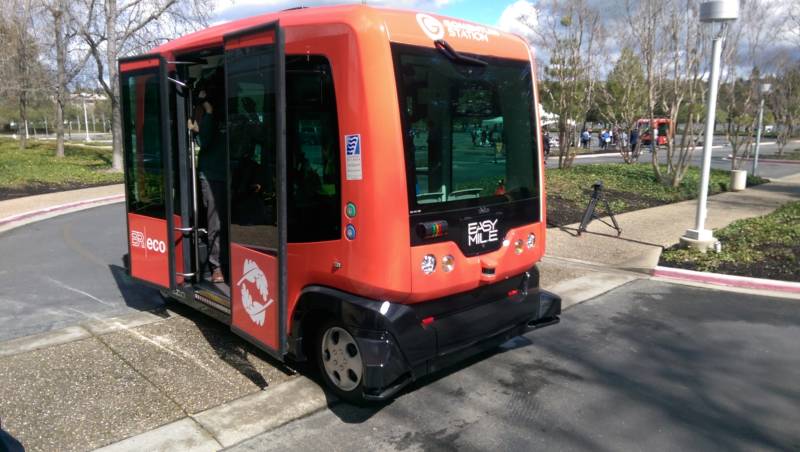
Look at the cute Colorado license plate for the EasyMile AV shuttle. It will be spring 2018 before regular passengers can get on board to ride the first-mile/last-mile route near Denver's 61st and Peña Station. Political and business partners came out to shine anyway for the early dog and pony show on Monday.

Perfect would be taking that shuttle from the commuter bus stop near Louisville, CO (near Boulder) to the Moxie Bread Company hipster bakery and coffee place. It's a Denver transit bus, so why not?

[Off topic: Moxie bialys are nowhere near the real thing, but their whole grain, naturally-leavened bread is excellent. In the bialy/bagel realm, I remain true to my pre-hipster Brooklyn roots.]

Pilots popping up everywhere

Nissan will be starting a pilot in Japan for app-based AV ridehailing. Will start with only two Nissan Leaf electric vehicles. The pilot will begin in March 2018.

Lyft riders in Boston's Seaport neighborhood may be experiencing AV ridehailing trips due to a pilot program and a partnership between Lyft and nuTonomy.  Delphi owns nuTonomy, which has experience in Singapore with AV pilots.

Previous posts about nuTonomy activity in Singapore: AV ridehailing in 2018; Singapore is a driverless sandbox; plus more posts about AV activity in Singapore.

Will vans be cool again?

The company first known for its cool vans is trying to climb back to regain that reputation. Volkswagon has developed an AV van called MOIA that will be launched as the vehicle for a ridehailing service. "The van-pooling MOIA service will launch in Hamburg in 2018 with 200 vans, letting passengers enter a departure point and destination in an app. "We've set ourselves the goal of taking more than a million cars off the roads in Europe and the USA by 2025," said MOIA CEO Ole Harms."

[Image from Endgadet.]
FYI: No flower power on these sleek, corporate-looking VW vans.

Fiskers has also developed an AV shuttle called Orbit and its shape varies from the cute boxy design of other companies. No word on when this van-like shuttle vehicle will appear on roads or where it will launch.

School bus without driver
[Image from Teague.]

So, I hope parents are aware that school bus drivers do not actually supervise children who ride the bus. I mostly walked my kids to school up to high school, but I overheard plenty of kid conversations about school bus rides.

The AV school bus design, named Hannah,  crafted by the Teague design firm is cute. The affluent-and-white world portrayed in the photographs suggests a crime-free, suburban paradise. In the real world, perhaps parent volunteers would be needed up to high school, especially in the prime cliquey years of fourth grade through middle school.

Friday, November 3, 2017

And, in a land that believes in planning, Japan continues AV pursuit

Maebashi will be the first city in Japan to host autonomous buses operating on public roads. Testing will begin in the spring of 2018. The expectation is that "[s]tarting from November 2018, the test buses will have passengers on board." Japan's motivation is a large aging population that will need to get around and will want to remain independent without driving.
Autonomous cars are still not recognized under Japan's Road Traffic Act or the Geneva Convention on Road Traffic, which sets common standards among signatory nations. However, driverless vehicles and artificial intelligence hold pride of place in the central government's cutting-edge tech growth strategy, which includes a 2020 deadline for the practical implementation of autonomous vehicle-based transportation systems. This push to get driverless vehicles on the road has jumpstarted local test projects across Japan.
This is not Japan's first testing of AVs. There has been testing in rural areas for connectivity for low-density populations, and it hosted an AV pilot at a shopping mall. Japan has also been playing around with driverless grocery delivery testing. This country even showed off AV taxis at a G7 summit. And, as far as I know, Japan still plans to ferry attendees around in robo-taxis at the 2020 Olympics.


Tuesday, September 12, 2017

Autonomous Shuttles: High-Tech Equivalent of Hay Ride

One really cannot be a busy person who pays attention on the side to autonomous vehicles (AVs). Today, I'm waiting for the new NHTSA guidelines to be released and tomorrow is a Senate hearing on autonomous trucks and "other large vehicles." Ooh! The guidelines were released four minutes ago. (Four minutes after I wrote that sentence, that is.)

A must read for all AV nerds and insomniacs. Okay, lots of reading ahead, but first this post.

Warning: Analogy, then London

If you've ever been apple picking at a big farm or at a large state fair, you have likely enjoyed a hay ride. The Ohio State Fair uses them as parking shuttles. Kids love them. AV shuttle pilots are providing the same thrill throughout the world, while, I hope, inculcating a positive outlook on AV shared use and transit modes.

Some quite recent examples:

London is having a 19-day pilot in its Olympic Park. Don't ask me why the random 19-day duration. The shuttle will be slow and it will be quite careful of pedestrians.
The Navya autonomous pod is limited to 5mph in the park but has a claimed top speed of nearly 30mph on the open road. It cost “in the hundreds of thousands of pounds” and was brought to London by Euston-based firm Keolis UK following trials on the Las Vegas Strip.
The UK government (apology for the "England" label on this blog) has been actively supporting investment in AVs and in realizing that pilots have a significant role in delighting and educating the public about the transportation transformation to come.

I see a Super Bowl ad coming

I hope that we get a good Superbowl ad out of the AV shuttle at the 2018 game. Super Bowl LII (52 for those of you who missed Roman numeral day in the third grade), will be held in Minneapolis in a domed stadium. The AV shuttle routes will ferry visitors between hotels and events. No report that the shuttles will operate all during game week, but I am making that assumption.
The Minnesota Department of Transportation (MNDOT) selected EasyMile, a French company that makes self-driving technology, to supply buses for testing the technology’s capabilities in the state’s snow and ice in February 2018. The first tests will be in a closed facility. The second testing phase would dispatch the buses as shuttles along pre-programmed routes on public streets, closed to other vehicular traffic— just as thousands of people pour into the Twin Cities for Super Bowl LII.
This MNDOT pilot hinges on a NHTSA waiver from Federal Motor Vehicle Saffety Standards (FMVSS) for the state and for EasyMile. MNDOT is seeking permission for the waiver to cover a bigger road show throughout Minnesota to give people across the state a glance, a local news report, or perhaps a ride to spark thoughts about AV shuttle possibilities.

I confess that I did not realize that Super Bowl (SB) was two words - this after many years of hosting a SB party and hoping that the Giants win if they are in the game so that household is not gloomy for days thereafter. I actually hail from more of a Jets community, but I have to keep that quiet at home. Plus I have zero interest in the game.

Rural approach to AV

Most AV pilots - one could say dog and pony shows - have been happening in large cities. Japan, quite smartly, is exploring the connection between transportation access in rural areas with depopulation and aging populations. These same trends are also taking place in the US rural communities, so, I hope, other Americans in transportation are paying attention to the Japanese work on this issue.

In the US, fewer available drivers for rural senior transportation services is a big problem and it is coupled with the challenge of expensive, long-distance rides to medical care and even shopping, not to mention a lack of transportation for everyday socializing or employment. Isolation for many older adults who live in rural areas is the sad result.

Japan is experimenting with AV transit shuttles "in rural communities such as Nishikata, 115 km (71 miles) north of the capital, Tokyo, where elderly residents struggle with fewer bus and taxi services as the population ages and shrinks. ... Japan could launch self-driving services for remote communities by 2020, if the trials begun this month prove successful."

Gets better

Wait, Japan's well-coordinated approach has one more feature - one meant, I am guessing, to cut costs. Instead of each older person in his or her own podcar, Japan is planning to use existing highway rest stops as feeder points to take people to "to medical, retail and banking services."

Thursday, August 17, 2017

Transit Pulling Ahead

Reading the news on autonomous vehicles (AVs), everyday I am seeing more shared-use, transit, and transit-like AVs. These pilot programs are spreading quickly. Slow, fixed-route - or limited radius - AV shuttles have captured the imagination of places in the United States that are (1) NOT our major cities, meaning places without strong transit unions, and (2) NOT transit rich. Indeed, in at least one spot, AV shuttles will used to ferry people to and from parking lots.

Most of the AV shuttles are manufactured by Navya and EasyMile, though there are other companies in the game and some homegrown, usually university-developed, shuttle vehicles.

Down under, over to Far East, and towards the West

Perth, Australia has an AV transit shuttle service - open to the public - that just turned one year old. The Navya shuttle, called Arma, operates on public roads. The shuttle reads signs and turns right. Unlike human drivers, it regularly improves due to software upgrades. [See photo.]

Singapore will have AV ridehailing in mid-2018 via a partnership with nuTonomy. Unknown is whether a local ride hailing company will be involved. This city-state is already ahead of the curve on AV testing and is currently well in the lead in terms of AV-related urban planning. (Lots more on that topic in a blog post soon.)

Helsinki, Finland has an AV shuttle as a regular service - NOT a pilot project. Finland's pilots have used the EasyMile EZ10 for AV service and that tradition continues with the Helsinki shuttle.

Tallinn, Estonia recently saw the end of a month-long AV transit shuttle pilot that was open to the public. This project also used EasyMile vehicles. There are already plans to bring the AV transit option back to Estonia, but next time to a different city and not until next summer. A leading Estonian transportation official is pushing for Estonia to move forward with AVs generally.

Go west young shuttle

Michigan: Ann Arbor, home of Big Ten school University of Michigan (UM) and the MCity AV testing facility (and not far from the American Center for Mobility testing facility in Ypsilanti, Michagan) is about to host an AV shuttle on a two-mile route between engineering buildings at UM's North Campus. The shuttle vehicles are manufactured by Navya and they carry up to 15 passengers. Rides will be fare free and the AV shuttle will operate during the university's business hours (not intended for late-night studying or as a drunk bus).

Texas 

Texas A&M has a homegrown AV shuttle on campus for Howdy Week. The plan is to have 15 of these shuttles in operation by the end of the spring semester, meaning by May.

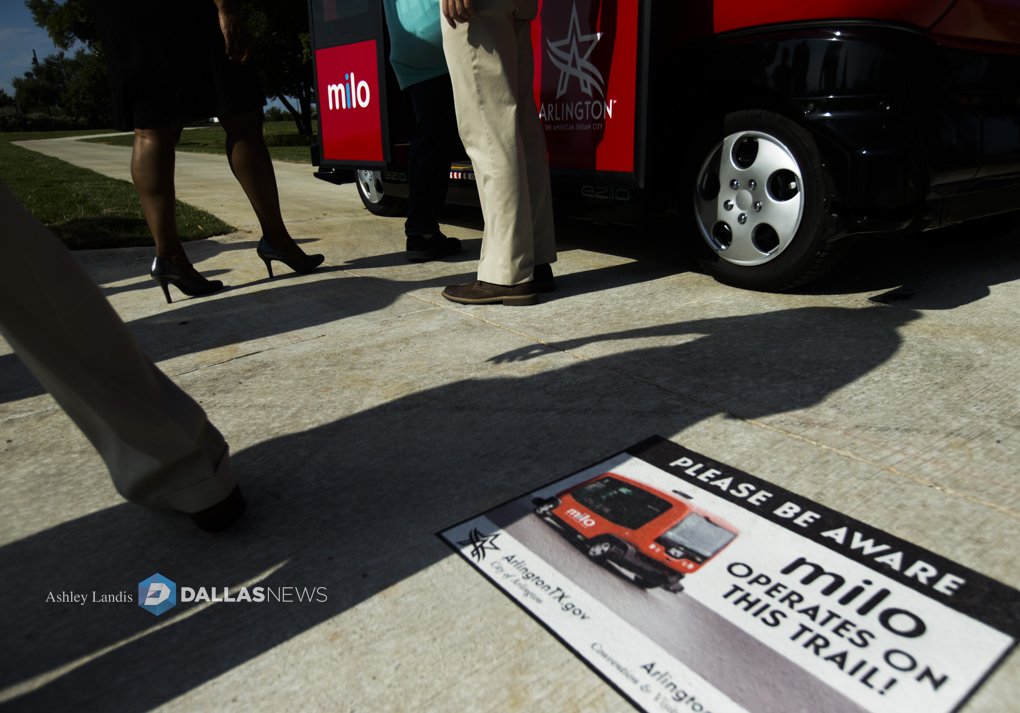
Arlington, Texas  has a pilot AV shuttle program that began on Aug. 26 and will continue through mid-2018. The shuttle will provide AV transportation around the Arlington entertainment district and to Texas Rangers and Dallas Cowboys games on game days and when concerts and other events are held. EasyMile shuttle vehicles will be used. Arlington is already considering expanding the use of AV transit shuttles beyond the pilot project. The vehicles hold 12 passengers, according to one enthusiastic report.

California

San Jose Airport is testing an EasyMile shuttle vehicle and hopes to use it for ferrying travelers and workers around the airport. The wish list includes an AV shuttle to transit and a dedicated lane on public roads. A local article about the project does a nice job of explaining the huge quality-of-life implications for people with disabilities and older adults.

San Ramon, CA, home of the Bishop Ranch office campus has an AV shuttle pilot program that is designed for ferrying office workers.  The AV shuttle became a local celebrity when it was featured as the grand marshal of the Concord, CA, July 4th paradeEasyMile shuttle vehicles are being used.

Apple is floating the idea of an AV shuttle for employees. No word on timing or which company will be supplying the shuttles.

Colorado: Denver's transit system is planning for cute AV shuttles for first and last mile connection to transit. RTD, the transit agency, was testing the EasyMile EZ10 in a giant parking lot. If you watch the video, just note that the snarky New Yorker reaction is that unless this vehicle has a dedicated lane or a built-in "oh no you don't" feature, in a busy city pedestrians will eating this adorable vehicle for lunch. You cannot combine a courteous, safe vehicle with a nasty, walking Brooklynite.

MaaS on the menu - tea leaf of expected profitable service

None other than Ernst & Young (really called EY), a large multinational accounting firm, has developed a Blockchain platform, called Tesseract, for managing fleets of AVs. The firm sees mobility as a service - or MaaS - somewhere on the expected horizon. From what I understand, which is little, about Blockchain, also used for bitcoin transactions, it is nearly unhackable and it is instantaneous. Evidently, EY sees money in this and has confidence that MaaS will emerge with sharing of different types of AVs, and differently-owned vehicles.

People with disabilities: AV transportation equity

Australia, like the US, a country of long distances, has a company about to pilot AV pods for older adults. Called Pod Zero, and manufactured by UK-based company RDM Autonomous, the pilot will only offer transportation on local roads within some elder communities owned by IRT, an Australian company. (For you older New Yorkers or subway history buffs, this company appears to have no relation to IRT train lines, such as the 1, 2, 3, 4, 5, and 6.) According to RDM, Pod Zero "is currently built in two variants – four-seater and eight-seater – and offers an operating speed up to 15 mph, multiple battery options up to eight hours or 50 miles, wheelchair accessibility and air conditioning."

Pod Zero will launch in November at an aging and information technology conference.

Autonomous wheelchairs are being tested and plans so far are for use in hospitals and airports. Though this wheelchair comes out of MIT research, the pilots are in Singapore and Japan.

Fare free for a price

Under the category "you get what you pay for," ideas for how businesses will make money off of AV transportation are growing. One idea floating around is that AV service, perhaps shared-use ridehailining trips, will be free - actually "sponsored" - by a local business, maybe a restaurant that wants your patronage. Other ideas revolve around fare free because transportation will be a cheap perk to deliver in exchange for valuable data. Sorry, forgot to get a link for this.

OMG, can't believe someone just said this - try being in a wheelchair for a few days

Below is a quote from a Mother Jones post that shows how people totally do not get the need for accessibility. It's as if the writer and like-minded individuals assume that all people with disabilities have extra cash to pay for personal service and that they don't deserve transportation equity. I agree with the point of the post, to not let the perfect be the enemy of the good, BUT people with mobility challenges - by they mothers with strollers or grandfathers with wheelchairs or cousins with intellectual disabilities, should not have to continue to be second-class transportation citizens. (I include the mother because so many parents develop back problems during the car-seat years. Why can't we have cars in which you can just roll in a stroller?)
No, we don’t need to deal with the problem of seniors and disabled passengers before it becomes an issue. Why would we? The market will almost certainly take care of this. Maybe companies will spring up that maintain human drivers, or that offer to have a human accompany the car to help you load your luggage or get your wheelchair into the trunk. Maybe driverless taxi companies will include this as an option. Or something. This is a no-brainer. [Emphasis added.]
So if you are an affluent person with a disability, no worries. But if you can't afford to pay twice as much for transportation or if you do not want to permanently be stuck at home, sorry. OMG, bad attitude. Maybe it's time to expand the Americans with Disabilities Act to comprehensively include all for-hire and private vehicle transportation. This just gets too hard for anyone marginalized just because he or she uses a wheelchair.

Friday, November 11, 2016

Japanese Insurance, Israeli Optics, and Michigan Laws

Israeli company Oryx Visionis scaling up on a cheap optical radar system for driverless. It sees better.

Or - spelled in Hebrew - אור - means light. Just check the beginning of Genesis; that is one old word. I'm guessing that's where Oryx comes from. There is no information about that on the website.


In the tea leaves of tech development, NXP Semiconductor, a company that concentrates on driverless technology for trucks, has been acquired by Qualcomm and is bringing advances in driverless computing power.

Deals on driverless insurance

Another insurance company will be providing coverage for self-driving vehicles - in Japan. The company is Tokio Marine. The first company to do so was in Britain and that was quite recent.

Michigan passes bill - forget the steering wheel

Michigan's governor is going all out to ensure that vehicles continue being developed, tested, and manufactured in his state. He signed a package of four bills (good summary article). Here's a previous post with more details and a statement from Gov. Snyder's office.

Friday, October 21, 2016

In-Depth Learning and Seeing - Asia and Israel

From Japan, China, and somewhere nearby the Mediterranean 

Toshiba has partnered with Denso Corporation to provide artificial intelligence (AI) capability for partial and fully autonomous vehicles. The Deep Neural Network-Intellectual Property (DNN-IP) - or DNN to its friends - that Denso has developed:
is an algorithm modeled after the neural networks of the human brain and is expected to perform recognition processing as accurately, or better, than the human brain. This algorithm will allow the system to identify different road traffic situations and a variety of obstacles and road markings. 
Due to the rapid progress in DNN technology, Denso Corp. and Toshiba Corp. plan to make the technology flexibly extendable to various network configurations, Denso adds. Additionally, the companies will design the technology to have the ability to be implemented on in-vehicle processors that are smaller, consume less power, and feature other optimizations, Denso said.
Please excuse the long quote; honestly, I do not understand the under-the-hood tech speak and I do not want to get it wrong.

A new eye for depth perception

An Israeli start up, Oryx Vision, is developing hardware to replace LIDAR. Oryx Vision recently received a $17 million boost in venture capital funding. Called Oryx, this new technology supposedly has much better depth perception than LIDAR. An Oryx Vision representative described the contrast between LIDAR and Oryx as the difference between a description of a person and live streaming a person's image. Oryx Vision claims that the speed of driverless vehicles will be able to increase because of the much-improved depth perception. The translation for my non-tech mind was that the low 25 mph speed of the Google cars is due to LIDAR's limitations.

[Editor's note: I wonder whatever happened to that optimistic Israeli radio station that declared many times a day: From somewhere in the Mediterranean, this is the voice of peace. The Internet is truly magical because one incredibly quick search turned up the whole story. As Einstein said, "There are only two ways to live your life. One is as though nothing is miracle. The other is as though everything is." End of unrelated note.]


Hello pedestrians! Bring the popcorn!

LeEco has built a demonstration driverless car - sans price tag. Not only would you be able to watch a movie in it, but if you are outside the vehicle it signals to pedestrians whether the car is in autonomous mode. Think Wizard of Oz: the car changes color when it changes modes from driverless to human-operated and back again. The steering wheel also folds in when the driver hands over control and, presumably, rests back to watch a movie. (Read the linked article after all of the stuff about its delay getting to its destination.) LeEco is a Chinese company.

Musk showing attitude

News is coming fast and furious from Tesla, which is now putting self-driving hardware into ALL of its vehicles. No movie screen, but hey, most people only look at their phones anyway. Elon Musk is also charging the media with distorting the excellent safety record of driverless vehicles, thus making people unsafe by displaying a journalistic preference for unsafe, human-operated cars.

Musk is remaining somewhat defiant about Tesla's liability when crashes occur during its partially-driverless mode. Instead of following Volvo's lead in assuming strict - or complete - liability, Musk puts the onus on the driver to prove a design flaw. He compares the liability situation to elevator mishaps. Clearly Musk has not been to PR school. But for all of Musk's defiance, he has stepped back the availability of Tesla's partially-driverless software after several crashes in different countries. [Nice reporting from Bloomberg in that article.]

Tuesday, August 2, 2016

Back to the Mall

This is one mall I want to visit. It's in Japan, in a suburb, and it looks completely boring - EXCEPT it has a driverless shuttle. Here's the video link. Truth be told, the video is also boring.

But it would be fun to take the cute shuttle from transit to the mall and back again. Maybe get a bad crepe because that is what malls are for.

One report says the bus is due to start service for regular people next month. Another says the service is now through Aug. 11. In any case, this is a test in anticipation of a permanent service.

Monday, August 1, 2016

Driverless Deliveries

Driverless Deliveries

I'm a native New Yorker, so it seems right that urban dwellers expect everything delivered, even groceries. (I don't want to give up on picking out my own produce, though, and in the city you can have it both ways.) Japan will be experimenting with driverless grocery delivery in the spring of 2017. The deliveries will be in a particular zone and in well-marked, cute vans. -


Crappy food and drink by drone

Why anyone would want any food or drink made at or manufactured by a 7-Eleven is beyond me, but I'm not their niche market. If you do like a bad donut, hot dog, or slurpy, soon perhaps you will be able to continue happily on the path to obesity by sitting on the couch and letting a drone deliver your treats. Oh wait, these are still carefully planned and one-off deliveries. Not available yet from your local, lottery-ticket-and-slurpy-selling 7 -Eleven. Sorry, the proper spelling for the mushy drink is slurpee.

17 Million from Michigan for Willow Run

Not that the state of Michigan is favoring any particular industry or manufacturer, but GM is planning on the Willow Run testing facility to push along its driverless cars to reality and real roads. The $17 million is in addition to a $5.7 million loan fund. The Willow Run facility to be called the American Mobility Center, in case anyone is interested in finding out more.

AI for Audi

As George Hotz goes, so goes the rest of the driverless pack? First it was Nvidia, then GM, and now Audi. The German manufacturer is seeing the light that when self-driving cars are sharing the roadway with human drivers, they have to be able to drive in a way that makes sense to those with human eyes. So, like Cruise Automation and Comma.ai and Nvidia, Audi will be going the AI-pseudo-human route as well. At this point, everyone is getting in on the game that driverless vehicles can't just be following a set of rules, but they must be able to both pay unceasing attention and have the capacity to make good decisions. 

If you want to read more about Tesla crash

Detailed article on Tesla crash
SmartDrivingCar.com newsletter - Alain Kornhauser has done a nice job of covering the crash, the seeming failure of the automatic braking system and the truck driver's proceeding through the turn with a speeding car barreling down the highway.

Wednesday, July 13, 2016

Transit, AI Routes to Driverless & International Stories

Time to book travel to Tokyo - oh wait, I mean the Tokyo suburbs, where there's a cute driverless transit shuttle currently in operation. DeNA is operating the service, working with EasyMile on this project.

Comma points - not a grammar thing

Comma.ai, the George Hotz company, is giving out comma points in exchange for collecting data from consenting drivers. Comma.ai put out an app called Chffr, which grants comma points to drivers who agree to allow Comma.ai to "record users' views as they drive." For now, Hotz is keeping information about what those points will be currency for close to his vest, but the speculation is that they will be redeemable at some point to get a good place in line or a discount for the upcoming Comma.ai self-driving kit due out later in 2016. 

Hotz isn't the only one with an AI approach. There's Cruise Automation, for which GM paid approximately $1 billion - with a "b" - and now a new entrant, a small British start-up named Five AI, which just received $2.7 million in venture capital, not that much really.  The company plans to be much less map-based than Google and other driverless producers. It is confident that British universities can supply the talent for its growth. 

China investing big and spreading the wealth

China is working on driverless transit, but it seems more interested in the luxury automobile market of the future. "Future Mobility Corp, the Chinese electric car startup backed by internet giant Tencent Holdings, plans to have its first driverless vehicles on the road by 2020." Production will be in China and it will be geared towards a Chinese audience (at least at first). Future Mobility, like Chinese company Faraday Future, has offices in Silicon Valley. Future Mobility has also played the game of poaching talent from its competitors, in this case German-based BMW and Mercedes-Benz, as well as Tesla and Google. More on this particular poaching in a second article.

Tuesday, June 14, 2016

UK, Japan Serious About Driverless for Seniors and People with Disabilities

I love this article out of England. There's a project that mixes driverless with transit, technology for people with disabilities, and transportation apps. This is definitely a complete trip perspective. The article discusses a technology firm in Coventry in connection with the University of Warwick Science Park's Venture Centre (which sounds more like the name of a children's museum).

The technology to assist people with disabilities is impressive. For instance, there is a whole tactile element for people with visual disabilities.

Growing market of older people

Toyota gets this.  The Toyota video below sends a clear message and, although the narration is in Japanese, anyone can understand that message, that there is a huge market in serving older people who do not drive or who are - or should be - cutting back on driving or not driving entirely.


Solar tidbit

Just for fun, read this piece about an entirely autonomous boat that is traveling across the Atlantic Ocean from Boston to Portugal. The boat is operating solely on solar energy. The guys who built the boat did the work in their spare time. Very neat. You can follow the vessel as well. It is currently approximately 20 percent of the way to its destination.

Friday, May 27, 2016

From Sea to Shining Sea - Everyone Is Interested

At a session I put on yesterday at a national community transportation conference, there were attendees from rural and small city areas across the United States and Canada. Everyone is interested in driverless and many in community transportation are afraid. They are afraid that their passengers who are elderly or disabled will not have a friendly driver on board - whether a car, a van, or a bus - to give assistance. They are afraid of interfaces that do not work for people with cognitive disabilities. Some are excited about the opportunities driverless transportation will bring, while others would prefer to hold on to the present, despite its inefficiencies and inequities. 

This is an exciting time; possibilities are not set in stone. Now is the time and it is the role now for advocates and educators - national associations and others - to make sure that manufacturers, tech companies, and elected officials understand the importance of equity, not only in large cities, but in rural areas, suburbs, and small urban areas. Transit and community transportation in many places is often the only link that enables older adults, people with disabilities, and people with low incomes to remain independent, to work, and to travel. Rural areas present a unique challenge, with long distances and low population densities. If such places and such people are not to be left in the rear view mirror, then solutions must be developed and voices heard by the powers that be.

Congestion is not the problem in many places; less dense cities and regions have significant equity issues that the Americans with Disabilities Act (ADA) has just touched the surface of. Driverless has the potential for vast improvements on this score.

That's my rant for the week.

Scant update

I have hardly paid attention to driverless news in the past week, so here is a summary, just so I jot down what I think is important. For anyone out there who concentrates on this stuff, much is this will be old news to you.

Follow the money

Ford putting its money where its mouth is, both working on and investing in the shared-use driverless business model. The venture capital firm founded by Bill Ford, Jr. has put real money into nuTonomy, the company doing the robo-taxis in Singapore. 

Intel buying up start-up companies so that it can go full speed ahead in the driverless race. The latest buzz focuses on Intel's purchase of Itseez, a San Francisco company. One could think that hanging out at SF coffee places is the way to get get intelligence on start-ups to invest in or purchase for driverless and other tech races.

Everybody's making sausages

Nice state legislation update, especially regarding New York and Michigan. New York wants to clear a path for sale of driverless vehicles and shared-use driverless transportation. The legislation will also trash the requirement that a driver have a hand on the steering wheel at all times - because there might not be a steering wheel.

UK government talking legislation that will make manufacturers of driverless vehicles and technology liable in case of crashes and other incidents.

Hints of Tesla going from partially autonomous vehicles to fully autonomous? Reports that updates could be coming before late 2017.

On the roads now and soon in ...

Driverless vehicles soon to be tested on roads in Australia.

Japan unveils robo-taxi for G7 summit.

Have recent tests in Europe of driverless - or almost driverless - connected vehicle (CV) convoys of trucks inspired the hungry state of Michigan? Hungry, that is, for keeping all things vehicular manufacturing and development in the Motor State. Michigan roads will soon see CV convoys. Right now,  these will be convoys operating for testing purposes only. Interesting - it will be the US Army doing the testing.