Two articles that popped up on my Google alerts this week point to a possible - though still unlikely - scenario of transcendent transit systems and a waning auto dealership distribution model - both due to fully automated vehiches (AVs) and the ways they will be available, particularly in cities and traditional suburbs (not exurbs).
Auto dealers have not said much or done much in response to AV developments thus far. Even as every prediction says that most AV passenger transportation will be fleet based and publicly available, whether through transit or private companies or public-private partnerships, auto dealers have remained silent. After all, it is still a profitable business in most places in the US to sell cars, even in most cities.
Change drastically or get out
Now an executive at a firm that does financial advising for car dealers, and which itself invests in dealerships, is ringing the alarm for dealerships and holding up the scary prospects of Kodak and Blockbuster as examples of companies that had their heads in the sand as technological developments began bubbling up around them.
The opinion piece insists that in the next 20 years, dealerships will either go out of business (so better to sell out soon) or undergo massive consolidation, down to a few huge dealership companies.
Singapore planning for drastic change
Singapore is possibly the city (okay city/state) most prepared for AVs. It has been investing in AVs and allowing testing for years. Now Singapore is turning to the AV shuttle with an EasyMile AV that will serve a university. This will be a pilot that begins in March 2019.
With its good weather, Singapore is well placed to take early advantage of AVs.
Waymo to launch real no-driver service and expand to more cities
Yes, it's all over the news, almost old news, from last week that Waymo will slowly begin and then incrementally expand its AV service, but without backup drivers in every vehicle. I'm about to head to the airport, so I am excusing myself from providing one of any 50 easy-to-find sources for this news.
Still no word from Waymo on working with transit or providing accessible vehicles. Since I like the company, that is quite disappointing.
So the title question - will AVs bring transit popularity?
The answer may be publicly available transportation will become popular, but transit itself becoming popular in the places where it barely hits the edge of the spectrum on mode share is doubtful. Transit quality means investment, which means funding in the form of public dollars, which has grown, but, in the US, still remains the exception rather than the rule.
Showing posts with label Singapore. Show all posts
Showing posts with label Singapore. Show all posts
Wednesday, November 14, 2018

Tuesday, February 20, 2018
Washington - the District and the State
DC brewing, distilleries, pop-up art and now AVs - time to rethink this city
I'll use the words prudent and leary, as in wary of new things, instead of employing the politically charged word "conservative;" but perhaps provincial is the best word for DC. And now, even DC is considering - not actually contracted to, not with actual date set - a small-scale autonomous vehicle (AV) shuttle pilot. Yes, after pondering in Bismarck, ND, and pilots in Arlington, TX, and in Contra Costa, Calif., DC is actively thinking and soliciting thoughts.
Last week, the mayor, Muriel Bowser, put out a "Request for Information [RFI] from private sector companies developing autonomous vehicle (AV) technology, seeking partnerships and industry input on policies and procedures to guide pilot projects within the District." This would be in an area with relatively little traffic, near tourist sites, and that the District wants to promote due to new development. According to this same article, "Starship Technologies autonomous delivery robots ... can be seen traversing sidewalks in Logan Circle and 14th Street, NW." You don't see those roaming near Metro Center and the White House.
The AV pilot RFI is the product of a municipal interagency working group and the business improvement district (BID) where the pilot would take place. The Mayor's press release identifies the municipal partners as including planning, transportation, emergency services and police, energy and the environment, the DMV, the Department of For-Hire Vehicles, and the Office on Aging, and Office of Disability Rights.
While in the other Washington, leaps ahead
Oh yes, anyone who says "Washington State" is likely from the East Coast. True that for me. Washington, the state, has AV cars in Kirkland and AV planning in Seattle. In Seattle,
Plan for this
In Singapore, testing begins next year on full-size AV Volvo buses. Time for transit to start planning and for drivers to get serious about Plan B.
I'll use the words prudent and leary, as in wary of new things, instead of employing the politically charged word "conservative;" but perhaps provincial is the best word for DC. And now, even DC is considering - not actually contracted to, not with actual date set - a small-scale autonomous vehicle (AV) shuttle pilot. Yes, after pondering in Bismarck, ND, and pilots in Arlington, TX, and in Contra Costa, Calif., DC is actively thinking and soliciting thoughts.
Last week, the mayor, Muriel Bowser, put out a "Request for Information [RFI] from private sector companies developing autonomous vehicle (AV) technology, seeking partnerships and industry input on policies and procedures to guide pilot projects within the District." This would be in an area with relatively little traffic, near tourist sites, and that the District wants to promote due to new development. According to this same article, "Starship Technologies autonomous delivery robots ... can be seen traversing sidewalks in Logan Circle and 14th Street, NW." You don't see those roaming near Metro Center and the White House.
The AV pilot RFI is the product of a municipal interagency working group and the business improvement district (BID) where the pilot would take place. The Mayor's press release identifies the municipal partners as including planning, transportation, emergency services and police, energy and the environment, the DMV, the Department of For-Hire Vehicles, and the Office on Aging, and Office of Disability Rights.
While in the other Washington, leaps ahead
Oh yes, anyone who says "Washington State" is likely from the East Coast. True that for me. Washington, the state, has AV cars in Kirkland and AV planning in Seattle. In Seattle,
A three-person team has been assigned to monitor what the area’s 20-plus autonomous vehicle firms are doing, while also researching what issues the city will have to address when self-driving cars are advanced enough and plentiful enough to require regulation. Among the things the team is considering: whether the city government or a corporation—similar a phone company or a cable services provider—should build and maintain the master computers, transmission towers and data storage facilities that self-driving cars will require.I'm sure this trio realizes that they are in a somewhat precarious position because the public sector, especially in cities, is the tail being wagged both by state governments preempting municipalities and by corporations and startups interested in their own rewards as much as in the public good - as defined locally.
Plan for this
In Singapore, testing begins next year on full-size AV Volvo buses. Time for transit to start planning and for drivers to get serious about Plan B.
Friday, January 12, 2018
AVs Appear Close for GM, Via, Navya, Buses, and Roving Corner Stores
Forget 2021 for large legacy auto companies to debut autonomous vehicles (AVs): GM is planning on 2019 to launch a car-like AV that will NOT include a steering wheel or brakes. Still looks eerily the same as current sedan, however, with normal seats, interior design, and many cupholders. No imagination there.
Very interesting is GM's strategy vis a vis the US Department of Transportation (DOT) to avoid steering- and brake-related regulatory requirements. According to nice article from myStatesman, which quotes from other sources, GM is seeking to avoid the safety standards, but (if I'm reading this correctly) meet safety objectives.
Digressing for a moment
Spoiler alert - Next post to address DOT AV-related requests. Lots of activity and room for comments.
Don't ask my opinion about DOT car safety standards - FMVSS - because, with upwards of 35,000 deaths in US alone, not to mention injuries, we do not have actual standards that are producing safety as that word is understood by all normal people.
Back to GM
Notable tea leaves from the GM announcement: (1) Influence GM has with Congress and DOT means that by well before the company's launch date, we will see AV-friendly changes in terms of regulation and legislation; (2) GM is serious about beating Ford and other auto companies as well as being truly competitive with Waymo, Uber, and the like. Nice to see this from a company that not so long ago predicted we would not see AVs on our roads for at least another generation.
Navya cuddles up to Via
In a sweet marriage that reflects the couplings and menage a trois (or more) partnerings, Navya has committed its Autonom Cab - I refuse to use the all caps in actual name - to Via's fleet management system. Via, for those outside of the shared-use transportation world, is a kind of hybrid of microtransit and taxi service. It is app-based, but shared ride, and can require a short walk to meet the vehicle. Via is currently in Manhattan, Brooklyn, Chicago, and DC; but a look at its jobs page shows the many cities where it is expanding or in some way otherwise operating.
Here's the Navya Autonom Cab video, which, curiously, shows no interior shots and a Paris magically sans congestion.
Another AV bus project
Just a month after the EasyMile announcement of an AV bus development project, Volvo and a university in Singapore have publicized their "cooperation agreement on a research and development program for autonomous, all-electric buses. According to the company, the program is part of the Land Transport Authority of Singapore’s drive to create new solutions for tomorrow’s sustainable public transport."
What is notable is that this project marks a departure, really more of a branching out, from Volvo's previous AV-as-conventional-car initiatives.
Roving convenience store - why stop there?
A California company, Robomart, has fitted out an AV as a mobile small convenience store. The video (on the boring side) shows a supposedly upscale, McMansion exurb with a contemporary reimagining of the corner store - but without people, candy, long pretzel sticks, friendly person behind the counter, and nine year olds.
As I wrote yesterday regarding the e-Pallete concept, why stop the imagination? Why not roving offices, coffee places, meeting rooms, tiny houses?
Very interesting is GM's strategy vis a vis the US Department of Transportation (DOT) to avoid steering- and brake-related regulatory requirements. According to nice article from myStatesman, which quotes from other sources, GM is seeking to avoid the safety standards, but (if I'm reading this correctly) meet safety objectives.
Digressing for a moment
Spoiler alert - Next post to address DOT AV-related requests. Lots of activity and room for comments.
Don't ask my opinion about DOT car safety standards - FMVSS - because, with upwards of 35,000 deaths in US alone, not to mention injuries, we do not have actual standards that are producing safety as that word is understood by all normal people.
Back to GM
Notable tea leaves from the GM announcement: (1) Influence GM has with Congress and DOT means that by well before the company's launch date, we will see AV-friendly changes in terms of regulation and legislation; (2) GM is serious about beating Ford and other auto companies as well as being truly competitive with Waymo, Uber, and the like. Nice to see this from a company that not so long ago predicted we would not see AVs on our roads for at least another generation.
Navya cuddles up to Via
Here's the Navya Autonom Cab video, which, curiously, shows no interior shots and a Paris magically sans congestion.
Another AV bus project
Just a month after the EasyMile announcement of an AV bus development project, Volvo and a university in Singapore have publicized their "cooperation agreement on a research and development program for autonomous, all-electric buses. According to the company, the program is part of the Land Transport Authority of Singapore’s drive to create new solutions for tomorrow’s sustainable public transport."
What is notable is that this project marks a departure, really more of a branching out, from Volvo's previous AV-as-conventional-car initiatives.
Roving convenience store - why stop there?
A California company, Robomart, has fitted out an AV as a mobile small convenience store. The video (on the boring side) shows a supposedly upscale, McMansion exurb with a contemporary reimagining of the corner store - but without people, candy, long pretzel sticks, friendly person behind the counter, and nine year olds.
As I wrote yesterday regarding the e-Pallete concept, why stop the imagination? Why not roving offices, coffee places, meeting rooms, tiny houses?
Thursday, August 17, 2017
Transit Pulling Ahead
Reading the news on autonomous vehicles (AVs), everyday I am seeing more shared-use, transit, and transit-like AVs. These pilot programs are spreading quickly. Slow, fixed-route - or limited radius - AV shuttles have captured the imagination of places in the United States that are (1) NOT our major cities, meaning places without strong transit unions, and (2) NOT transit rich. Indeed, in at least one spot, AV shuttles will used to ferry people to and from parking lots.
Most of the AV shuttles are manufactured by Navya and EasyMile, though there are other companies in the game and some homegrown, usually university-developed, shuttle vehicles.
Down under, over to Far East, and towards the West
 Perth, Australia has an AV transit shuttle service - open to the public - that just turned one year old. The Navya shuttle, called Arma, operates on public roads. The shuttle reads signs and turns right. Unlike human drivers, it regularly improves due to software upgrades. [See photo.]
Singapore will have AV ridehailing in mid-2018 via a partnership with nuTonomy. Unknown is whether a local ride hailing company will be involved. This city-state is already ahead of the curve on AV testing and is currently well in the lead in terms of AV-related urban planning. (Lots more on that topic in a blog post soon.)
:format(webp)/cdn.vox-cdn.com/uploads/chorus_image/image/50589169/self-driving-bus-vehicles-Finland-Helsinki-transportation-1.0.jpg) Helsinki, Finland has an AV shuttle as a regular service - NOT a pilot project. Finland's pilots have used the EasyMile EZ10 for AV service and that tradition continues with the Helsinki shuttle.
Helsinki, Finland has an AV shuttle as a regular service - NOT a pilot project. Finland's pilots have used the EasyMile EZ10 for AV service and that tradition continues with the Helsinki shuttle.
Tallinn, Estonia recently saw the end of a month-long AV transit shuttle pilot that was open to the public. This project also used EasyMile vehicles. There are already plans to bring the AV transit option back to Estonia, but next time to a different city and not until next summer. A leading Estonian transportation official is pushing for Estonia to move forward with AVs generally.
Go west young shuttle
Michigan: Ann Arbor, home of Big Ten school University of Michigan (UM) and the MCity AV testing facility (and not far from the American Center for Mobility testing facility in Ypsilanti, Michagan) is about to host an AV shuttle on a two-mile route between engineering buildings at UM's North Campus. The shuttle vehicles are manufactured by Navya and they carry up to 15 passengers. Rides will be fare free and the AV shuttle will operate during the university's business hours (not intended for late-night studying or as a drunk bus).
Texas
Texas A&M has a homegrown AV shuttle on campus for Howdy Week. The plan is to have 15 of these shuttles in operation by the end of the spring semester, meaning by May.
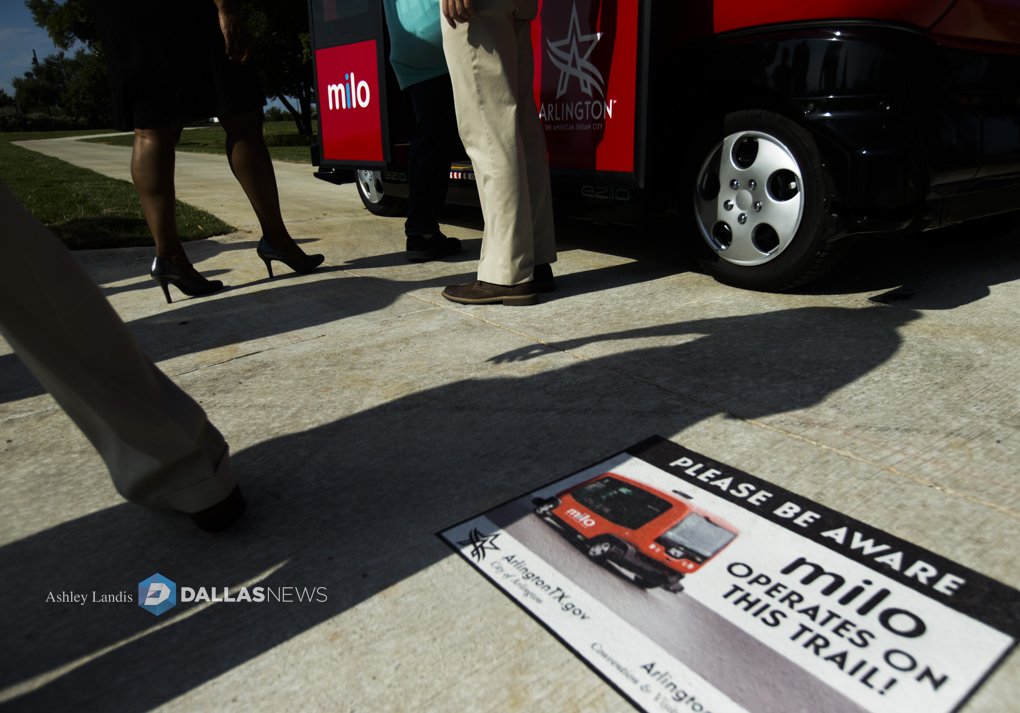 Arlington, Texas has a pilot AV shuttle program that began on Aug. 26 and will continue through mid-2018. The shuttle will provide AV transportation around the Arlington entertainment district and to Texas Rangers and Dallas Cowboys games on game days and when concerts and other events are held. EasyMile shuttle vehicles will be used. Arlington is already considering expanding the use of AV transit shuttles beyond the pilot project. The vehicles hold 12 passengers, according to one enthusiastic report.
California
San Jose Airport is testing an EasyMile shuttle vehicle and hopes to use it for ferrying travelers and workers around the airport. The wish list includes an AV shuttle to transit and a dedicated lane on public roads. A local article about the project does a nice job of explaining the huge quality-of-life implications for people with disabilities and older adults.
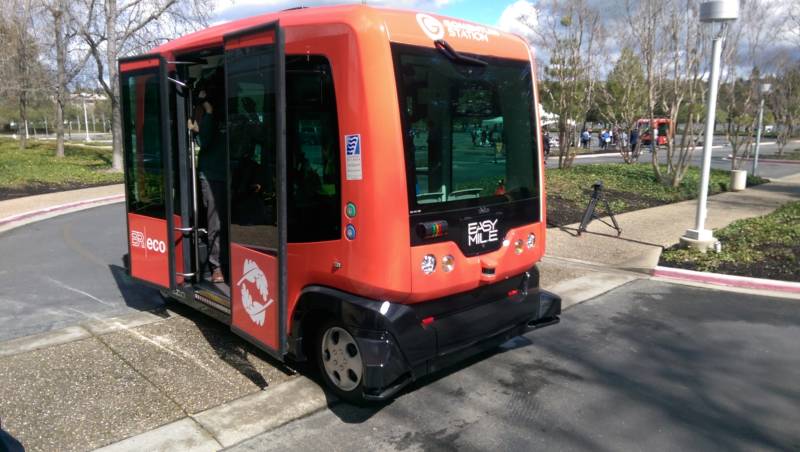 San Ramon, CA, home of the Bishop Ranch office campus has an AV shuttle pilot program that is designed for ferrying office workers. The AV shuttle became a local celebrity when it was featured as the grand marshal of the Concord, CA, July 4th parade. EasyMile shuttle vehicles are being used.
Apple is floating the idea of an AV shuttle for employees. No word on timing or which company will be supplying the shuttles.
Colorado: Denver's transit system is planning for cute AV shuttles for first and last mile connection to transit. RTD, the transit agency, was testing the EasyMile EZ10 in a giant parking lot. If you watch the video, just note that the snarky New Yorker reaction is that unless this vehicle has a dedicated lane or a built-in "oh no you don't" feature, in a busy city pedestrians will eating this adorable vehicle for lunch. You cannot combine a courteous, safe vehicle with a nasty, walking Brooklynite.
MaaS on the menu - tea leaf of expected profitable service
None other than Ernst & Young (really called EY), a large multinational accounting firm, has developed a Blockchain platform, called Tesseract, for managing fleets of AVs. The firm sees mobility as a service - or MaaS - somewhere on the expected horizon. From what I understand, which is little, about Blockchain, also used for bitcoin transactions, it is nearly unhackable and it is instantaneous. Evidently, EY sees money in this and has confidence that MaaS will emerge with sharing of different types of AVs, and differently-owned vehicles.
People with disabilities: AV transportation equity
Australia, like the US, a country of long distances, has a company about to pilot AV pods for older adults. Called Pod Zero, and manufactured by UK-based company RDM Autonomous, the pilot will only offer transportation on local roads within some elder communities owned by IRT, an Australian company. (For you older New Yorkers or subway history buffs, this company appears to have no relation to IRT train lines, such as the 1, 2, 3, 4, 5, and 6.) According to RDM, Pod Zero "is currently built in two variants – four-seater and eight-seater – and offers an operating speed up to 15 mph, multiple battery options up to eight hours or 50 miles, wheelchair accessibility and air conditioning."
Pod Zero will launch in November at an aging and information technology conference.
Autonomous wheelchairs are being tested and plans so far are for use in hospitals and airports. Though this wheelchair comes out of MIT research, the pilots are in Singapore and Japan.
Fare free for a price
Under the category "you get what you pay for," ideas for how businesses will make money off of AV transportation are growing. One idea floating around is that AV service, perhaps shared-use ridehailining trips, will be free - actually "sponsored" - by a local business, maybe a restaurant that wants your patronage. Other ideas revolve around fare free because transportation will be a cheap perk to deliver in exchange for valuable data. Sorry, forgot to get a link for this.
OMG, can't believe someone just said this - try being in a wheelchair for a few days
Below is a quote from a Mother Jones post that shows how people totally do not get the need for accessibility. It's as if the writer and like-minded individuals assume that all people with disabilities have extra cash to pay for personal service and that they don't deserve transportation equity. I agree with the point of the post, to not let the perfect be the enemy of the good, BUT people with mobility challenges - by they mothers with strollers or grandfathers with wheelchairs or cousins with intellectual disabilities, should not have to continue to be second-class transportation citizens. (I include the mother because so many parents develop back problems during the car-seat years. Why can't we have cars in which you can just roll in a stroller?)
Most of the AV shuttles are manufactured by Navya and EasyMile, though there are other companies in the game and some homegrown, usually university-developed, shuttle vehicles.
Down under, over to Far East, and towards the West
Perth, Australia has an AV transit shuttle service - open to the public - that just turned one year old. The Navya shuttle, called Arma, operates on public roads. The shuttle reads signs and turns right. Unlike human drivers, it regularly improves due to software upgrades. [See photo.]Singapore will have AV ridehailing in mid-2018 via a partnership with nuTonomy. Unknown is whether a local ride hailing company will be involved. This city-state is already ahead of the curve on AV testing and is currently well in the lead in terms of AV-related urban planning. (Lots more on that topic in a blog post soon.)
Tallinn, Estonia recently saw the end of a month-long AV transit shuttle pilot that was open to the public. This project also used EasyMile vehicles. There are already plans to bring the AV transit option back to Estonia, but next time to a different city and not until next summer. A leading Estonian transportation official is pushing for Estonia to move forward with AVs generally.
Go west young shuttle
Michigan: Ann Arbor, home of Big Ten school University of Michigan (UM) and the MCity AV testing facility (and not far from the American Center for Mobility testing facility in Ypsilanti, Michagan) is about to host an AV shuttle on a two-mile route between engineering buildings at UM's North Campus. The shuttle vehicles are manufactured by Navya and they carry up to 15 passengers. Rides will be fare free and the AV shuttle will operate during the university's business hours (not intended for late-night studying or as a drunk bus).
Texas
Texas A&M has a homegrown AV shuttle on campus for Howdy Week. The plan is to have 15 of these shuttles in operation by the end of the spring semester, meaning by May.
Arlington, Texas has a pilot AV shuttle program that began on Aug. 26 and will continue through mid-2018. The shuttle will provide AV transportation around the Arlington entertainment district and to Texas Rangers and Dallas Cowboys games on game days and when concerts and other events are held. EasyMile shuttle vehicles will be used. Arlington is already considering expanding the use of AV transit shuttles beyond the pilot project. The vehicles hold 12 passengers, according to one enthusiastic report.California
San Jose Airport is testing an EasyMile shuttle vehicle and hopes to use it for ferrying travelers and workers around the airport. The wish list includes an AV shuttle to transit and a dedicated lane on public roads. A local article about the project does a nice job of explaining the huge quality-of-life implications for people with disabilities and older adults.
Apple is floating the idea of an AV shuttle for employees. No word on timing or which company will be supplying the shuttles.
Colorado: Denver's transit system is planning for cute AV shuttles for first and last mile connection to transit. RTD, the transit agency, was testing the EasyMile EZ10 in a giant parking lot. If you watch the video, just note that the snarky New Yorker reaction is that unless this vehicle has a dedicated lane or a built-in "oh no you don't" feature, in a busy city pedestrians will eating this adorable vehicle for lunch. You cannot combine a courteous, safe vehicle with a nasty, walking Brooklynite.
MaaS on the menu - tea leaf of expected profitable service
None other than Ernst & Young (really called EY), a large multinational accounting firm, has developed a Blockchain platform, called Tesseract, for managing fleets of AVs. The firm sees mobility as a service - or MaaS - somewhere on the expected horizon. From what I understand, which is little, about Blockchain, also used for bitcoin transactions, it is nearly unhackable and it is instantaneous. Evidently, EY sees money in this and has confidence that MaaS will emerge with sharing of different types of AVs, and differently-owned vehicles.
People with disabilities: AV transportation equity
Australia, like the US, a country of long distances, has a company about to pilot AV pods for older adults. Called Pod Zero, and manufactured by UK-based company RDM Autonomous, the pilot will only offer transportation on local roads within some elder communities owned by IRT, an Australian company. (For you older New Yorkers or subway history buffs, this company appears to have no relation to IRT train lines, such as the 1, 2, 3, 4, 5, and 6.) According to RDM, Pod Zero "is currently built in two variants – four-seater and eight-seater – and offers an operating speed up to 15 mph, multiple battery options up to eight hours or 50 miles, wheelchair accessibility and air conditioning."
Pod Zero will launch in November at an aging and information technology conference.
Autonomous wheelchairs are being tested and plans so far are for use in hospitals and airports. Though this wheelchair comes out of MIT research, the pilots are in Singapore and Japan.
Fare free for a price
Under the category "you get what you pay for," ideas for how businesses will make money off of AV transportation are growing. One idea floating around is that AV service, perhaps shared-use ridehailining trips, will be free - actually "sponsored" - by a local business, maybe a restaurant that wants your patronage. Other ideas revolve around fare free because transportation will be a cheap perk to deliver in exchange for valuable data. Sorry, forgot to get a link for this.
OMG, can't believe someone just said this - try being in a wheelchair for a few days
Below is a quote from a Mother Jones post that shows how people totally do not get the need for accessibility. It's as if the writer and like-minded individuals assume that all people with disabilities have extra cash to pay for personal service and that they don't deserve transportation equity. I agree with the point of the post, to not let the perfect be the enemy of the good, BUT people with mobility challenges - by they mothers with strollers or grandfathers with wheelchairs or cousins with intellectual disabilities, should not have to continue to be second-class transportation citizens. (I include the mother because so many parents develop back problems during the car-seat years. Why can't we have cars in which you can just roll in a stroller?)
No, we don’t need to deal with the problem of seniors and disabled passengers before it becomes an issue. Why would we? The market will almost certainly take care of this. Maybe companies will spring up that maintain human drivers, or that offer to have a human accompany the car to help you load your luggage or get your wheelchair into the trunk. Maybe driverless taxi companies will include this as an option. Or something. This is a no-brainer. [Emphasis added.]So if you are an affluent person with a disability, no worries. But if you can't afford to pay twice as much for transportation or if you do not want to permanently be stuck at home, sorry. OMG, bad attitude. Maybe it's time to expand the Americans with Disabilities Act to comprehensively include all for-hire and private vehicle transportation. This just gets too hard for anyone marginalized just because he or she uses a wheelchair.
Friday, February 10, 2017
Long Post: Georgia, Florida, Singapore, Etc Legislation
Singapore, which is already hosting a driverless pilot, is moving ahead in the legal realm as well. A new law in Singapore will allow for testing of autonomous vehicles on public roads. This paves the way, no pun intended, for the Land Transport Authority (quite roughly translated as a department of transportation) to regulate the where, when, design, and required data, among other aspects, of testing initiatives. Companies doing the testing - and the humans inside the testing vehicles - would be exempt from the road safety law that applies to conventional vehicles and their human drivers.
The new law will remain in effect for five years to reflect the reality that the fast pace of this emerging industry will require legal changes. Though the law contemplates the possibility of no human being present in the vehicle, if and only if certain ducks are lined up in a row, until then violation-free, licensed humans must be on board to monitor and take over control if necessary.
Elsewhere in Asia
Okay, presume my knowledge of geography is limited to the five boroughs of New York City and then sketchy for the US, Canada, and Western Europe. It's not quite there for Asia at all. So, elsewhere in Asia, this time in South Korea (the Korea without the crazy person at the helm) there is a new law applicable to driverless vehicles testing. The Korea Automobile Management Act permits testing on public roads and does away with the two-human requirement for vehicles being tested. "Safety zones" are exempt. I'm wondering if that's analogous to the US drug-free and reduced speed limits near schools, but I have not one iota of South Korean legal knowledge except for this bit of information. (The linked article from Forbes goes into much more detail about driverless developments in this country.)
Driverless candy
Uber and others are investing in flying driverless commuter transportation. Just hired for the ride hailing behemoth - still waiting to make a profit - is a former NASA aircraft engineer. The trips envisioned are distances of 50 to 100 miles. So, in New York terms, think longer than Greenwich, CT, and more in the neighborhood of Southampton, Long Island to the City. This luxury will, presumably, not help the commutes of babysitters, nurse's aides, or fast food workers.
Not only cars and aircraft will be driverless, there will be massive autonomous container ships with no one at the helm. That's a Rolls Royce venture.
The new law will remain in effect for five years to reflect the reality that the fast pace of this emerging industry will require legal changes. Though the law contemplates the possibility of no human being present in the vehicle, if and only if certain ducks are lined up in a row, until then violation-free, licensed humans must be on board to monitor and take over control if necessary.
Elsewhere in Asia
Okay, presume my knowledge of geography is limited to the five boroughs of New York City and then sketchy for the US, Canada, and Western Europe. It's not quite there for Asia at all. So, elsewhere in Asia, this time in South Korea (the Korea without the crazy person at the helm) there is a new law applicable to driverless vehicles testing. The Korea Automobile Management Act permits testing on public roads and does away with the two-human requirement for vehicles being tested. "Safety zones" are exempt. I'm wondering if that's analogous to the US drug-free and reduced speed limits near schools, but I have not one iota of South Korean legal knowledge except for this bit of information. (The linked article from Forbes goes into much more detail about driverless developments in this country.)
No need for person with a license ...
and US regulatory options to ponder
I read what turned out to be somewhat old article - a few months in the past - about California's revised draft regulation that self-driving vehicles deemed sufficiently capable and safe (licensed?) by the federal government - through NHTSA? - will not require the presence of a human licensed driver when these vehicles are operating on public roads. Despite the timing of the article, it offers a thoughtful exploration of the need for uniformity among US states and the possibility of federal preemption.
For all of you who are not constitutional scholars and who have not attended law school, preemption refers to those matters on which the US Constitution allows for national law to govern and even to, shall I say it, trump (overrule) state laws. Interstate commerce is the most prominent subject of preemption in action, but often, instead of preemption, we see state cooperation in the adoption of uniform laws, the most famous of which is the Uniform Commercial Code. Translation: There is more than one regulatory option for achieving a seamless national driverless transportation network.
Commercial interruption: Driverless Chevy Bolt called Albatross on streets of San Fransisco. No Michael Douglas or Karl Malden and that's a weird name for a car. Yes, here is the opening for the 70s TV show.
Georgia on my mind
A Georgia legislator has introduced a bill that would govern autonomous vehicles and would not require the presence of a human driver. HR 248 (click further for full text) considers the "manufacturer" to be the driver when the vehicle is in automated mode. It also contemplates vehicles being in self-driving mode or being operated at times by a human person - as opposed to US Supreme Court decisions that define "person" to include corporations.
The Georgia bill assumes a leading role, as other state laws do, for NHTSA (the National Highway Traffic Safety Administration) for submission of equipment and software documentation. Automated vehicle testing in Georgia would be allowed, but manufacturers would be required to submit an annual report about crashes and vehicle failures. When crashes or failures occur, systems are required that would automatically generate a report to a local police department. There would be no obligation for the automated vehicle itself to communicate with the owner of another vehicle or damaged property. Local police will use forms generated at the state Department of Transportation for crash and failure reporting.
Automated car = automated crash reporting
What does this mean? Georgia would require that automated vehicles be equipped with crash reporting technology and a data recording system. Oh, and if you are driving a vehicle made before 1965, you do not have to wear a seatbelt in Georgia. I'll tell my parents to get back their red '57 Chevy. (Yes, they actually had one and drove it for 11 years. We were the only family with such an old car.) Occupants of automated vehicles will be required to wear seat belts.
For a passenger, and, presumably, for an employee of the company testing the vehicle, there would be a waiver of the right to privacy in data generated. Towns, cities, counties, or other jurisdictions below the Georgia state level would not be empowered to impose fees or restrictions on testing or testing companies relating to testing in their jurisdictions. The Georgia bill also contains a bunch of provisions meant to decrease distracted driving - by humans - and to penalize driving away without paying for gas.
This article explains the considerations at play in the Peach State and why legislators are acting quickly.
Florida tries to say ahead on law
A state legislator in Florida introduced HB 725, a driverless bill, this week. The bill would deem the "autonomous technology" to be the vehicle operator and a human would not be required to be physically present in a vehicle or to be licensed in connection with the operation of an autonomous vehicle. In contrast to Georgia, in terms of reporting any crashes or other incidents, Florida puts the responsibility in human hands for reporting. Georgia is assuming that technology can and will take care of that task.
Florida's legislation would require the vehicle technology to alert humans, licensed or not, that failure is imminent and the bill would mandate that the vehicle safely be be equipped to travel to a safe spot where it will shut off. However, the bill also contemplates that a licensed human could take over operation in the situation of such a failure. The bill's text has details.
Tennessee bill introduced
Another piece of proposed legislation in a US state that contemplates vehicles without any licensed humans, or any humans, aboard. The legislation, HB 1131, was introduced this week in Tennessee. Like bills in other states, compliance with vehicle safety laws and some kind of getting-out-of-trouble mode would be required so that the driverless vehicle would quietly transport itself to a safe space before wreaking havoc in the middle of a road. Similar to Florida, when in automated mode, the autonomous technology will be deemed the driver. As you can see, when it comes to legislation, plagarism is allowed and desirable so that one can cross state lines without problems.
To protect the automotive industry, the bill would exempt car companies from liability if vehicles were retrofitted with equipment and software that transforms it into a self-driving vehicle. Therefore, even if the company knows or should know that people are right and left dramatically altering their conventional vehicles, the auto manufacturers would win a lawsuit automatically.
Likewise for software manufacturers whose code is edited by anyone other than the company without its consent.
New Zealand ambition for driverless transit
From the land where the Lord of the Rings trilogy was filmed comes an ambitious local representative on a regional council who sees the transformative power of driverless public transit for Tauranga, a city down in New Zealand. Transit there is not currently attracting much ridership, but Andrew von Dadelszen is pushing his region to plan now for the inevitable transportation revolution. There is a cost-conscious angle at work here: von Dadelszen sees driverless buses as being a cheap and effective alternative to light rail, which takes years of planning and lots of money to put into place.
Uber and others are investing in flying driverless commuter transportation. Just hired for the ride hailing behemoth - still waiting to make a profit - is a former NASA aircraft engineer. The trips envisioned are distances of 50 to 100 miles. So, in New York terms, think longer than Greenwich, CT, and more in the neighborhood of Southampton, Long Island to the City. This luxury will, presumably, not help the commutes of babysitters, nurse's aides, or fast food workers.
Not only cars and aircraft will be driverless, there will be massive autonomous container ships with no one at the helm. That's a Rolls Royce venture.
Monday, August 1, 2016
Singapore - A Driverless Sandbox
Singapore's LTA (Land Transport Authority = Department of Transportation) is partnering with Delphi and nuTonomy on an MOD (Mobility on Demand) program that will provide first-and-last-mile services. Nice moxie for a small island nation.
nuTonomy just issued a press release today that the company has:
Delphi loving Singapore
For some reason, the Delphi Automotive news is all over, whereas the nuTonomy information is not catching as much buzz. Delphi will be providing the self-driving Audi cars. Here's another article with more details.
This article makes matters much more clear in terms of the different Singapore projects and what Delphi and nuTonomy are doing.
And a testing facility
Perhaps in a bid to get beyond low-speed shuttles and taxipods, Singapore is also opening a small driverless testing facility. In its ambitious quest, the country is also working on being a forerunner in driverless regulation, though another island nation is the first with that.
nuTonomy just issued a press release today that the company has:
... entered into a new partnership with Singapore’s Land Transport Authority (LTA) to begin trials of an autonomous mobility-on-demand transportation service. The partnership will expand and accelerate the company’s development efforts in Singapore as it progresses towards the launch of a commercial autonomous vehicle (AV) service in 2018.Back in early April, 2016, news broke that Cambridge, MA-based nuTonomy had succeeded in being selected by Singapore to do a driverless taxi-pod pilot project.
Delphi loving Singapore
For some reason, the Delphi Automotive news is all over, whereas the nuTonomy information is not catching as much buzz. Delphi will be providing the self-driving Audi cars. Here's another article with more details.
This article makes matters much more clear in terms of the different Singapore projects and what Delphi and nuTonomy are doing.
And a testing facility
Perhaps in a bid to get beyond low-speed shuttles and taxipods, Singapore is also opening a small driverless testing facility. In its ambitious quest, the country is also working on being a forerunner in driverless regulation, though another island nation is the first with that.
Thursday, April 7, 2016
Singapore vs. North Dakota vs. Google vs. ...
Singapore + nuTonomy = Pod-mania
OMG, the twittersphere and conventional journalism - here, via Forbes - are full of Singapore's plan to introduce taxi-pods (taxibots?). These will be accessible by apps. How else, right? (Not quicker, by the way, than catching a cab on CPW in Manhattan.) This could beat Uber at its own game and get a leg up on shared-use plans by Google, GM, Ford, and others.
Google stays out West
Google is bringing its cute driverless vehicles to Phoenix, Arizona. Who wants to be there? No offense, but it' not a pedestrian-friendly place. Maybe it's just my East Coast sensibilities. Google says there's good air-born dust, as in dust storms. I was there for one once and it was creepy. Thank goodness someone else was driving.
North Dakota to have driverless highway? Every hardly-any-people state has two senators
One weird aspect of the US Constitution is that every state, no matter how small and no matter how few people, gets two senators. Hence a state like Wyoming, which has a population the size of a Brooklyn neighborhood, gets somewhat outsize representation. In a way, this is a good thing. Some of those senators are able to push through interesting ideas and not get swamped by the more populous states.
North Dakota (pop. a bit under 750,000) Sen. John Thune is backing an idea to allow a particular highway that runs north-to-south and goes through seven states to be the first to allow driverless hauling of freight. Lots of driverless trucks. There's an association formed to push the idea toward fruition, the Central North Trade Corridor Association.
This would mean seven states permitting driverless travel, whether through laws, regulations, or pure neglect. It could just mean interpreting existing provisions to not require a human driver. They're all laissez-faire/no-government-intervention out West, (super broad generalization there) so maybe that could happen.
Truck trip success in Europe
Speaking of a trucking company fantasy, a convoy of connected trucks - lorries, to those of you in the UK - has completed a trip across Europe. I think the first truck needs a driver, but the followers do not, though, of course, there were drivers present during this test. I'm not sure what happens to the CV trucks when obnoxious, speeding drivers of cars weave into the middle of the convoy. That will be the New Jersey Turnpike test.
Volvo going to China
First, Volvo is now owned by a Chinese company. Second, Chinese companies are pushing for their government to establish driverless-friendly rules. Third, China presents good challenges for driverless vehicles, as in crazy congestion and drivers. Volvo plans to essentially give 100 ordinary people 100 driverless vehicles to test on urban Chinese roads. I think the drivers must be present and they will be able to take over the wheel. This pilot will not happen until 2017.
NHTSA and technical details that make driverless possible
Tomorrow, the US National Highway Traffic Safety Administration (NHTSA) will be hosting a public meeting at the USDOT (Department of Transportation) building. One of those details is the technology that allows driverless vehicles to "see" its surroundings and "communicate" - as in connected vehicles or CV - with others. It will be interesting because DOT announced it will come out with regulations within the next few months. Okay, I remember that, but I don't have a link right now. That is warp speed for a government agency.
OMG, the twittersphere and conventional journalism - here, via Forbes - are full of Singapore's plan to introduce taxi-pods (taxibots?). These will be accessible by apps. How else, right? (Not quicker, by the way, than catching a cab on CPW in Manhattan.) This could beat Uber at its own game and get a leg up on shared-use plans by Google, GM, Ford, and others.
Google stays out West
Google is bringing its cute driverless vehicles to Phoenix, Arizona. Who wants to be there? No offense, but it' not a pedestrian-friendly place. Maybe it's just my East Coast sensibilities. Google says there's good air-born dust, as in dust storms. I was there for one once and it was creepy. Thank goodness someone else was driving.
North Dakota to have driverless highway? Every hardly-any-people state has two senators
One weird aspect of the US Constitution is that every state, no matter how small and no matter how few people, gets two senators. Hence a state like Wyoming, which has a population the size of a Brooklyn neighborhood, gets somewhat outsize representation. In a way, this is a good thing. Some of those senators are able to push through interesting ideas and not get swamped by the more populous states.
North Dakota (pop. a bit under 750,000) Sen. John Thune is backing an idea to allow a particular highway that runs north-to-south and goes through seven states to be the first to allow driverless hauling of freight. Lots of driverless trucks. There's an association formed to push the idea toward fruition, the Central North Trade Corridor Association.
This would mean seven states permitting driverless travel, whether through laws, regulations, or pure neglect. It could just mean interpreting existing provisions to not require a human driver. They're all laissez-faire/no-government-intervention out West, (super broad generalization there) so maybe that could happen.
Truck trip success in Europe
Speaking of a trucking company fantasy, a convoy of connected trucks - lorries, to those of you in the UK - has completed a trip across Europe. I think the first truck needs a driver, but the followers do not, though, of course, there were drivers present during this test. I'm not sure what happens to the CV trucks when obnoxious, speeding drivers of cars weave into the middle of the convoy. That will be the New Jersey Turnpike test.
Volvo going to China
First, Volvo is now owned by a Chinese company. Second, Chinese companies are pushing for their government to establish driverless-friendly rules. Third, China presents good challenges for driverless vehicles, as in crazy congestion and drivers. Volvo plans to essentially give 100 ordinary people 100 driverless vehicles to test on urban Chinese roads. I think the drivers must be present and they will be able to take over the wheel. This pilot will not happen until 2017.
NHTSA and technical details that make driverless possible
Tomorrow, the US National Highway Traffic Safety Administration (NHTSA) will be hosting a public meeting at the USDOT (Department of Transportation) building. One of those details is the technology that allows driverless vehicles to "see" its surroundings and "communicate" - as in connected vehicles or CV - with others. It will be interesting because DOT announced it will come out with regulations within the next few months. Okay, I remember that, but I don't have a link right now. That is warp speed for a government agency.
Monday, April 4, 2016
Not News: Singapore Becoming Smart and More Mobile
Singapore is quickly becoming a smart city/new urbanist's dream. Officials are talking smart lamp posts that provide light, cameras, and maybe data collection.
Some restaurants already feature robot wait staff. I'm guessing they refuse tips.
Driverless pods are being designed to solve the first mile/last mile challenges of transit. These should be on the roads within two years.
There's a nice ethos here of coordination, transit, and a government embracing change.
I actually would like to have human waiters and waitresses, even if the service is inconsistent.
Some restaurants already feature robot wait staff. I'm guessing they refuse tips.
Driverless pods are being designed to solve the first mile/last mile challenges of transit. These should be on the roads within two years.
There's a nice ethos here of coordination, transit, and a government embracing change.
I actually would like to have human waiters and waitresses, even if the service is inconsistent.
Friday, March 25, 2016
Too Many Driverless Restrictions in the States?
The answer seems to be "oh yes," at least for nuTonomy, started by MIT-related folks, which will be testing a shared-ride driverless service soon in Singapore. Singapore has been ambitious to push the driverless revolution. nuTonomy was also involved with the Singapore week-long pilot of ferrying around public garden visitors in a driverless golf cart.
nuTonomy claims that it's fleet management algorithms are so efficient that Singapore will be able to reduce by half its taxi fleet and keep the same level of service. We're talking about a current fleet of 700,000 taxis (Manhattan on steroids?). nuTonomy vehicles use LIDAR, which sometimes is capitalized and sometimes not.
Minnesota joins the race - a slow, state-by-state race
Minnesota is throwing its hat into the self-driving ring, but it is acting similarly to other gun-shy states. Report by Dec. 31, 2018; a big task force; blah, blah, blah. Nice to see, however, that people with disabilities are included in the rationale for the legislation along with generating revenue for the state.
One important tidbit: In terms of operating a self-driving vehicle, although a licensed driver must be available, that human does NOT have to be present in the vehicle. I re-read the text because I don't trust myself. Here it is, in bold, italic, and underlined.
I'm sure that $5 million, with a chance to be near the Mary Tyler Moore statue, will be a huge temptation for those billion dollar companies. Maybe a tiny start up. Sarcasm dripping again. Okay, but if you do go to the Twin Cities, definitely have pancakes at Mickey's Diner in St. Paul. So, so good.
nuTonomy claims that it's fleet management algorithms are so efficient that Singapore will be able to reduce by half its taxi fleet and keep the same level of service. We're talking about a current fleet of 700,000 taxis (Manhattan on steroids?). nuTonomy vehicles use LIDAR, which sometimes is capitalized and sometimes not.
Minnesota joins the race - a slow, state-by-state race
Minnesota is throwing its hat into the self-driving ring, but it is acting similarly to other gun-shy states. Report by Dec. 31, 2018; a big task force; blah, blah, blah. Nice to see, however, that people with disabilities are included in the rationale for the legislation along with generating revenue for the state.
One important tidbit: In terms of operating a self-driving vehicle, although a licensed driver must be available, that human does NOT have to be present in the vehicle. I re-read the text because I don't trust myself. Here it is, in bold, italic, and underlined.
a person who holds a class D license or its equivalent is present in the vehicle or is monitoring the vehicle from a remote location during operation, and in either case, the licensed person is able to take control of the vehicle's movements immediately, if necessary.The bill, SF 2569, calls for a whopping $5 million. In case you did not get it, the previous sentence was dripping with sarcasm. Just yesterday, I wrote about Japan spending $3 TRILLION. I can't write trillion, dollars that is, without capital letters (woo, just did).
I'm sure that $5 million, with a chance to be near the Mary Tyler Moore statue, will be a huge temptation for those billion dollar companies. Maybe a tiny start up. Sarcasm dripping again. Okay, but if you do go to the Twin Cities, definitely have pancakes at Mickey's Diner in St. Paul. So, so good.
Thursday, December 17, 2015
Singapore and England Reveal Ambitious Plans, but not California
Asia
Singapore has an ambitious, organized driverless plan that includes trials for trucks and transit as well as mobility on demand - otherwise known as taxi, ride hailing, or Uber-like service. (Yes, I am starting to use "Uber" as a generic noun.)
One more piece of news from Asia is activity in China. Baidu is set to produce driverless buses to be ready for operation in 2018.
Europe
UK transport officials have met with Google staff multiple times about regulation that will allow driverless transportation on UK roads. Supposedly, England is forging ahead and intends to be a leader. I would add that the Telegraph is the best provider of journalism on the Google/UK topic.
And here is a boring Swiss video from Rinspeed with a very conventional looking car, though it has a retractable steering wheel. Also, it's a personal vehicle, complete with creepy "I'm helping you" - you, specifically - technology. Again, boring. I dare you to make it to the end of the video. I did not.
Step back in California?
California's proposed - not adopted yet - law would require a licensed human driver to be present in every driverless vehicle being operated. Do they not get the whole point of driverless transportation from calling a vehicle to pick up a friend at the station, to deliver pizza, or to park itself? And what about sending the driverless transit bus to the start of its route? I could go on.
If this bill passes, Google, Tesla, and others will concentrate their testing and - maybe soon - sales strategy in other states. Texas, Arizona, and Florida, for top-of-my-head examples, would love to welcome more driverless activity.
Tidbits
Ford to begin testing fully driverless cars on California roads. The car company is partnering with Pivotal Software.
Kia to do driverless testing in Nevada.
Singapore has an ambitious, organized driverless plan that includes trials for trucks and transit as well as mobility on demand - otherwise known as taxi, ride hailing, or Uber-like service. (Yes, I am starting to use "Uber" as a generic noun.)
One more piece of news from Asia is activity in China. Baidu is set to produce driverless buses to be ready for operation in 2018.
Europe
UK transport officials have met with Google staff multiple times about regulation that will allow driverless transportation on UK roads. Supposedly, England is forging ahead and intends to be a leader. I would add that the Telegraph is the best provider of journalism on the Google/UK topic.
And here is a boring Swiss video from Rinspeed with a very conventional looking car, though it has a retractable steering wheel. Also, it's a personal vehicle, complete with creepy "I'm helping you" - you, specifically - technology. Again, boring. I dare you to make it to the end of the video. I did not.
Step back in California?
California's proposed - not adopted yet - law would require a licensed human driver to be present in every driverless vehicle being operated. Do they not get the whole point of driverless transportation from calling a vehicle to pick up a friend at the station, to deliver pizza, or to park itself? And what about sending the driverless transit bus to the start of its route? I could go on.
If this bill passes, Google, Tesla, and others will concentrate their testing and - maybe soon - sales strategy in other states. Texas, Arizona, and Florida, for top-of-my-head examples, would love to welcome more driverless activity.
Tidbits
Ford to begin testing fully driverless cars on California roads. The car company is partnering with Pivotal Software.
Kia to do driverless testing in Nevada.
Monday, October 12, 2015
Europe, Singapore Go for Driverless Transit; England Behind?
Fare-free, driverless transit in Greece as CityMobil2 provides actual bus service for actual riders on the streets of Trikala. No idea where that is, but it has 80,000 people. A nice small city for a test project. (Though the article calls Trikala rural, it would not be deemed rural by American standards. American transportation regulations define rural as 50,000 or less.)
The CityMobil2 buses are on the roads right now and will continue to provide rides through February 2016.
Singapore designs driverless transit for everyone - including people with disabilities
In an ongoing series of shared-use driverless projects - fitting about 10 people per vehicle, Singapore is designing universally so that one category of transportation-challenged people will be afforded true equality. The little transit buses are designed for wheelchair-user riders and not just "normal" riders.
If you look at the vehicles, notice that unlike conventional transit buses, which seem as though wheelchair accessibility is an add on, these seem as if they were designed for more than one type of passenger.
England choosing conventional car manufacturers
I'm thinking this is a mix of forward-thinking car manufacturers and the UK government getting a bit desperate that other countries are passing by the Union Jack in the race to bring autonomous transport to the world's roads. Jaguar and Land Rover are teaming up with British universities and the UK government - a la Michigan's M city, perhaps.
But wait, this multi-faceted endeavor, which also involves 10 UK universities, will be studying drivers as well, meaning increasingly autonomous cars rather than driverless ones as fast as possible. UK might be more behind than it thinks.
The CityMobil2 buses are on the roads right now and will continue to provide rides through February 2016.
Singapore designs driverless transit for everyone - including people with disabilities
In an ongoing series of shared-use driverless projects - fitting about 10 people per vehicle, Singapore is designing universally so that one category of transportation-challenged people will be afforded true equality. The little transit buses are designed for wheelchair-user riders and not just "normal" riders.
If you look at the vehicles, notice that unlike conventional transit buses, which seem as though wheelchair accessibility is an add on, these seem as if they were designed for more than one type of passenger.
England choosing conventional car manufacturers
I'm thinking this is a mix of forward-thinking car manufacturers and the UK government getting a bit desperate that other countries are passing by the Union Jack in the race to bring autonomous transport to the world's roads. Jaguar and Land Rover are teaming up with British universities and the UK government - a la Michigan's M city, perhaps.
But wait, this multi-faceted endeavor, which also involves 10 UK universities, will be studying drivers as well, meaning increasingly autonomous cars rather than driverless ones as fast as possible. UK might be more behind than it thinks.
Monday, September 21, 2015
Driverless Testing Spreading Across Globe, US
Transit union drivers, taxi drivers, Uber and other ridehailing drivers, beware. Time now to train for new work. The driverless revolution is coming your way fast.
Literally, it is impossible to take a week off, let alone a decent vacation, from driverless vehicle news because daily there are updates. I'm just catching up after a summer of work and actual vacation travel. Next year, such a schedule could mean I'll miss a sight of the first driverless taxi or ridehailing car in my neighborhood. More likely that will be two years from now. But if I were planning to visit the Netherlands this summer, I could treat myself to a ride on driverless transit.
Catch a ride near some tulips
The Netherlands takes the lead with driverless transit starting in November of this year. The pods are on the roads now being tested and come November they will be shuttling up to six passengers at a time around two towns in the province of Gelderland. (Not sure if there is a connection, but geld, or something close, means money in several languages.) The WEpods will go up to 15 miles per hour (25 kph). Initially, this driverless shuttle will be treated gently; it will not be available during rush hours, at night, or in inclement weather. But you will be able to book it with an app along its initial fixed route.
The Netherlands WEpod follows in the footsteps of CityMobil2, which has operated in towns in Finland and Switzerland. There are also driverless pods at Heathrow Airport outside of London.
And a short trip from London, Oxford, Cambridge ...
 In the town of Milton Keynes, in England, two-seater driverless pods are about to be given a trial run. In the works for more than a year, the pilot project will ramp up from three up to 40 pods for ferrying people around and taking lessons for fine tuning regulation of driverless technology.
While in Asia, ...
Singapore did a six-day trial (something biblical here?) a few months ago with tourists as guinea pigs. A large garden that is a tourist destination allowed for pre-arranged rides on the driverless shuttle golf-cart-type vehicle. Turns out that the tourists loved the driverless service and the guinea pigs were safe.
News from across the pond
New York City is already behind as a DOT connected-car-technology testing site. But it may fall further back in the advent of new vehicular technology because it is planning to test only connected vehicle technology and not driverless vehicles on its streets. That's okay, my home town has a long tradition of launching shows after previews elsewhere. This project goes with the conventional wisdom of most traditional car manufacturers, and perhaps more than a few departments of transportation around the US, that regular cars outfitted with driver warning systems, vehicle-to-vehicle technology, and limited autonomous features will win the war against total driverless - and be safe. I do not believe that someone napping, checking email, or watching a cable show clip will suddenly snap to attention when the car somehow shouts out EMERGENCY! Maybe my reflexes are unusual, though.
On the way to Miami
Other spots to test this same connected-vehicle technology will be Tampa, FL, Wyoming, and Ann Arbor, MI.
Literally, it is impossible to take a week off, let alone a decent vacation, from driverless vehicle news because daily there are updates. I'm just catching up after a summer of work and actual vacation travel. Next year, such a schedule could mean I'll miss a sight of the first driverless taxi or ridehailing car in my neighborhood. More likely that will be two years from now. But if I were planning to visit the Netherlands this summer, I could treat myself to a ride on driverless transit.
Catch a ride near some tulips
The Netherlands takes the lead with driverless transit starting in November of this year. The pods are on the roads now being tested and come November they will be shuttling up to six passengers at a time around two towns in the province of Gelderland. (Not sure if there is a connection, but geld, or something close, means money in several languages.) The WEpods will go up to 15 miles per hour (25 kph). Initially, this driverless shuttle will be treated gently; it will not be available during rush hours, at night, or in inclement weather. But you will be able to book it with an app along its initial fixed route.
The Netherlands WEpod follows in the footsteps of CityMobil2, which has operated in towns in Finland and Switzerland. There are also driverless pods at Heathrow Airport outside of London.
And a short trip from London, Oxford, Cambridge ...
While in Asia, ...
Singapore did a six-day trial (something biblical here?) a few months ago with tourists as guinea pigs. A large garden that is a tourist destination allowed for pre-arranged rides on the driverless shuttle golf-cart-type vehicle. Turns out that the tourists loved the driverless service and the guinea pigs were safe.
News from across the pond
New York City is already behind as a DOT connected-car-technology testing site. But it may fall further back in the advent of new vehicular technology because it is planning to test only connected vehicle technology and not driverless vehicles on its streets. That's okay, my home town has a long tradition of launching shows after previews elsewhere. This project goes with the conventional wisdom of most traditional car manufacturers, and perhaps more than a few departments of transportation around the US, that regular cars outfitted with driver warning systems, vehicle-to-vehicle technology, and limited autonomous features will win the war against total driverless - and be safe. I do not believe that someone napping, checking email, or watching a cable show clip will suddenly snap to attention when the car somehow shouts out EMERGENCY! Maybe my reflexes are unusual, though.
On the way to Miami
Other spots to test this same connected-vehicle technology will be Tampa, FL, Wyoming, and Ann Arbor, MI.
Wednesday, April 22, 2015
Singapore Launching Testing Facility
Following in the footsteps of the University of Michigan, Singapore is launching a new testing facility for autonomous vehicles at a large university. The facility will be at Nanyang Technological University (NTU). There are already three vehicles roaming the campus, reports IEEE. The project is connected to a solar plant on the campus and a campus EcoCampus Initiative announced in April 2014.
Subscribe to:
Posts (Atom)