The future has already happened and it is 1970s Brooklyn. Imagine a world with a subway system, lots of transit buses, taxis and car services. Car services were (maybe still are) these businesses that voila! produced a car - with a driver - within five minutes of when you called. No one ever had to drive.
Dads of high school students loved this because they did not have to get out of bed at some late hour to retrieve their kids. Of course, since we thought the drivers were creepy, we usually ended up sleeping over at friends' houses so that no one had to be the last kid in the car with the driver. My grandmother and her friends used the buses and car services to go everywhere.
Now the world is catching up. Soon everyone can achieve the nirvana of my hometown - except that it will not be so heavenly with a few big competitors and the permanent travails of lack of transit funding likely to continue. Here are some players that have announced on-the-street AV service to launch within the next few years.
Caveats - No word from any car manufacturer or AV technology company about AV ridehailing that will be accessible for people with disabilities. And that's another thing, these companies are all talking about cities, but no one is volunteering to serve rural communities or people with disabilities. Maybe we still are in the 1970s.
Uber is not waiting
Uber is already on the streets of San Francisco providing AV rides - but only for its self-driving staff. I wonder if there's a clause in the employee manual about relinquishing the right to sue. The rides, by the way, are free, so I'm not sure about applicability of federal or state laws or regulations when no money is changing hands and the ride is kind of, sort of, part of the job. Don't get too excited.
As is true for all self-driving vehicles on California public roads, the cars will have backup drivers. The Department of Motor Vehicles recently created a system for companies to test self-driving cars without backup drivers but has not yet issued permits for it.
No doubt Uber will be ready to submit one of those no-human-backup-driver permits.
Happening in China and Japan
Pony.ai is starting an AV ridehailing service in China. "its fleet is running a nearly two-mile route in Nansha, Guangzhou, where its China HQ is located."
News of GM bringing AV ridehailing to lower Manhattan in New York City is the product of good journalist digging. Tribeca Citizen, a neighborhood news source, looked into GM's leasing of office space and discovered that the party named in the lease is none other than "GM Cruise LLC, commonly referred to as Cruise or Cruise Automation." This follows Gov. Cuomo's announcement in October that GM will be doing testing in Manhattan at some unspecified 2018 date.
May Mobility goes for quick trip - shouldn't you walk? - market
May Mobility also scored a big win by getting Tampa's transit agency on board for a pilot with this newcomer AV producer's shuttle. Testing began this week and the pilot for regular riders will commence later in 2018.
Toyota and BMW are funding some May Mobility activity involving "plans to use the seed money to expand in Texas and Florida — states that don’t require a safety driver." This involves some one kilometer routes. Am I missing something or isn't that a short walk - unless we are talking inclement weather? Really inclement weather.
Forget 2021 for large legacy auto companies to debut autonomous vehicles (AVs): GM is planning on 2019 to launch a car-like AV that will NOT include a steering wheel or brakes. Still looks eerily the same as current sedan, however, with normal seats, interior design, and many cupholders. No imagination there.
Very interesting is GM's strategy vis a vis the US Department of Transportation (DOT) to avoid steering- and brake-related regulatory requirements. According to nice article from myStatesman, which quotes from other sources, GM is seeking to avoid the safety standards, but (if I'm reading this correctly) meet safety objectives.
Digressing for a moment
Spoiler alert - Next post to address DOT AV-related requests. Lots of activity and room for comments.
Don't ask my opinion about DOT car safety standards - FMVSS - because, with upwards of 35,000 deaths in US alone, not to mention injuries, we do not have actual standards that are producing safety as that word is understood by all normal people.
Back to GM
Notable tea leaves from the GM announcement: (1) Influence GM has with Congress and DOT means that by well before the company's launch date, we will see AV-friendly changes in terms of regulation and legislation; (2) GM is serious about beating Ford and other auto companies as well as being truly competitive with Waymo, Uber, and the like. Nice to see this from a company that not so long ago predicted we would not see AVs on our roads for at least another generation.
Navya cuddles up to Via
In a sweet marriage that reflects the couplings and menage a trois (or more) partnerings, Navya has committed its Autonom Cab - I refuse to use the all caps in actual name - to Via's fleet management system. Via, for those outside of the shared-use transportation world, is a kind of hybrid of microtransit and taxi service. It is app-based, but shared ride, and can require a short walk to meet the vehicle. Via is currently in Manhattan, Brooklyn, Chicago, and DC; but a look at its jobs page shows the many cities where it is expanding or in some way otherwise operating.
Here's the Navya Autonom Cab video, which, curiously, shows no interior shots and a Paris magically sans congestion.
What is notable is that this project marks a departure, really more of a branching out, from Volvo's previous AV-as-conventional-car initiatives.
Roving convenience store - why stop there?
A California company, Robomart, has fitted out an AV as a mobile small convenience store. The video (on the boring side) shows a supposedly upscale, McMansion exurb with a contemporary reimagining of the corner store - but without people, candy, long pretzel sticks, friendly person behind the counter, and nine year olds.
As I wrote yesterday regarding the e-Pallete concept, why stop the imagination? Why not roving offices, coffee places, meeting rooms, tiny houses?
Sorry, sorry for posting delay. Work is a bear; my Metro station is closed for two weeks, meaning my usual simple commute is transformed into the nightmare of most normal people. Uch. At least I can include a nice walk instead of the shuttle bus to hell. [Image source: Daily Mail.]
Bold announcement
GM-owned Cruise Automation will be avoiding pilot projects and going straight for full-scale deployment. The exact date is yet to be determined, but 2019 will be the year. "The goal of the service, ultimately, is to maximize its impact, ... and create something that truly affects people’s lives in a big, significant way. To do that, you need to launch first in big cities where ride hailing and electric vehicles available on-demand in significant numbers will make a serious dent not only in reducing traffic fatalities, but also in ecological footprint thanks to reduced emissions." Autonomous neighborhoods to come
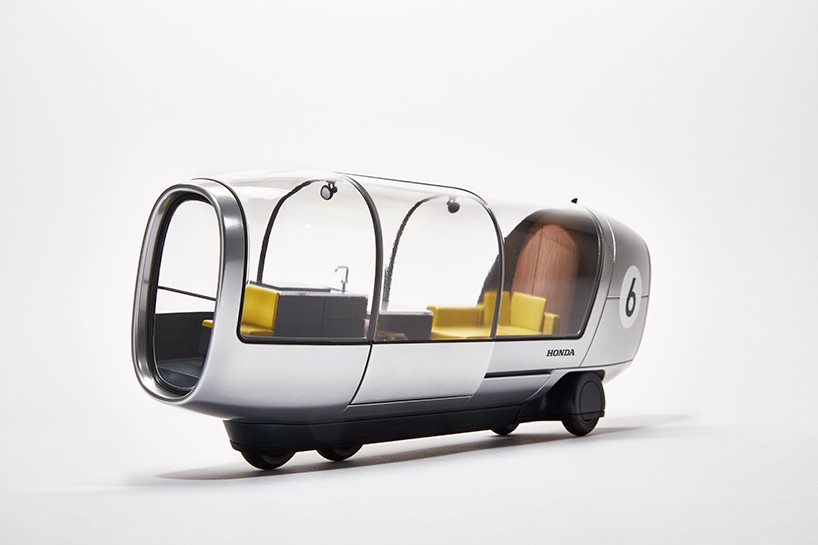
Silicon Prairie, otherwise known as Lincoln, NE, is doing more than union-entrenched cities to plan for autonomous vehicles. Not that the city is doing much; it has merely hired a consultant, but it perceives the need to get going. A city like New York, on the other hand, is so avoiding offending its unions that it is lagging behind. It's New York, so it will be fine. [Image source: Honda.]
As I have said before, if you are a professional driver, it is time to put together plan B.
Outside of Boston, like in Florida at the town of Babcock Ranch, a new neighborhood is being developed for driverless transportation from the start. This is a "1,550-acre urban development located 12 miles south of Boston." The development is a partnership between:
Optimus Ride, a MIT spinoff company developing self-driving vehicle technology ... [and] renowned real estate developer LStar Ventures to provide Union Point's residents with access to self-driving vehicles. This agreement represents the world's first revenue generating autonomous vehicle pilot program.
Revenue generating = NOT fare free.
Connected and wealthy
Bellevue, WA, is putting its money where its mouth is and investing heavily to speed toward AVs and a network of ACES (actually called the ACES network), which stands for autonomous, connected, electric, and shared. There are government and industry players actively involved. Whether this turns out to be an expensive venture that will later become off-the-shelf and cheaper remains to be seen. There's always someone or some community that is willing to pay big bucks just to be first or near the top, whether or not the additional investment makes financial sense in the long term. [Image source: vox.com.]
Don't ruin my nap time
Please, please, please do not force me to watch sponsored content when I ride in an AV. Okay, yes, I will if that movie, TV show, or article is only available for free with the commercial. But leave me alone if all I want to do is nap. Creeps me out to constantly read headlines - basically all the same article - about the Intel-Time Warner deal to provide entertainment inside AVs.
Navya will be starting an autonomous vehicle taxi service next spring, that's the second quarter of 2018. So, flowers, buds on trees, and a taxi sans driver - but only in Paris - so far. Also nice is that the taxi will be EV as well as AV (electric vehicle, autonomous vehicle for you non-acronym lovers). For now, Navya merely offers a boring, corporate-styled video.
Okay, yes, I can't resist the temptation to include the boring video.
More taxi-like news
We have advanced beyond "what's good for GM is good for America" to the point where GM is going after the business of people completely car-free or at least car-lite with its Maven ridehailing service. Maven is now expanding to more cities, operating in Baltimore, DC, Boston, and Los Angeles, among others, bringing the total to eight.
GM's Maven is not yet autonomous, but it represents GM's foray into a different business model in preparation for an AV world that may not mirror the old model of a car - or two or three - in every driveway.
Off topic: Where maven comes from
Maven, by the way, is from Yiddish and means expert. In Yiddish, the word maven often carries a negative connotation, as in "What are you, a maven?" My parents always talked about the men who gossiped on the street corner in this way - people who talked, thought they were experts, but did not contribute.
However, the word has taken on a more sunny, positive disposition in American English.
2018 in Tennessee
Knoxville, TN, may soon see an AV shuttle from Local Motors. Yes, Olli will be manufactured in Knox County and an Olli AV shuttle, to be 90 percent 3D printed, will likely begin ferrying Knoxville passengers in 2019 - which is like seven years from now in AV time. (My family in materials science generally poo poo's the 3D printing thing, but Local Motors seems to be making this work, or, at least, is persistent in pursuing it.)
Hyperloop actually progressing - and being built
Despite my skepticism, two distinct and quite separate hyperloop projects have official approval to begin building - with private dollars. The first will go from Baltimore to DC and the second will be in suburban metro Denver and into the city.
What is hyperloop? In case you do not follow this stuff, wikipedia has a good page that explains pretty much everything.
Watch out MARC train, there will be a much faster way to go from Baltimore to DC - or to Baltimore for a fantastic Italian sub at Isabella's. (I say that as a native New Yorker.) Virgin Hyperloop One, an Elon Musk/Richard Branson company (renamed from Hyperloop One with the Branson investment) could be bringing Musk's vision of hyperloop pods traveling all the way from DC to NYC in less than 30 minutes. Maryland's governor has given approval to a chunk of the Baltimore to DC segment. (I hope there will be a stop at BWI Airport.)
"Hogan [Maryland's governor] administration officials said [in mid-October] the state has issued a conditional utility permit to let Musk’s tunneling firm, The Boring Co., dig a 10.3-mile tunnel beneath the state-owned portion of the Baltimore-Washington Parkway, between the Baltimore city line and Maryland 175 in Hanover. ... More than two-thirds of the 35-mile Baltimore Washington Parkway is owned by the federal government, which as of Thursday had not publicly granted permission for the hyperloop system."
The Colorado project will be built by Arrivo, which is headed by a former Elon Musk employee at SpaceX and a co-founder of Hyperloop One. This will be "a public-private partnership with Colorado’s Department of Transportation and E-470 Public Highway Authority." I can tell you personally that there is both excitement and concern about hyperloop in the growing suburbs around Denver. The Arrivo hyperloop version goes slower than the Musk version, at about 160 mph instead of at several hundred miles per hour, which has not yet been achieved.
New York, my home town, is a navel-gazing city, and this is amply demonstrated with GM's announcement that autonomous Chevy Bolt's will soon be cruising the streets of Manhattan as part of Cruise Automation testing, Cruise being the GM subsidiary startup famously purchased for $1 billion. This story is everywhere. Yes, this is news, but autonomous vehicles (AVs) have been driving around other US cities for a long time now. It's not that big a deal.
In fact, New York, both the state and the city, are lagging far behind other places. Just one example: Switzerland.
Clean, great chocolate, and AV transit
Image from PostBus press release.
What's not to like about Switzerland? Well, for a native New Yorker, plenty. It's too clean and orderly - even with the great chocolate - but anyone can ride on an AV transit bus, a shuttle pod, really. And many people have ridden one 1.5 kilometer route, to the tune of 60,000.
Sion, a city in Switzerland that has had AV shuttle service for almost two years (since Dec. 2015), is expanding its AV service to extend from the Old Town to the train station. There is a concierge, but not a driver, on each shuttle vehicle.
"The organisers now want to test the shuttles in heavier traffic and using traffic lights. The buses will be operational in the morning and afternoon several days a week, the partners said in a statement on Tuesday."
Can't even take an AV shuttle from the Heights into the City, but in chocolate, pretty mountain land ...
Wait, there's not even AV service in New York and the test is limited to Manhattan; it doesn't go into Brooklyn, let alone Queens or the Bronx, and Switzerland is quietly expanding AV transit, and not just in lovely Scion. According to a PostBus press release:
The self-driving shuttles are the fruit of a collaboration between the Sion and Valais authorities, PostBus and Swiss start-up BestMile, founded in 2014 by graduates from Lausanne’s Federal Institute of Technology (EPFL).
Brooklyn's Wonder Wheel and Cyclone from the beach. Image from CBS News.
The capital of Switzerland, Bern, is also experimenting with a pilot in a closed area.
You can still get better pizza, lox, bagels, and even some litter in the City (NYC, of course), but you will only get to look at an AV Chevy Bolt, not ride in one - yet. Go to Switzerland for an AV transit experience and for the chocolate, some cheese, pretty views ...
Today's post is brought to you by the acronym of the day, CBI. Since DC is a town of acronyms, here is one that does not stand for the name of an agency, but instead means confidential business information. This is a post about yesterday's public meeting held by NHTSA. I do not believe a video of the event will be made available because there was not a live feed. So much for transparency.
Good outreach does not equal posting one announcement on one government webpage, okay?
Here's my take on yesterday's NHTSA public meeting and it begins before the meeting took place. First, before getting to the meeting, let me say that the outreach was terrible and limited. I'm sorry, but an official announcement with just a few days open for registering to attend the meeting - which was not even held at the US Department of Transportation building - displays an impression that you only want people in the know, an inner circle, to attend. In the age of Twitter, Facebook, and tons of social media outlets, that is poor and inadequate outreach and public engagement. Second, my bad, I am ditzy and inattentive (which is why I really want driverless transportation), but I failed to read the fine print that the event was being held at the GSA (General Services Administration) building, which is in an entirely different part of town than DOT. Fortunately, both agencies are only a couple of Metro stops away from each other on the same Metro line.
I attended even though mid-level NHTSA employees hosted the meeting at an obscure location. The DOT building is quite large, so I am not sure why the meeting was not held there.
It is so weird for me to be in a room with the likes of Google, Ford, Toyota, GM, and Zoox. The one interesting misfit, besides me, was the guy (did not catch his name) from the Commercial Vehicle Training Association (CVTA), a group doing its best to keep drivers at the wheel and attending their member driving schools. Unlike the American Trucking Associations (that is a singular entity, by the way), which has a big interest in cheap, efficient trucking operations sans drivers, CVTA is a voice for delay and roadblocks to thwart a driverless trucking industry.
Points of agreement from those actually in the no-decor government auditorium
Except for the CVTA guy, who has diametrically opposed fish to fry than anyone else who was in the room (a truly boring, small auditorium with no windows or interesting decor), everyone - tech and car companies and public advocates alike - wants clarity and safety. Most want flexibility to support innovation. I say most because I do not get that feeling from one public safety organization, Consumer Watchdog, which has one particular representative at every NHTSA driverless event.
In terms of public advocacy groups speaking out there was Consumers Union, which is the policy and action division of Consumer Reports; the Future of Privacy Forum, which advances "principled data practices" and self-regulation (more on that oxymoron later) because the pace of technology development is inconsistent with the speed and constraints on the process of regulatory change; and Advocates for Highway and Auto Safety, which has worked for decades on auto safety issues.
Car companies with representatives who spoke were Ford, General Motors, Toyota, and Hyundai. Tech companies with representatives who made statements were Google, Zoox, Lyft, and Bosch. Industry associations and representatives were the Center for Automotive Research (the one housed at Stanford) and the Association of Global Automakers. An interesting missing person was David Strickland of the Self-Driving Coalition for Safer Streets, but I came late due to other obligations, so it is possible that I missed him as well as representatives for people with disabilities, who have been active and enthusiastic driverless proponents.
The public comment period is open until Nov. 22 and every single representative who spoke yesterday stated that his or her company or organization will be submitting written comments. To submit comments in response to the proposed NHTSA guidelines, officially known as the Federal Automated Vehicles Policy, visit the Federal Rulemaking Portal (sounds very Harry Potter) and type in NHTSA-2016-0090. Or go straight to this comment page for the docket number. Much easier.
Where's that acronym already? (Say that with a Bernie Sanders voice.)
I will refrain from sharing my notes and instead concentrate on writing a quick summary about agreement and disagreement in the room, while pointing out what I find ridiculous. Being an outsider gives me a possibly less informed, but, perhaps, less biased and bureaucratic perspective.
A major concern of both the tech and the car industries is the protection of - here is today's acronym - CBI, or confidential business information. No one wants their trade secrets, more touchingly known as intellectual property, to become common knowledge. But an acronym is great because you have to be in the know to get it, though this one was easy to figure out. I was not the only one in the room who had not heard that particular acronym before, according to public remarks made.
Agreement List
I'm barely mentioning and not even listing this: Everyone except the CVTA guy loves driverless. What produces agreement and disagreement are the many details. It was a driverless, bureaucratic, mostly dark-suited love fest.
1. Preventing CBI from being disclosed. Every player producing, developing, or hoping to make tons of money on driverless vehicles wants to protect the CBI of themselves and their partners. Knowledge is power and no one wants to share a potentially superior and cheaper algorithm, sensor, AI software (okay, my tech expertise is non-existent). I did just watch the Imitation Game last night and I'm thinking of AI as a kind of Turing machine.
The balance of public disclosure versus CBI: Though there was, at the very least, lip service paid to transparency and the idea of information available to the public, there was broad agreement for the idea that as much information as possible be made public. That said, once details were touched upon, corporate interests expressed discomfort with any intellectual property - CBI- being open to scrutiny.
2. Trigger for new assessment letter or update - Should be a significant change, such as a change in the level of automation. There's not complete unanimity, but broad agreement. Otherwise the regulatory burden will become unbearable.
3. A little less agreement, though there was some consensus that for purposes of regulation and paperwork there should be a point person or company. Where several companies contribute equipment, software, and hardware to a driverless vehicle, who answers to and must file documents with a regulatory agency? You see where this gets into the weeds very quickly. The consensus was to have one entity per vehicle type (that's my language) be responsible so that every vehicle does not require massive paperwork from many companies. OMG, there will not be sufficient agency staff to do an adequate job in that reality.
4. The Safety Assessment Letter - get ready for it, because a new acronym is about to hit your brain, SAL - should have a cover or summary page up front. Basic contact and other information, probably a summary, should be on page one. Now while the details are not clear, the concept attracted a broad consensus.
5. Government should be supportive of corporate innovation, flexibility, and driverless in general.
6. Clarity, clarity, clarity on everything, but specifically the scope of the guidelines, and timing of required documentation to be submitted.
7. Quick response to SAL that it is complete or incomplete - and, if incomplete, how so. GM suggested that a response come from NHTSA's general counsel. Suggestions of 30 days were made, but there were others.
8. Template or templates for SALs were requested by several speakers. This will help both the parties preparing these documents and those analyzing them, whether inside or outside of government.
Disagreement and open questions list
1. Self-regulation or actual enforceable, mandatory regulations? This breaks down along predictable lines of tech and auto industry players versus safety advocates. With a new and completely different kind administration coming to Washington so soon, NHTSA under the Obama Administration will lose its chance to answer this question. The hearing provided an opportunity for public comment, but this game has just begun.
2. Triggers: Trigger level for regulation as an autonomous vehicle and for safety assessment letter: Is SAE level 2 the trigger? Level 3? Are the levels in practice actually clearly distinct? There are lots of opinions on this issue.
In fact, the whole issue of what constitutes a significant update triggering an update of an SAL is far from clear. Very in the weeds and I await a spectrum of comments from those far more conversant with automotive policy and government regulation. And may I say that this is where the average person needs experienced and knowledgeable players in government because the gobbledegook of regulatory details is a foreign language that one must be learned about to participate effectively.
3. Testing versus vehicles sold or in operation: There was disagreement or at least divergent opinions expressed about how testing should be regulated, particularly testing on public roads - like next to your car - versus how to regulate an industry that will be selling, leasing, and likely providing the contemporary equivalents of taxi, jitney, and transit service.
I thought it was interesting the mentions of consumer information because they harken to the 20th century model of individually-owned cars and light trucks versus the distinct possibility for driverless of substantial shared-use services, particularly in dense urban areas and suburbs. Does anyone look at vehicle or airplane safety information when they get into an Uber or onto a plane? That's not happening.
4. Timing of required filing of SAL - using that acronym already. Should the filing deadline be three or four months before an update or new equipment is put on the road? More? One suggestion was made of a mandated annual update for each letter. That was Lyft, but the word "mandate" is mine and perhaps I am misreading the statement made.
Singular points raised
Since industries sometimes cover up health and safety risks - not only the tobacco and football powerhouses - it is relevant whether there will be whistleblower protection and a safe space for companies to reveal unsafe conditions and things that need to be fixed. This raised the issue of tort liability in case of accidents, which is a deterrent to releasing information that admits of or suggests imperfect hardware, software, and equipment. A fear raised at the hearing was that safety data mandated for disclosure to NHTSA (or, presumably, to state regulators) would set companies up for liability in case of accidents.
Me to industry - Just take the lead of Volvo and the few others that are taking my advice, or, more likely, coming to the conclusion on their own to take the airline industry model of effective strict liability and promoting a safety culture. Pay out some money and forget about the who is actually liable. There will be accidents and the public appreciates assumption of responsibility rather than obfuscation. We all hope that driverless will be way safer than human-operated vehicles, but nothing is completely safe.
The Future of Privacy Forum (FPF) speaker was interesting for advocacy for protections of privacy, but not for a government mandate to protect personal data, or, in privacy-speak, requirements for deidentification of data. FPF dreams of a world where companies voluntarily adhere to standards, which effectively are agreed-upon, crowdsourced regulation or industry-wide standard practices, all embraced by the public. I'm on the fence.
Just a round up today because I'm super busy. Volvo Volvo announcement and its other driverless plans: Testing in 2018, production and sales in 2021, working with Uber Will produce private cars and fleets Volvo joins club of opening Mountain View facility As GM goes ... GM-owned Cruise Automation grows to 100 employees as it tests cars in California Business models Car companies are planning for different possible business models or a combination thereof: Ride sharing/hailing versus private ownership (a/k/a a car or two or three in every driveway). This is explored in a report from the Center for Automotive Research, which mostly explains how shared-use modes work and their value for the customer, particularly where and at what levels of miles traveled.
A few US states, though behind the curve, are trying in their own auto-centered ways to catch up to the 21st century. Arizona and Pennsylvania are attempting to become more testing-friendly to driverless vehicle companies. William Pitt would be proud Pennsylvania is planning for testing on actual roads, with the help of the corporate representation of Uber on its Autonomous Vehicles Testing Policy Task Force, which has been meeting recently, according to reports in the press. Despite reports that GM is represented on the committee, the June 2016 PennDOT press release about the committee does not indicate that is so. In fact, Uber is the only company represented. There are also task force members from AAA and the trucking and insurance industries. Article from govtech.com Article from The Morning Call
Pennsylvania is contemplating driver-free - no driver required in the vehicle - testing. The state is concerned that Carnegie Mellon, especially, maintains a good position in the driverless race. Uber, Carnegie Mellon, and Pittsburgh are heavily invested and represented on the task force. Get a driverless Uber in September - that's 2016 Uber will be the first, passing Google, Ford, GM, and others in the rear mirror - to bring driverless shared-use service to the public - only in Pittsburgh.
Starting later this month, Uber will allow customers in downtown Pittsburgh to summon self-driving cars from their phones, crossing an important milestone that no automotive or technology company has yet achieved.
There will be drivers in the car, a la the drivers in the Google cars, but with paying passengers. Arizona on the road Arizona is not exactly known as a progressive state and it is quite auto centered. Try walking in Phoenix or staying the weekend downtown car-free, let alone anywhere else in the state. But Arizona's governor is bullish on driverless testing. An oversight committee of state officials met this week to discuss the encouragement of encouraging more driverless testing in the state. Google is expanding testing to Chandler, AZ. It has been mapping the streets and it held an open house with residents last week. GM is also testing in Arizona, in Scottsdale. AZDOT, the state's department of transportation, seems very relaxed about this, with statements that nothing prevents driverless marketing in the state.
Driverless Deliveries I'm a native New Yorker, so it seems right that urban dwellers expect everything delivered, even groceries. (I don't want to give up on picking out my own produce, though, and in the city you can have it both ways.) Japan will be experimenting with driverless grocery delivery in the spring of 2017. The deliveries will be in a particular zone and in well-marked, cute vans. -
Crappy food and drink by drone Why anyone would want any food or drink made at or manufactured by a 7-Eleven is beyond me, but I'm not their niche market. If you do like a bad donut, hot dog, or slurpy, soon perhaps you will be able to continue happily on the path to obesity by sitting on the couch and letting a drone deliver your treats. Oh wait, these are still carefully planned and one-off deliveries. Not available yet from your local, lottery-ticket-and-slurpy-selling 7 -Eleven. Sorry, the proper spelling for the mushy drink is slurpee. 17 Million from Michigan for Willow Run Not that the state of Michigan is favoring any particular industry or manufacturer, but GM is planning on the Willow Run testing facility to push along its driverless cars to reality and real roads. The $17 million is in addition to a $5.7 million loan fund. The Willow Run facility to be called the American Mobility Center, in case anyone is interested in finding out more. AI for Audi
As George Hotz goes, so goes the rest of the driverless pack? First it was Nvidia, then GM, and now Audi. The German manufacturer is seeing the light that when self-driving cars are sharing the roadway with human drivers, they have to be able to drive in a way that makes sense to those with human eyes. So, like Cruise Automation and Comma.ai and Nvidia, Audi will be going the AI-pseudo-human route as well. At this point, everyone is getting in on the game that driverless vehicles can't just be following a set of rules, but they must be able to both pay unceasing attention and have the capacity to make good decisions. If you want to read more about Tesla crash Detailed article on Tesla crash SmartDrivingCar.com newsletter - Alain Kornhauser has done a nice job of covering the crash, the seeming failure of the automatic braking system and the truck driver's proceeding through the turn with a speeding car barreling down the highway.
I'm just going to put links here. This is not my area of interest, but the hiring back and forth - hence the musical chairs - and the fevered pairings/takeovers, in my opinion,come out of a sense of desperation that no matter how much money one puts into driverless technology and manufacturing, there will be winners and losers. And no one knows whom that will be.
Just the updates for right now. George Hotz and Comma.ai still aiming for late 2016 release for their gizmo to make existing cars turn into driverless ones (at least on the highways) and for gathering driver data with an app - Chafr. First insurer to go all out with a policy for self-driving cars and partially driverless is in the UK.
Toronto council member pushing for plan for driverless buses. Why stop at a vehicle? There's a passenger drone, kind of a driverless helicopter, approved for testing in Nevada. Drone taxi anyone? Speaking of flying, Google co-founder Larry Page is deep into inventing (and, presumably, selling, renting, or share-using) flying cars. The report claims this is easier to accomplish than driverless vehicles, but isn't flying way more three dimensional? Just to be clear, these would be self-flying. No pilot's license necessary. Beyond George Jetson. I have to look at this more closely. The NHTSA Administrator has expressed in public the need for government guidelines that will allow innovation to proceed regarding self-driving vehicles. The word regulation was not used. Mark Rosekind emphasized that we need to improve our safety record and noted that we kill a large airplane's worth of people with human-operated vehicles every week - just in the US. Comments on NHTSA comments. And lots and lots of buzz about rumors that Uber will take over Daimler or some other auto manufacturer, partner with an auto manufacturer (maybe Fiat Chrysler, but other names mentioned), or be taken over. I'm not going to give a source because this is super easy to find. The one thing that is significant is the big pile of money from Saudi sources being put into Uber, whose valuation is - not actual value, I think - is higher than that of conventional car companies. I mention this because of Uber's substantial investment in and testing of driverless vehicles. Is Tesla in denial? Another Tesla crash and Tesla is again blaming the driver - after reviewing crash data. Fortunately, the crash was not serious; it happened when the car accelerated while parking. Similar Tesla argument as it has previously spouted, that the driver had switched off autopilot. When will Tesla learn that partially autonomous is a recipe for disaster? It is the company's fault, in my opinion, if it puts out a vehicle that was designed to "understand" how a sometimes software/sometimes human-controlled vehicle works without itself understanding and testing how humans would act in those circumstances. I'd like to write a brief for that plaintiff in the inevitable lawsuit - unless Tesla quietly settles soon, which is likely. I'm also reading in various sources about GM CEO statements that the company is holding onto steering wheels, brakes and other human-operated equipment. I am presuming that GM is not as advanced as it would like to be and is likely jealous of the companies that are further along in this regard. A couple of years ago it was saying that driverless vehicles were decades away. Now it is investing billions and making deals. GM will stay wedded to the idea of steering wheels etc. until it has developed - or purchased a company that has developed - a fully autonomous vehicle without such human-operator equipment.
I'm away from work, but peeking at driverless news before I delete a mountain of useless emails. Uch! I hope I don't miss any needle-in-a-haystack important ones. I'm pretty good, though I've done that before. This parking lot is for my own brain. Peruse if you please. Legislation Legislation introduced in Pennsylvania.
GoMentum recycles old military into driverless neighborhood - Honda grabs opportunity Honda going slowly on the partially autonomous route and testing at GoMentum north of San Francisco.
Simplistic video, but shows the GoMentum facility, an old Army site.
Honda working on an affordable self-driving car that is environmentally friendly. Not the shared-use model GM and Ford are pursuing? (That's my question). Likely that neither business model will take over the entire market when it emerges. Just a guess. $$$ flow Quicker, more nimble driverless mapping data - in real time - from Mapbox, an open-source-based map provider. Lots of money flowing to Zoox, which is betting and planning on fleets of driverless taxipods (my word). Kind of sweet that a business can be valued at so much more than it has as yet delivered, considering the risks and stiff competition.
When I was a little girl, every Rosh Hashanah (Jewish New Year) we would pass a car dealership, with new cars, on our walk to Sheepshead Bay, that's the real Brooklyn, to throw away our sins. It's true. That's why the bay needed to be cleaned up. But we could not pass that dealership without a big pause. My father loved to look at those new, shiny cars in the window. Well, we are sufficiently into the driverless age that we are getting second and third generation prototypes. Honda Acura - Seems fancy. No technology breakthroughs; no design wows. This is NOT completely autonomous, which Honda is saying is at least 15 years away. Translation: Honda is nowhere near ready. Here's a link to some more details and a video. GM - Chevy Volt EV, with driverless sensors, spotted on the streets of San Francisco. We need Karl Malden and Michael Douglas to investigate. (If you are a millennial, you probably do not get the reference to the long-ago TV show, the Streets of San Francisco.) Here's the theme song.
Google - According to several reports (I'm linking to just one), Google has patented and is, presumably, adding to its driverless vehicles a system to be used when a car crashes for spreading or oozing a sticky substance, akin to flypaper, onto the exterior of the vehicle. Wait, this is brilliant. Meant as a pedestrian safety technique, the flypaper-like substance would stick to the hit pedestrian - gluing the person to the car - so that the pedestrian would not be flung and further injured. Messy, but not harmed as badly. On all normal days, the car would have an "eggshell like" covering so that ordinary leaning against a vehicle would not result in ruined clothes and sticky hands.
Remember when the car companies were talking down the idea of driverless transportation? Remember when, maybe a year and a half ago, or two years ago, they were saying it is a few decades away? Well, Google, Tesla and others have changed the tune of almost every company. Here's the recent evidence. * GM finalizes contract for purchase of Cruise Automation, which will remain in San Francisco. * BMW to have iNext, a fully autonomous car, on the road in 2021. There's also a new car in 2018, but I could not tell how advanced that vehicle will be. * Audi is testing a driverless car, its A7, on the autobahn. It plays well with others and does not exhibit any road rage. The article reports that its driving style is very human like, actually like a nice human who does not drive too fast or weirdly. * Renault is committed to introducing an affordable driverless car in 2020. The company is sponsoring a design competition at an arts college in London. The college, Central Saint Martins, University of the Arts London, will have groups of students working on designs for the interiors of totally driverless cars. And now, after years of speculation, the first solid evidence of Apple's driverless situation and plans. Seems that Apple's previous efforts in this direction were fruitless or showed that Apple was way too far behind in this race to catch up on its own. Now, taking advantage of the shared use model of transportation - sans drivers - Apple has bought up China's version of Uber, Didi Chuxing, commonly called Didi. Testing and operations in China have the benefit of a supportive government that is presently doing more to pave the way for driverless than the United States. That's the benefit of no democracy, though there are serious and depressing downsides.
You should read Tulipmania for an insight into Dutch entrepreneurship and commerce. You should remember the history of global exploration. Remember that it was the Dutch who bought Manhattan. That's why we have Amsterdam Ave. It's why Dutch words permeate the city. If you live in Brooklyn, your front steps are a stoop. Your supervisor is a boss. Now the Dutch are forging ahead again, this time with driverless vehicles.
Cooperation in the field of connected and automated driving. FIA Region I and its European Mobility Clubs welcome the Dutch Presidency’s ambition to facilitate the introduction of highly automated and connected vehicles throughout Europe by 2019. The document’s objective is to intensify cooperation, leading to the expected benefits of vehicle automation in terms of safety, efficiency and sustainability while also supporting value-added services using vehicle data.
Wow, in one week, the leaders in driverless race are the Netherlands and Beverly Hills. Who would have thought? Terrorists usually go low-tech I work less than a couple of blocks from the White House. I always used to walk down the street where the Boston Marathon bombing happened. I'm as scared as the next person about terrorism, BUT these maniacs do not need driverless vehicles to pull off their evil stunts. So why do people - including a high US government security official - think driverless vehicles are the next great opportunity for terrorists? I don't know. After a gazillion trips on the NY subway, the DC Metro, and the Boston T, I can tell you that the "see something, say something" campaign does not work. Just the other day, I saw luggage unguarded, seemingly unconnected to anyone, sitting right outside Metro Center in DC (the closest station to the White House) and we were all passing by without saying or doing anything. There is almost no security at these crowded subway stations. The maniacs do not need driverless to pull off their terrible deeds. We have open sidewalks, train stations, airports, malls, etc., etc., etc. We don't seem to be closing any of them due to the possibility of terrorism. Let's not be disproportionately paranoid about driverless. I'm also a mother and I can tell you I am much more nervous at the prospect of my kids driving down the open road than I am about driverless vehicles. Just last spring, a dear friend lost her son in a car accident. That same awful experience visited more than 30,000 US families just last year. I don't downgrade the terrible losses of the families of terrorism victims. But we make a choice to live in the world and take risks. Otherwise, we'll all be stuck at home watching videos. That said, anything can be hacked and I hope the technology developers - whose goal is to make money - are always steps ahead of the evil maniacs. Tea leaves department GM has hired a lobbying firm to push its driverless agenda. With Cruise Automation on board and its partnership with Lyft, GM is no longer talking up how Americans love having their hands on the steering wheel.
Coming back from vacation, I was hoping for no news, or redundant news, to ease me back. But no, here we are with a USDOT report and a Senate hearing, both notable as much for what they do not explicitly say as for what they do. Then there is GM's ramping up efforts on driverless vehicles, at the same time that Britain is going all in. And I feel compelled to mention that Chinese technology giant Baidu plans to begin testing driverless cars in the US and to launch its vehicles in 2018. The race is on, boys One thing is clear: Whatever advantage the US has had is sure to disappear if steering wheels and brake pads and human drivers are required. So why is the US Department of Transportation - USDOT - going all conservative (with a small "c") by finding that steering wheels and brake pads, as well as a conventional driver's seat area are all mandatory? Basically, DOT is taking the high road that its lawyers are giving approval for. Those lawyers are pointing to transportation law provisions that refer to - and therefore assume the presence of - a driver. Actually, Congress and the DOT building are a nice, long walk from each other - not on the same road In my opinion, and this is, thus far, only based on the DOT report's executive summary, is that DOT is kicking this can down the road to the doorstep of Congress. Now if Congress is willing to act and agree on something, I will be surprised. But that was what the whole Senate hearingwas about: Google, GM, Lyft, and Delphi (plus one restrained academic from Duke) all begging Congress to see reason and allow for AV (automated vehicles) to happen and soon and the way the companies envision the technology. Scroll down the page with the Senate hearing information to view a video of the whole event. Notice the empty chairs of the absent Senators. They are not ready to do anything yet, and certainly not this close to heavy campaign season. Embedded US civics lesson For those of you who never took civics: Every member of the House is up for re-election this year, as well as one third, about 33, of the Senate.The House members represent districts (practically neighborhoods in Brooklyn, but sometimes half of or whole states in those places where hardly anyone lives). They are up for reelection every two years. Senators serve six-year terms and represent entire states. Civics lesson over Two big concerns at the hearing were privacy of personal information and protection from hacking. Will we still be able to live in a world where one can cheat on a spouse's dietary regime with a secret visit to McDonalds? I'll be enjoying the full report this weekend, maybe with a nap on the porch? Who knows. The National Highway Transportation Safety Administration will be hosting two public hearings this spring. The first to be held on Apr. 8 at USDOT headquarters - right near the ballpark - in Washington, DC, and the second, still a mystery on exact date and location, though somewhere in the state of California. In brief - goings on outside of DC As I have other work and life interests, I'll be extremely brief here. I'm also leaving out legislative activities in California because that is a whole other post. Britain: Driverless trucks (or lorries, as trucks are called across the pond) are set for a connected vehicle trial on a quiet stretch of highway. Only the lead truck will have a driver. I'm guessing that the driver will not be singing the convoy song. GM: The company is buying Cruise Automation, a San Francisco startup, for more than - wait for it - one billion with a B dollars.
Advice: For most people, people who do not like the intense summer heat, that is, this is the nicest time of year to be in DC. The weather is lovely, the flowers are blooming, and the cherry blossoms are soon to make an appearance. One reason to avoid being here are the legions of eighth graders on their spring break trips to the nation's capital. Like so many flocks of geese, one sidesteps them during their seasonal migration.
No a surprise at all that Google is threatening to leave California and take its driverless testing and business elsewhere due to the state's draft regulations for autonomous vehicles. The draft regs read like they could have been written in the 1950s. But where should Google go? Google (or rather Alphabet, which, we all know, is Google) driverless could leave the U.S. There's a driverless shuttle transit service already being tested - on public roads - with passengers - at slow speeds - in the Netherlands. If Google would prefer being in an English-speaking country, there is the United Kingdom, which is about to start three driverless pod pilot programs, also on local roads. In 2016, travel to England and hop on for an exciting ride before even getting to a plane at Heathrow airport. With all of the driverless pilot shuttles and tests going on, Google staff might be in their Mountain View bathrooms and screaming ... Shoot, we're already behind! Google is correct to be freaked out. Driverless competition is not only coming from overseas, but from its own American backyard. A small Cambridge company, nuTonomy is right on its heels, as well as every conventional car company and Uber. nuTonomy is promising a more human-driver-like experience. I hope that does not mean more crashes and fatalities. GM is reported to be stepping up its driverless game with a team that will be going beyond research into actual product development. And now they have Lyft on board as well. States are begging Michigan sorely wants to remain the center of automotive technology and manufacturing, even if that means driverless taxi pods and shared shuttles. Ann Arbor is reported to be one of the places Google is either considering or actually going. This story is everywhere and maybe it's just a head fake to freak out California. No one knows at this point, but Google would like its cars to experience rain and snow. Other states are making noises about wanting driverless. Some seem pretty desperate. That will be Part Two of this post if I get to Part Two. Lawmakers need to step up to the plate Like it or not, developers and sellers of driverless vehicles will have to account for a legal system that governs what is permitted on the roads of states and countries. That's just a fact, according to former Google-employee and now Baidu-employee Andrew Ng. In my opinion, the setback for driverless in the US is that our states independently govern their own roadways, with responsibility often at the city and county levels. A hodgepodge of conflicting laws would be the worst situation. In the next year or two, we need either federal legislation to pass, which is unlikely, or a meeting of the minds for a uniform code of driverless laws among the states. The uniform code approach works well in many areas of the law, including many aspects of commercial law. It would also allow the states and state judiciaries to retain their authority over regulation and litigation concerning driverless vehicles.
Instead of the "normal" consumer product roll out of expensive product-to-less-expensive with consumer purchasing and word of mouth leading to widespread use, it is looking more and more like the roll out of driverless vehicles will be a splashy display of product and product delivery chutzpah with lots and lots of the product available on day one. The widespread introduction will not only familiarize the public with a new type of vehicle - one that is completely driverless - BUT also with a vehicle that is largely only available to the public via ride hailing services such as Uber and Lyft/GM. Ford is another car company that is seeing the future this way. Of course, if you happen to be wealthy and either an early adopter and/or a conspicuous consumer, you might want to purchase a personal driverless vehicle, but for the rest of us, the freedom from car maintenance, gassing up, car payments, car depreciation, and car shopping - not to mention converting garages into studies, extra bedrooms, or family rooms - will be a welcome lifting of burdens. So instead of showrooms with a few of the new fancy cars, and only a relatively few consumers affluent enough to purchase them, we will see lots of the these driverless taxi/ride hailing pods available, maybe at first only in a few cities, on day one of the launch. All we will have to do is pay. GM agrees with me I am sure that Uber agrees with me, but now the Mr. America of conventional car companies, is seeing the light. GM is reported to be considering/excitedly predicting that the ride hailing model will be the way to go. I know there are those who disagree, those who say Americans will not relinquish their steering wheels. They are wrong. Right now, what Americans, especially young ones, do not want to relinquish is time with their personal screens - smartphones, especially. Add to them the seniors who would rather not or should not be driving. Suddenly there's a big market that, in my opinion, will only grow.
Elon Musk is pushing up his timeline, now saying that a completely driverless Tesla will be available in two years. Apparently, Musk does not want to be outdone by Google or Uber. Maybe Musk was alarmed by the early rumors of the Ford/Google coupling. The Ford/Google rumored marriage will be an immediate powerhouse coupling of technology and automobile manufacturing. Ford has been making quite progressive statements and moves of late. The company is applying for patents right and left, particularly relating to driverless technology and connected vehicles. What better spouse could Google desire as it readies itself to progress from testing to sales, taxi pods, and other strategies for selling the driverless dream? A menage a trois? Ford has announced that it will work with Amazon to use the delivery/warehouse/online-retailer's personal assistant software in Ford's driverless vehicles. The software will enable a person to remotely control or monitor the vehicle. Call the car, check it's oil, crash a KGB agent - oh wait, I'm too immersed in watching The Americans. Yes, yes, I've been busy with other stuff, what with baking and actual office work and real life. But driverless developments literally never sleep. And another entrant into the race Everyone - and I mean every auto company - is at least attempting to compete in this race. Here's a rundown of recent activity. It is not complete. For example, I've left out anyone currently saying they are aiming for a 2030 rollout of a completely driverless vehicle.