Showing posts with label Older adults. Show all posts

Friday, March 5, 2021

#3 Comments on Draft Strategic Plan on Accessible Transportation

We have 28 comments to the Draft Strategic Plan on Accessible Transportation and, now that the deadline has passed, I am grouping the rest into categories. In this post are two summaries of comments submitted by cities, in fact, the only cities to share their responses to the draft plan. People with disabilities live in every city, every county and every state. Yet the two comments submitted represent a mere two municipalities of any kind. According to the Census Bureau, there are just over 89,000 municipalities in the US.

Engagement ≠ Opportunity, Engagement = > Opportunity

I would guess that accessibility is important to every city and town. Indeed I am certain that many city mayors and staff would agree. But I wonder that many lack the staff to monitor Federal Register notices, which is a nice public engagement tool if you are from the 19th century rather than the 21st century. To be fair, the Federal Register does allow one to monitor notices with keywords of one's choice, which prompts an email to be sent every time those keywords appear in any kind of notice. 


So maybe it isn't the opportunity itself that is hidden, but the Federal Register doesn't actively reach out to stakeholders on any particular topic. That falls to whomever wishes to do so, mainly non-profit advocacy groups that are themselves stretched thin. Advice to those advocacy groups representing people with disabilities: Do better outreach for comment submitting campaigns. I will be having a post on that topic at some point. 

I am guessing that any city responding to the draft plan is going to come out in favor of expanding accessibility because it would be like opposing apple pie to say otherwise, at least publicly. This guess turns out to be correct, but these cities that have submitted comments are offering concrete guidance about routes to that end.


Comment from Portland Bureau of Transportation

This comment is from PBOT, the Bureau of Transportation in Portland, OR. Portland suggests engaging municipalities more to expand accessibility through city accessibility plans. "State ADA Transition Plans focus on state highways, which in many cases, run through cities and operate as city streets, but only as a small part of a city’s transportation system. A much bigger impact to accessibility can be accomplished by implementation of city ADA Transition Plans."

In case you are unaware, different streets have different designations. In my state of Maryland, any main thoroughfare is a state road, with some county roads, and then local roads. This really messes with local control and becomes even worse in those states where state legislatures and governors are very anti-city, notably Texas. The letter explains, "City transition plans focus entirely on transportation system elements: streets, sidewalks, pedestrian signals, transit stops, accessible parking, and curb ramps that are used by pedestrians every day. Implementing these plans will get people to school, work, medical appointments, the market, and provide opportunities for healthy activities like biking, running, and walking." 

Quite rightly, PBOT points out that despite the 30-year-old Americans with Disabilities Act (ADA), there is much to be done to fulfill its mandate. PBOT suggests an economic stimulus that includes implementation of local accessibility plans, with opportunities given to historically underrepresented contractors (such as minority-owned businesses).

In terms of guidance, PBOT asks for advice concerning service animals on public transit and on shared on-demand transportation, such as taxis. 

I am going to be a bit critical here, not of the comment itself, but of affixing the equivalent of a bunch of sticky notes to the source document. Yes, this "comment" is actually notes thrown on the margins of the draft plan. Harumph. 😠


The comment requests funding increases or creation of funding to increase geographic equity beyond rural areas by expanding accessibility in underserved neighborhoods; and funding to support complaint processing to enforce the ADA, thus decreasing backlogs and processing time.

San Diego suggests national standards and technical assistance for several aspects of broadening accessibility, specifically requesting: 
  • Design guidelines for the right of way
  • Development of national standards of accessibility and training
  • Adoption of public rights-of-way accessibility guidelines (PROWAG)
  • Outreach and education about ADA enforcement for people with disabilities
Sidewalks are another area of concern. San Diego is argues in favor of adding sidewalk maintenance to the list of barriers to accessibility and including sidewalk design to the necessary steps to accessibility.

On another note


Thinking of topics of history that can guide us - positively or negatively - toward a better transportation future. Pondering a podcast about these. Feel free to send a note via LinkedIn, email or twitter - @DriverlessRev or at grossglaser@gmail.com. Whatever.

  • Roman roads/early American roads
  • Union Stations
  • History of Braille 
  • Rebuilding of DC Union Station
  • Polio and the ADA
  • Disappearance of streetcars 
  • History of the American suburb and racism
  • Transportation in the Constitution
  • Why Isn't there a DC subway station in Georgetown?
  • Thriving Buses in the Midwest
  • Rural versus Urban in Colonial and Early America 
  • History of planning and why we elevate public meetings

Thursday, October 12, 2017

Which Disabilities?

One coalition states that it is glad to see the US House of Representatives and the Senate actively passing and pushing federal legislation to promote autonomous vehicles (AVs), particularly on behalf of people with disabilities.

This is what CFM says about AV transportation for people with disabilities:
Blind people. Older Americans. Veterans. They all deserve more mobility. Self-driving cars will make that possible. Along with more freedom, Autonomous Vehicles can increase ride sharing, which saves money. Money that can be spent living the life they want.
This CFM dream, however, requires accessible vehicles with universal design that work for people of different ability and disability levels. Who is the Coalition for Future Mobility (CFM)? CFM membership includes two organizations that represent people who are blind, a veterans organization, one organization representing seniors, but most of the others are various roadway and auto alliances. And Lyft.

Waymo has also showcased people with visual disabilities. They require accessible interfaces, but not accessible vehicles.

More inclusive?

Another coalition, the Self-Driving Coalition for Safer Streets, also advocates that AVs will be liberating for people with disabilities, but their non-voting members go beyond people with visual disabilities. The powerful MADD - Mothers Against Drunk Drivers is a prominent parter as well.

It should be noted that of the many organizations representing people with disabilities, particularly mobility disabilities, not many are actively advocating on the topic of AVs and most are not listed as members of any AV coalition.

Not all disabilities are created equal and if organizations representing people with disabilities split off into those whose conditions are cheaper and easier for AV manufacturers to serve and those who are more expensive to serve then we will not achieve equitable results.

Senior power

AARP Highly Automated Vehicle Policy - AARP has come out against "the use of partially automated vehicles on non-controlled access roads, such as city streets." AARP points out that one-third of Americans do not drive, including older adults. This organization is advocating that AVs bring with them a more equitable transportation system. [Image is from part of AARP Policy.]

Friday, October 6, 2017

Shared Ride Roundup


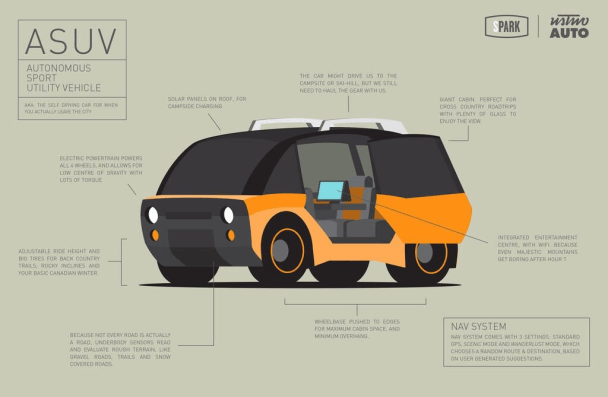
Love this: Artist renderings that are much closer to my imaginings of rethinking vehicle design for AVs than we are seeing from the auto companies. Definitely take a look at those! Image #6 is my personal favorite. Images posted here are all from those renderings.

Shared ride options for all getting closer

GM in California - more than doubles fleet of Cruise Automation vehicles. Now at 100 AVs.

Lyft partnerships with car companies to open up AV ridesourcing services.

Waymo full-scale AV ridesourcing operations to start in Phoenix area by early 2018.

AV ridesourcing for affluent older adults happening now in California. Voyage, a startup, is using Ford cars, to do just that in a gated senior community. Lots of opportunities in this market. More on the Voyage pilot.

Public shared-ride AV pilots

Publicly-funded A-Taxi, an AV shuttle ridesourcing pilot, is being planned for Greenville, SC (isn't that a state that does not believe in taxes?) with FHWA funds. The intent is to use these shuttles for commuter transportation for "to improve access to transportation for disadvantaged and mobility-impaired residents." That's why the public dollars. How progressive for South Carolina. Impressive. [Image source: muxxi]

Another publicly-funded experiment with AV shared-ride service will take place in Britain in Greenwich, with Ford and Transport for London (TfL) among a broader partnership. However, this project will only be planning a business model, with the assumption being that one-third of London trips in 2025 will be by AV.

Stuff you can do, but maybe shouldn't, in an AV - if allowed

If you own your AV, you will have more leeway, but if you are a shared-use or transit AV person in the future, I imagine rules against:
  • Drinking too much alcohol - or any - while on board
  • Being obnoxiously drunk on a shared vehicle
  • Sex or even making out (tacky, though fun at the time)
  • Eating
  • Drinking anything but water (our rule in the station wagon when the kids were young)
  • Vomiting - try not to and use a bag
  • Watching or listening to anything without earphones or earbuds
  • Screaming
  • Singing, unless there is a 0-5 year old involved (in which case, I recommend singing Wheels on the Bus)
Stuff that should be allowed to roll right onto AVs when they are universally designed
  • Wheelchairs and other mobility devices
  • Strollers, even double ones
  • Personal shopping carts
  • Luggage
I make this list with the assumption that only the wealthy will have personal attendants and that the rest of us will be in the same sorry position we are in as airline passengers, forced to deal with and lift heavy items instead of receiving personal service. [Image source: Ustwo]

Personal dream

AV tiny house to cruise across the country in style. 💚