Showing posts with label California. Show all posts

Friday, March 5, 2021

#3 Comments on Draft Strategic Plan on Accessible Transportation

We have 28 comments to the Draft Strategic Plan on Accessible Transportation and, now that the deadline has passed, I am grouping the rest into categories. In this post are two summaries of comments submitted by cities, in fact, the only cities to share their responses to the draft plan. People with disabilities live in every city, every county and every state. Yet the two comments submitted represent a mere two municipalities of any kind. According to the Census Bureau, there are just over 89,000 municipalities in the US.

Engagement ≠ Opportunity, Engagement = > Opportunity

I would guess that accessibility is important to every city and town. Indeed I am certain that many city mayors and staff would agree. But I wonder that many lack the staff to monitor Federal Register notices, which is a nice public engagement tool if you are from the 19th century rather than the 21st century. To be fair, the Federal Register does allow one to monitor notices with keywords of one's choice, which prompts an email to be sent every time those keywords appear in any kind of notice. 


So maybe it isn't the opportunity itself that is hidden, but the Federal Register doesn't actively reach out to stakeholders on any particular topic. That falls to whomever wishes to do so, mainly non-profit advocacy groups that are themselves stretched thin. Advice to those advocacy groups representing people with disabilities: Do better outreach for comment submitting campaigns. I will be having a post on that topic at some point. 

I am guessing that any city responding to the draft plan is going to come out in favor of expanding accessibility because it would be like opposing apple pie to say otherwise, at least publicly. This guess turns out to be correct, but these cities that have submitted comments are offering concrete guidance about routes to that end.


Comment from Portland Bureau of Transportation

This comment is from PBOT, the Bureau of Transportation in Portland, OR. Portland suggests engaging municipalities more to expand accessibility through city accessibility plans. "State ADA Transition Plans focus on state highways, which in many cases, run through cities and operate as city streets, but only as a small part of a city’s transportation system. A much bigger impact to accessibility can be accomplished by implementation of city ADA Transition Plans."

In case you are unaware, different streets have different designations. In my state of Maryland, any main thoroughfare is a state road, with some county roads, and then local roads. This really messes with local control and becomes even worse in those states where state legislatures and governors are very anti-city, notably Texas. The letter explains, "City transition plans focus entirely on transportation system elements: streets, sidewalks, pedestrian signals, transit stops, accessible parking, and curb ramps that are used by pedestrians every day. Implementing these plans will get people to school, work, medical appointments, the market, and provide opportunities for healthy activities like biking, running, and walking." 

Quite rightly, PBOT points out that despite the 30-year-old Americans with Disabilities Act (ADA), there is much to be done to fulfill its mandate. PBOT suggests an economic stimulus that includes implementation of local accessibility plans, with opportunities given to historically underrepresented contractors (such as minority-owned businesses).

In terms of guidance, PBOT asks for advice concerning service animals on public transit and on shared on-demand transportation, such as taxis. 

I am going to be a bit critical here, not of the comment itself, but of affixing the equivalent of a bunch of sticky notes to the source document. Yes, this "comment" is actually notes thrown on the margins of the draft plan. Harumph. 😠


The comment requests funding increases or creation of funding to increase geographic equity beyond rural areas by expanding accessibility in underserved neighborhoods; and funding to support complaint processing to enforce the ADA, thus decreasing backlogs and processing time.

San Diego suggests national standards and technical assistance for several aspects of broadening accessibility, specifically requesting: 
  • Design guidelines for the right of way
  • Development of national standards of accessibility and training
  • Adoption of public rights-of-way accessibility guidelines (PROWAG)
  • Outreach and education about ADA enforcement for people with disabilities
Sidewalks are another area of concern. San Diego is argues in favor of adding sidewalk maintenance to the list of barriers to accessibility and including sidewalk design to the necessary steps to accessibility.

On another note


Thinking of topics of history that can guide us - positively or negatively - toward a better transportation future. Pondering a podcast about these. Feel free to send a note via LinkedIn, email or twitter - @DriverlessRev or at grossglaser@gmail.com. Whatever.

  • Roman roads/early American roads
  • Union Stations
  • History of Braille 
  • Rebuilding of DC Union Station
  • Polio and the ADA
  • Disappearance of streetcars 
  • History of the American suburb and racism
  • Transportation in the Constitution
  • Why Isn't there a DC subway station in Georgetown?
  • Thriving Buses in the Midwest
  • Rural versus Urban in Colonial and Early America 
  • History of planning and why we elevate public meetings

Tuesday, March 12, 2019

AV State Laws Passed From 2018 to Present

I was wondering recently what has been the trajectory in terms of state laws passed in the post-2016-17 heyday of perfectly safe AVs will soon be here! The killing - yes, killing - of Elaine Herzberg on Mar. 18, 2018, with a combination of unsafe pedestrian infrastructure and Uber's hubris was a major dump of cold water on a free pass for lenient AV legislation. Ms Herzberg did not die in vain; state legislatures slowed down considerably.

This slowdown did not mean inaction. In the last year, two types of state laws have become popular: those mandating AV studies and those allowing for truck platooning. Please note that the source for most the provisions discussed below is the set of links from the National Conference of State Legislatures (NCSL) webpage that houses a list of enacted state laws dealing with autonomous vehicles, and some independent research.

I have no idea how much trucking trade associations and companies are paying for lobbying at the federal level, but they have quietly infiltrated state legislatures and, without fanfare, accomplished the passage of platooning bills in many states.

There are a few exceptions in terms of topics among the 2018 and 2019 statutes, which are explained below.

Another reason for a slowdown and look around among state legislators is the anticipation that the US Congress will act and that it needs to act. There is limited authority to among states to regulate vehicles anyway. What I find most interesting in the passage of recent state laws is the diversity among the "Let's study this" laws as to what is actually being pondered and examined.

Study and report

Maine requires state government agency participation related to aging and people with disabilities,  and participation of a non-profit transit provider.

New York requires that its second annual AV report, in 2019, be from the Commissioner of Motor Vehicles.

Oregon's task force is mandated to include representatives from transit, the taxi industry, and transportation unions, as well as the usual AV, cybersecurity, and insurance industry representation, among others. The study topics go beyond those routinely mentioned in such legislation, with land use, transit, and infrastructure design among the specified long-term topics.

Pennsylvania requires transit participation and either pedestrian or biking participation on its advisory committee.

Washington State has created a work group that is tasked with reporting annually and which is set to expire in 2023. The work group is made up solely of state officials and legislators. The net that the work group is required to cast is broad in that it includes examination of AV social impacts, among other topics, and the task force is legislatively mandated to engage stakeholders and the public.

Washington, District of Columbia (DC) has an impossible legislative search system, so I did a Google search for the name of the legislation. The legislative text (link gives you a Word document) authorizes an expansive AV study, but it does not restrict or discuss who specifically (or their designees) will serve on any committee to research and consider AV laws, regulations, and possible impacts. The District Department of Transportation (DDOT) is required to produce a study that will be made publicly available by July 1, 2019. The DDOT study must consider many of the usual AV study topics, as well as public space and public health, safety of pedestrians and bicyclists, various transportation modes - "including mass transit, shared-use vehicles, and public and private vehicles-for-hire" - and the "impact on the District's disability community."


Platooning

Alabama allows for truck platooning, offers a definition, and authorizes its state Department of Transportation to regulate. Alabama does not appear on the studies list because it passed a "thou shalt study and prepare a report" law in 2016.

Indiana platooning law is not limited to trucks.

Kentucky requires that a proposed plan be submitted to the state Department of Vehicle Regulation, which must approve before platooning is permitted; notification is required to be made to the state police.

Louisiana platooning is not permitted on two-lane roads.

Mississippi does not allow platooning on two-lane roads. Platooning must be also expressly approved by both the state department of transportation and the department of public safety after a "plan for approval of general platoon operations" is submitted.

Oregon does not use the term "platooning," instead calling it "connected automated braking system" and this term conceivably applies to any type of vehicle, not merely commercial vehicles or trucks, that is equipped with the appropriate technology.

Pennsylvania allows for platooning with military, bus, or motor carrier vehicles. Platooning vehicles must bear a visual mark. Platoons are limited to a maximum of three vehicles and each must have a driver on board. There's more, which means that platooning takes a considerable amount of lead time.

Utah has passed a platooning law. It is not limited to any particular type of vehicle. This is in addition to Utah's general AV law discussed below.

Wisconsin passed a simple platooning law. It is not limited to specific classes of vehicles.


Other

California statute allows law enforcement officers to remove an AV from a road if the vehicle does not possess a permit to operate as an AV on public roads within the state.

Another California law allows the City of San Francisco to impose a fee for every AV ridehailing or shared ride provided for a fare.

Nebraska general AV law: Requires that an AV be able to achieve on its own a minimal risk condition, but does not require proof or testing of such capability. Also explicitly allows for ridehailing, other shared-use AV commercial passenger transportation, and public transit. Preempts local regulation or taxes related to AVs.

New York specifies the coordination with the state police required prior to AV testing demonstrations in the Empire State. This is an update to a pretty restrictive AV statute passed in 2017. The 2018 law requires that a "law enforcement interaction plan shall be included as part of the demonstration and test application that includes information for law enforcement and first responders regarding how to interact with such a vehicle in emergency and traffic enforcement situations." The law also calls for a report to be written; see above for details about that.

Pennsylvania allows for automated work zone vehicles as part of its Turnpike Commission's road projects.

Utah's legislature just passed an AV law, awaiting the governor's signature, that:
  • Governs and allows for AV ridehailing 
  • AV registration requirement
  • Fully allows, for level 3 automation, whether with driver on board or a remote driver 
  • No license required for AV systems
  • Preemption of local government regulation of AVs 
  • Low speed vehicles have different rules. Defined as four passengers, including the driver or fallback operation, or less. BUT that human driver is permitted to be a remote operator. These vehicles have a maximum speed permitted of 25 mph.
It should be noted that Utah was an early state that studied AVs. Perhaps the state is a bellwether for others that are or have studied AVs and will then consider AV legislation.

Friday, December 14, 2018

AV constants: New Shuttle Pilots and Senate Bill in Play

AV transit on a roll

In the US, more medium-sized cities and suburbs have taken the lead on AV shuttles, notably ones without what this native New Yorker would call robust transit systems. That trend continues.

Providence, RIProvidence will be using cute AV shuttles from May Mobility for its AV pilot program, set to start in the spring of 2019. This is a Rhode Island DOT project. The shuttles will seat six passengers and will travel in a place that does not currently have a fixed route bus "and is being eyed for new development."

Columbus, OH: Columbus, Ohio, a pretty car-centric city with pockets of walkability, is working hard to become and to tout itself as a smart city. Now it has a cute AV shuttle for its downtown, where most people are driving to, that has a fixed route with four stops. This is another May Mobility coup and the vehicle is different than the usual cute shuttle. It looks like a cross between a car, which it is often called, and a shuttle. There's a separate driver area and then a passenger area with four seats that face each other.

True ambition lies elsewhere

Forget limiting AV thoughts to ridehailing and cute shuttle vehicles, Japan is thinking AV transit, as in BRT - bus rapid transit. After all, fixed route seems to make for easier AV programming and operations than even geofenced AV transportation. Also, why limit to 4, 10, or 15 passengers on a route that is better suited for 60 to get on board? Japan's Mobility Innovation Consortium, which includes several partners, the national railway company among them, is ready to test AV buses "to evaluate self-driving technologies for bus transit applications, including automated lane-maintenance control, speed control, parking assist, and alternating passage tests on JR East’s Bus Rapid Transit lines."

It's a long story, but suffice it to say that the 2011 earthquake and tsunami had a role in shifting from a rail line to BRT in the area being discussed.

Proceeding with caution is wise PR move

Yes, Waymo is permitted to send out AVs in Arizona without backup drivers. Instead this AV leader continues to use backup driver/safety engineers even in Arizona.

I've seen criticism of the decision to hold onto backup drivers. What's wrong with proceeding with caution? As a critic of companies that seek to innovate without taking responsibility for safety, I am glad to see Waymo continue to take baby steps.

Now in California, where Waymo is the only company allowed to operate AVs without a backup driver, Waymo has hosted public meetings in Silicon Valley, where it plans to expand testing of its AV cars. People with disabilities are showing up, actually the blind community, and so are seemingly affluent neighbors, some of whom are supportive of the technology and the company, while others remain skeptical. Honestly, it is difficult to tell from the news coverage where the local public opinion percentages fall on the spectrum from support to total NIMBY (not in my backyard).

Senate still mulling over recipe for safety vs innovation, as if they are opposite sides of the coin

An Uber internal memo warned of insufficient safety training, procedures, incentives, and enforcement right before the Arizona crash that killed Elaine Herzberg. The Uber employee who penned the memo sent it to top Uber executives and company lawyers. Perhaps a complaint to the bar of whatever states where those lawyers are licensed to practice law is in order. [Editor's note: Since I do not pay for The Information, which published the Uber memo, I have not read the actual words about the Uber employee's concerns.]

This leads me to chat for a moment about the AV START Act negotiations to make the bill palatable to its longtime opponents so that it can quickly pass by the end of the month, when the current Congress finishes its session. A major theme of the opposition is that government's role - in this case NHTSA - is to create an even and safe playing field for partially and fully AV technology. Proponents of the legislation do not want laws or regulations standing in the way of corporate and startup innovation.

Tell that to the family of Elaine Herzberg and the people who have perished in their expensive Teslas. The fact that Elon Musk can get away with his misleading statements about what is required of drivers operating one of his Autopilot cars is beyond me. Lawyers take note: That 60 Minutes interview of Musk is just one good piece of evidence against Tesla.

Watch at 12 minutes, 30 seconds into the interview to see Musk in the driver's seat - his hands are not on the wheel. He's having a conversation and his hands are resting in his lap.

Tesla and Elon Musk represent a perfect example of why we need government regulation. No one wants a corporation testing them in a potentially deadly game that involves a machine not designed to comport with human nature. Tesla owners might be willing to be test subjects, but not the rest of us. After the fact is too late, no matter how big the settlement. I much prefer having a government that makes sure that safety is assessed prior to sale and operation on public roads. We can't guarantee safety, but we can do way better than the roadway violence numbers we see on roads around the world.

Thursday, April 26, 2018

California Gets Into the Weeds, and Other States Continue Down Other Paths

Waymo has applied to the state of California for a permit to test completely autonomous vehicles (AV) - as in no human operator in the vehicle - on the state's public roads. So far, Waymo has no peers in applying for this top tier California AV operation permit. A post from Teslarati also reports that a second, unnamed, company applied, but that the application was incomplete. That makes one company out of 52 that already have obtained permission to test AVs with a driver. Consumer Watchdog is pressing the state to make the application process open to the public. This group has been the primary national voice for slowing down state and national permission to test and operate AVs and for restrictions.

California's new regulatory regime provides for testing and deployment of full-scale AV fleet operations of taxipods or shuttles zipping around its cities and suburbs or replacing rural vanpools. California is asking quite a bit of manufacturers that wish to test without human drivers, leveraging its geography as home base to Silicon Valley and a robust AV industry. I am not certain that a state or country without such a strong AV presence would be able to attract applicants for a permit otherwise.

Starts at level 3


Stays the same: For level 3 and above, California is allowing companies to continue AV testing with a driver, just continuing the regulatory regime of the past few years. Unlike many states, California requires:
A manufacturer conducting testing of autonomous vehicles on public roads shall maintain a training program for its autonomous vehicle test drivers and shall provide the department with a course outline and description of the autonomous vehicle test driver training program. 
This training will include"practical experience in recovering from hazardous driving scenarios." Not a job for me.

Completely human driverless testing: New Section 227.38 conceives of the empty AV and the AV with only passengers on public roads, but only for testing of a level 4 or 5 AV. Lots more information is required of the AV manufacturer for this higher-level permit. Among other requirements, the state will want to know where and when this testing is happening.

Remote operation capability required: Section 227.38 only permits AV operation without a human driver ready to take over IF there is a human somewhere who is tasked to remotely take over operation of the vehicle in case of emergency or failure.

A two -way communication link is required and the remote human must "continuously monitor" the vehicle. The applicant must provide a "description of how the manufacturer will monitor the communication link" of each of its AVs. Other requirements include, but are not limited to, a law enforcement interaction plan. I am uncertain whether this human, resembling the security guard who stares at security camera monitors for hours at a time, will be able to avoid distraction, boredom, and drowsiness.

Navya AV shuttle on Apr. 25 at University of Wisconsin-Madison campus.
There is quite a bit of information that must be included in a mandatory law enforcement plan so that law enforcement will be able to detect an AV, will be able to communicate with its remote operator, and will have the capability to safely remove such a vehicle from a roadway.

Oh, and the remote operators must be trained.

Not all about safety: First, presume no privacy in the information about your whereabouts, what you are doing in the vehicle, and what, if anything, you say. That's my advice. California is acting as if we are interested in the details. "The manufacturer shall disclose to any passenger in the vehicle that is not an employee, contractor, or designee of the manufacturer what personal information, if any, that may be collected about the passenger and how it will be used."

We'll all be clicking on I Agree to long privacy notices.

California continues to require collision and disengagement reports for all AVs.

The big kahuna - deployment: California has developed a separate application for the top tier of deployment of AVs. Remember that this includes level 3 vehicles that have backup drivers as well as AVs that can operate without a human operator on board.

California is requiring that AVs have event data recorders, which it calls an "autonomous technology data recorder," that are required to collect and store "autonomous technology sensor data for all vehicle functions that are controlled by the autonomous technology at least 30 seconds before a collision with another vehicle, person, or other object while the vehicle is operating in autonomous mode. The data captured and stored by the autonomous technology data recorder, in a read only format, must be capable of being accessed and retrieved by a commercially available tool."

Self-aware AVs only: 

Enthusiasm vs. prudence - prudence gets passing on the right in Uber/Tesla crash aftermath


Connecticut is on its way to implementing a law passed in 2018 that will only address a preliminary phase of AV testing and pilots. Towns and cities may apply to be testing areas, but only four will be selected. "Participating municipalities will have to enter into agreements with autonomous vehicle testers." Click here to view the requirements for city-corporate AV agreements and the application form for municipalities.

One report says that Stamford will be first to apply. No other cities or towns have been mentioned. My suggestion: AV shuttle for a New Haven pizza tour. Slices included.

There's a reason why New Hampshire is the Granite State. State legislators are reportedly resisting lobbying efforts to weaken its bill. These legislators are not quite ready for testing and full-scale deployment on any road at any time and with no conditions.

It is the conditions that are giving AV proponents cause for concern. "Test vehicles would have to be accompanied by escort vehicles, and the license could be revoked for violating the rules of the road." Other conditions include a larger bond than is usually required ($10 million instead of $5 million); notification to localities of where and when testing will occur; and law enforcement freedom to pull over an AV for vehicle code infractions.

Oh, and the bill, HB 314, requires:
Certification that, prior to testing on public roads, the autonomous vehicle has been tested under controlled conditions that simulate, as closely as practicable, the real world conditions that the autonomous vehicle will be subject to during testing.
No surprise that AV industry advocates are pushing for legislation that is more favorable for companies.

Nebraska puts out welcome mat

Nebraska just passed a very permissive law. Instead of passing its original bill, which provided for an AV pilot in Lincoln with four shuttle vehicles, the new law allows fully AVs to operate on public roads without a human driver present in the vehicle. The one unique aspect of Nebraska'a law is a concern about AV operations vis a vis railroad crossings.
The automated driving system feature, while engaged, shall be designed to operate within its operational design domain in compliance with the Nebraska Rules of the Road, including, but not limited to, safely negotiating railroad crossings, unless an exemption has been granted by the department. The department shall consult with the railroad companies operating in this state when considering an exemption that affects vehicle operations at railroad crossings.
Crashes must be reported. The law preempts local governments from imposing any requirements or restrictions. Nebraska seems to be giving a hell yes! green light to on-demand AV fleet operations, whether they be for ridehailing, transit, or any kind of microtransit.

More, but ...

There is more from Pennsylvania and Indiana, but this post is already way too long. Those will wait, though, like Lucy and Ethel on the speeded up chocolate factory assembly line, I don't have enough pockets or tabs to fit everything.

Wednesday, March 7, 2018

AV Ridehailing = 70s Brooklyn

The future has already happened and it is 1970s Brooklyn. Imagine a world with a subway system, lots of transit buses, taxis and car services. Car services were (maybe still are) these businesses that voila! produced a car - with a driver - within five minutes of when you called. No one ever had to drive.

Dads of high school students loved this because they did not have to get out of bed at some late hour to retrieve their kids. Of course, since we thought the drivers were creepy, we usually ended up sleeping over at friends' houses so that no one had to be the last kid in the car with the driver. My grandmother and her friends used the buses and car services to go everywhere.

Now the world is catching up. Soon everyone can achieve the nirvana of my hometown - except that it will not be so heavenly with a few big competitors and the permanent travails of lack of transit funding likely to continue. Here are some players that have announced on-the-street AV service to launch within the next few years.

Caveats - No word from any car manufacturer or AV technology company about AV ridehailing that will be accessible for people with disabilities. And that's another thing, these companies are all talking about cities, but no one is volunteering to serve rural communities or people with disabilities. Maybe we still are in the 1970s.

Uber is not waiting

Uber is already on the streets of San Francisco providing AV rides - but only for its self-driving staff. I wonder if there's a clause in the employee manual about relinquishing the right to sue. The rides, by the way, are free, so I'm not sure about applicability of federal or state laws or regulations when no money is changing hands and the ride is kind of, sort of, part of the job. Don't get too excited.
As is true for all self-driving vehicles on California public roads, the cars will have backup drivers. The Department of Motor Vehicles recently created a system for companies to test self-driving cars without backup drivers but has not yet issued permits for it.
No doubt Uber will be ready to submit one of those no-human-backup-driver permits.

Happening in China and Japan

Pony.ai is starting an AV ridehailing service in China. "its fleet is running a nearly two-mile route in Nansha, Guangzhou, where its China HQ is located."

Meanwhile in Japan, "Nissan and Japanese telecom company DeNA [started] a field test of driverless Easy Ride taxis ... on March 5, offering rides to passengers along a fixed 2.7-mile route between the Nissan headquarters and the Yokohama World Porters shopping center." The ridehailing service that is planned is not expected to be in operation until at least 2020.

Waymo  in 2019

Okay, the date is unspecified, but it looks like Arizona and California will see completely no-human-driver AV ridehailing service first. Waymo has partnered with MADD - Mothers Against Drunk Drivers - and groups representing seniors and people who are blind to join in an advertising campaign about the benefits of AV transportation.

Waymo's application to remove the human driver as backup has already been submitted in Arizona - and approved. Word is that ridehailing will begin in 2019. No date or locations have been announced.

GM date uncertain for heading to the big apple

News of GM bringing AV ridehailing to lower Manhattan in New York City is the product of good journalist digging. Tribeca Citizen, a neighborhood news source, looked into GM's leasing of office space and discovered that the party named in the lease is none other than "GM Cruise LLC, commonly referred to as Cruise or Cruise Automation." This follows Gov. Cuomo's announcement in October that GM will be doing testing in Manhattan at some unspecified 2018 date.

May Mobility goes for quick trip - shouldn't you walk? - market

May Mobility also scored a big win by getting Tampa's transit agency on board for a pilot with this newcomer AV producer's shuttle. Testing began this week and the pilot for regular riders will commence later in 2018.

Toyota and BMW are funding some May Mobility activity involving "plans to use the seed money to expand in Texas and Florida — states that don’t require a safety driver." This involves some one kilometer routes. Am I missing something or isn't that a short walk - unless we are talking inclement weather? Really inclement weather.

Tuesday, February 27, 2018

AV Shuttles in the Outback and US; MADD Partners

Yes, I will admit that to a native New Yorker, anything beyond Ohio, let alone Chicago, seems like the outback, but that is where AVs are taking hold first. By the way, I am simply being self-aware here and not proud of this mindset as I work with many lovely people across the US who see far prettier landscapes than I do everyday and live outside of the DC and NY bubbles.

Plus, we already have 12 mph vehicles in NYC; that's called regular traffic.

Australia

Perth has had a driverless shuttle for over a year and the Darwin Airport just had its own AV shuttle demo to ferry folks on airport grounds. This was the "EZ10 shuttle from Transdev and Easymile." However, this was only a two-day demonstration last week to show the wonders of new transportation technology and to get the conversation started.

Meanwhile, a suburb in Queensland, Australia, is planning for a totally AV system in a private area. Springfield - not the one in Illinois or Massachusetts - is a suburb of Ipswich and this week it is hosting an EasyMile AV shuttle demo.

Minneapolis wants another taste

Now that Minnesota had its first taste with an AV shuttle, this during the winter in downtown Minneapolis during Super Bowl week, the Minnesota Department of Transportation (MNDOT) is moving on demos elsewhere in its biggest city. ""I've ridden on the vehicle, and it feels a bit like the people-mover at the airport that runs between terminals," says [Hennepin] county transit director John Doan."

The Hennepin County Board just approved the idea for a demo in another location. That location is the Greenway, which advocates are touting as part of a route for another light rail line. The Greenway is a six-mile bike and pedestrian trail. "Driverless rides will be offered over a weekend in April. They'll take place along a 2-3 block stretch." Rides will be fare free.

FYI: If you go out to Minneapolis to ride an AV shuttle, take the time to go have pancakes at Mickey's Diner in St. Paul. The place is tiny, so get there early or on the very late side.

One more FYI: I know John Doan and he heads up Mobility 4 All, which is advocating for accessible AVs for people with disabilities. Mobility 4 All is a partner in the Self-Driving Coalition for Safer Streets.

Even the Marines

A Marine Corps air station in California is planning for AV routes, as in real service, on a sprawling base in Miramar, CA. "Two routes on the air station, a “rural” and “urban” route, will provide opportunities for stakeholders to initiate autonomous vehicle testing and development projects. The rural route is located on East Miramar where autonomous vehicle technology testing began early February 2018."

The AVs will be vans and they will also be part of a connected vehicle project.

Buffalo university buys a shuttle

The state university of New York campus at Buffalo has purchased an Olli with help from the NYS DOT and the NYS Energy and Research Development Authority. The Olli, a product of Local Motors, will be used on campus for first-mile/last-mile service to and from public transit. Service is not set to begin until at least the end of April.

Public good case for AVs

MADD and Velodyne Lidar have entered into a partnership to do something unspecified for the cause of getting humans away from the steering wheel.
To fulfill this vision, Velodyne and MADD have adopted the shared mission of promoting and advancing Autonomous Vehicle technology with the singular goal of getting you and your loved ones home – safely. The Designated Driver of the future is Velodyne LiDAR. Velodyne LiDAR will never be drunk, drugged, distracted, or even drowsy.
Following the press release, I have not seen anything more detailed.

MADD is an easy partner because unlike advocacy groups for people with disabilities, MADD's push to transport drunk and tipsy people - who seem to greatly overestimate their ability to drive under the influence of alcohol (or other substances) - without having them drive does not require any accessible equipment or interfaces.

And if I sound snarky, I do not mean to. I have known a few people who have been killed in car crashes and I have seen a dear friend try to rebuild her life after her son's death. My father's best friend was killed by a drunk driver. Already two young adults from my daughter's high school class have been killed on US roads. I applaud MADD for encouraging AV technology.

Velodyne is supplying lidar technology to Ford, Volvo, Baidu, Mercedes and other companies, according to the Velodyne Lidar homepage. MADD is a partner in the Self-Driving Coalition for Safer Streets.

Thursday, October 19, 2017

AV Designs - California and England

Sacramento wants autonomous vehicle (AV) demonstrations routes to include the entire city, but there is no concrete plan in place. The owner of the Sacramento Kings professional basketball team had made attempts to ferry attendees of the first home game of the NBA season in AVs, but the arrangement fell through.

The chief innovation officer, an increasingly common business title around the US, for Sacramento says that "plans are still in place however to bring autonomous technology to the area for testing and implementation." This is a priority for the mayor and the city is in discussions with lots of AV companies, though only car companies and others testing AV cars are listed in the Capital Public Radio news piece.

Maybe AVs will help the Kings. Their record so far this season, only one game in, is zero wins and one loss, to the Houston Rockets.

Sleek design

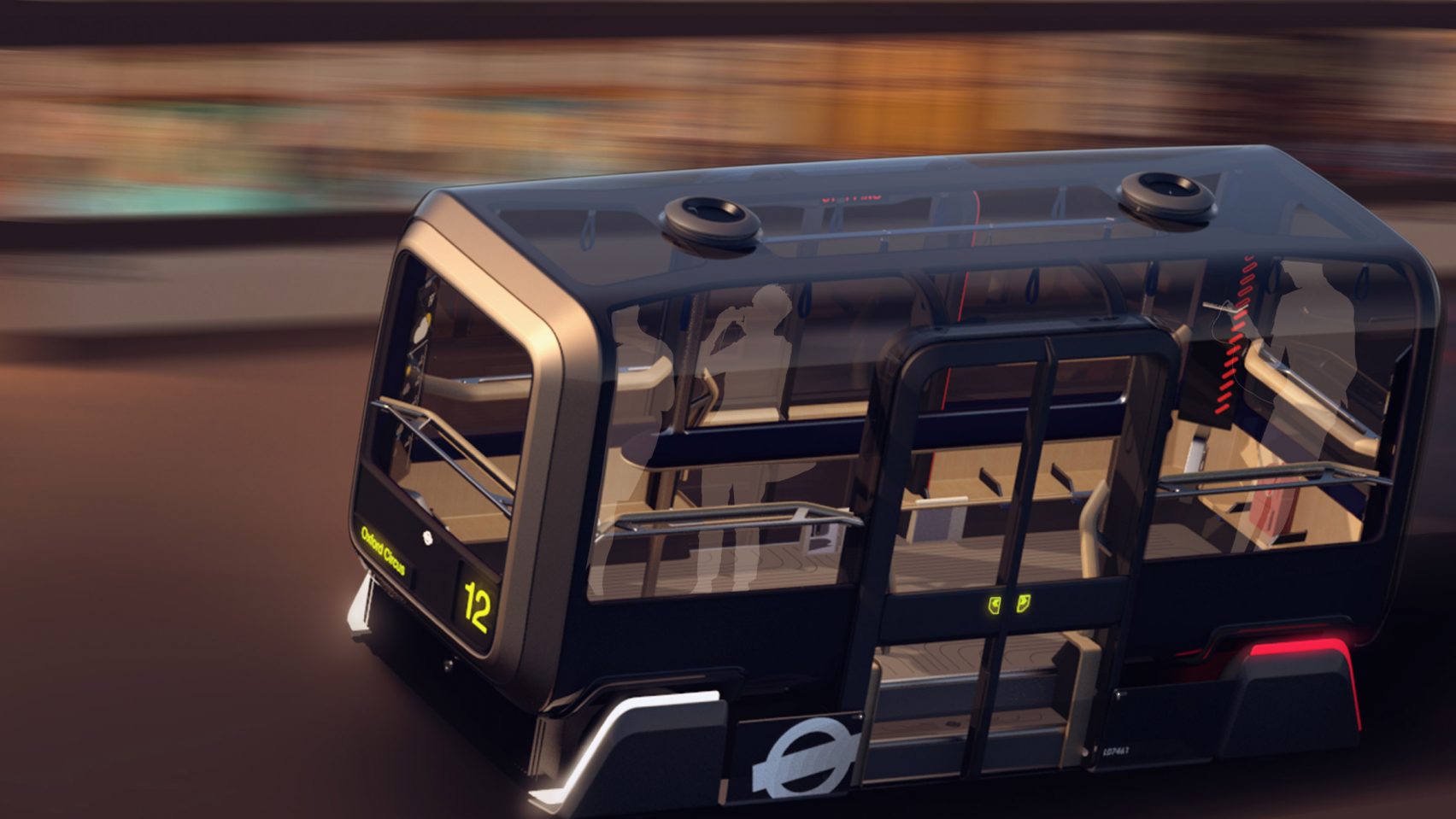
Image from dezeen.com
In AV transit news, a polished design, full of windows, comes from the United Kingdom, well England. Transit designer Jonny Culkin imagines a world with views of city surroundings. "Described by Culkin as 'technology with a friendly face," the conceptual vehicle is designed to offer a more attractive alternative to London's Tube, as well as the city's bus networks.' " Notice the sleek, minimalist interior.

No word on whether this design will be adopted or whether Transport for London or any other UK transit agency is planning on supplementing big red buses - AV or otherwise - with small shuttle vehicles.

Thursday, October 12, 2017

Ads and Private Roads

Appealing to  people with money, autonomous vehicle (AV) businesses are showing the expectation of massive wealth generation to come. First, the LeBron James ad. A major sports figure who has garnered three professional basketball championships, James does not come cheap; he is popular and credible.

The sponsor of the advertisement is Intel, reports the New York Post.

Way different

On the other hand, the Waymo video takes the slick, but friendly, corporate-speak ad approach. Both ads seek the same result: A message of friendliness, safety, attractiveness, and reliability - without reference to cost, equity, and related aspects of a multimodal transportation network.


Already serving private roads

The AV transportation revolution is happening, but not in the usual places. Not San Francisco, New York, Seattle, London, or elsewhere. Private roads in gated communities and campuses are the new frontier.

I covered the Village last week. In that California gated senior community, app-based, on-demand, shared-use AVs are ferrying older adults around. That news got lots of press attention. Called the Voyage, the two AV sedans operate on private roads within the community.

In the other sunshine state

Across the country, Babcock Ranch, a development I wrote about last year (scroll down), has gone beyond plans, and has AV shuttle service on its private roads. This is a transit-like vehicle and is probably the first of a network of AV options. The development is billed as allowing for a car-free and walk-and-bike-friendly existence for 50,000 people. Transdev is planning a Mobility as a Service (MaaS) network of AV transportation services. The new development is also solar powered.

Don't confuse Babcock Ranch with Bishop Ranch, which is an office park in California that also has an AV shuttle.

Public planning

Not to be outdone, affluent small towns are beginning to plan. Aspen, CO, wants to establish a Mobility Lab. This will mean a transportation demand management (TDM), or mobility management, approach to transportation transformation.

And public streets in California may soon boast AVs being tested without humans on board for that matter. Proposed regulations await the current notice-and-comment period. 

Thursday, August 17, 2017

Transit Pulling Ahead

Reading the news on autonomous vehicles (AVs), everyday I am seeing more shared-use, transit, and transit-like AVs. These pilot programs are spreading quickly. Slow, fixed-route - or limited radius - AV shuttles have captured the imagination of places in the United States that are (1) NOT our major cities, meaning places without strong transit unions, and (2) NOT transit rich. Indeed, in at least one spot, AV shuttles will used to ferry people to and from parking lots.

Most of the AV shuttles are manufactured by Navya and EasyMile, though there are other companies in the game and some homegrown, usually university-developed, shuttle vehicles.

Down under, over to Far East, and towards the West

Perth, Australia has an AV transit shuttle service - open to the public - that just turned one year old. The Navya shuttle, called Arma, operates on public roads. The shuttle reads signs and turns right. Unlike human drivers, it regularly improves due to software upgrades. [See photo.]

Singapore will have AV ridehailing in mid-2018 via a partnership with nuTonomy. Unknown is whether a local ride hailing company will be involved. This city-state is already ahead of the curve on AV testing and is currently well in the lead in terms of AV-related urban planning. (Lots more on that topic in a blog post soon.)

Helsinki, Finland has an AV shuttle as a regular service - NOT a pilot project. Finland's pilots have used the EasyMile EZ10 for AV service and that tradition continues with the Helsinki shuttle.

Tallinn, Estonia recently saw the end of a month-long AV transit shuttle pilot that was open to the public. This project also used EasyMile vehicles. There are already plans to bring the AV transit option back to Estonia, but next time to a different city and not until next summer. A leading Estonian transportation official is pushing for Estonia to move forward with AVs generally.

Go west young shuttle

Michigan: Ann Arbor, home of Big Ten school University of Michigan (UM) and the MCity AV testing facility (and not far from the American Center for Mobility testing facility in Ypsilanti, Michagan) is about to host an AV shuttle on a two-mile route between engineering buildings at UM's North Campus. The shuttle vehicles are manufactured by Navya and they carry up to 15 passengers. Rides will be fare free and the AV shuttle will operate during the university's business hours (not intended for late-night studying or as a drunk bus).

Texas 

Texas A&M has a homegrown AV shuttle on campus for Howdy Week. The plan is to have 15 of these shuttles in operation by the end of the spring semester, meaning by May.
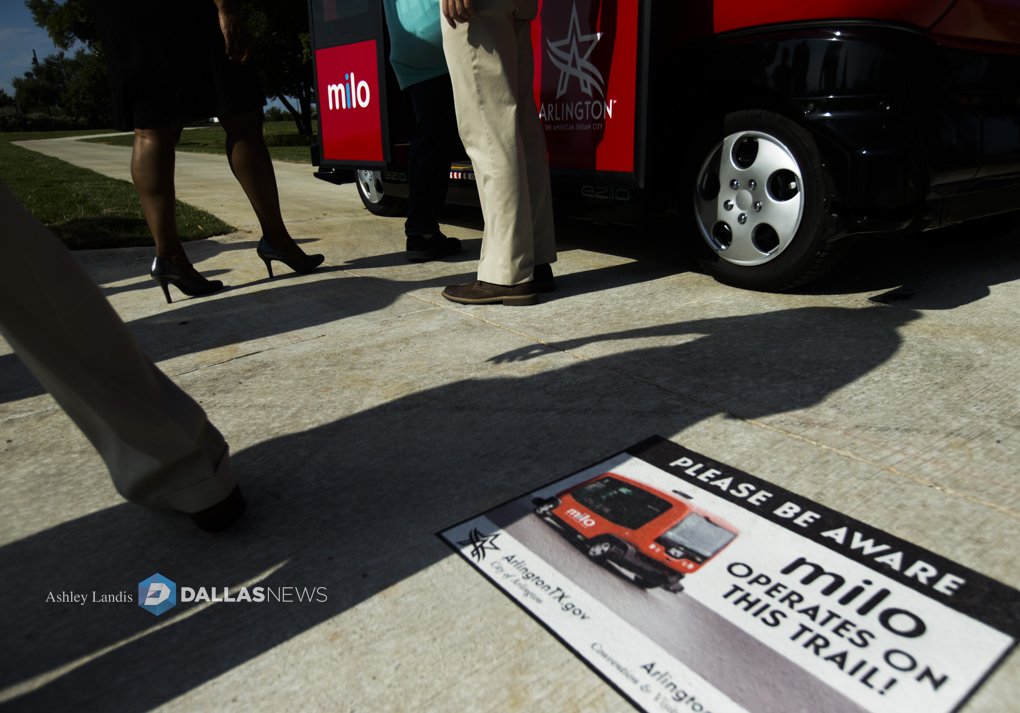
Arlington, Texas  has a pilot AV shuttle program that began on Aug. 26 and will continue through mid-2018. The shuttle will provide AV transportation around the Arlington entertainment district and to Texas Rangers and Dallas Cowboys games on game days and when concerts and other events are held. EasyMile shuttle vehicles will be used. Arlington is already considering expanding the use of AV transit shuttles beyond the pilot project. The vehicles hold 12 passengers, according to one enthusiastic report.

California

San Jose Airport is testing an EasyMile shuttle vehicle and hopes to use it for ferrying travelers and workers around the airport. The wish list includes an AV shuttle to transit and a dedicated lane on public roads. A local article about the project does a nice job of explaining the huge quality-of-life implications for people with disabilities and older adults.

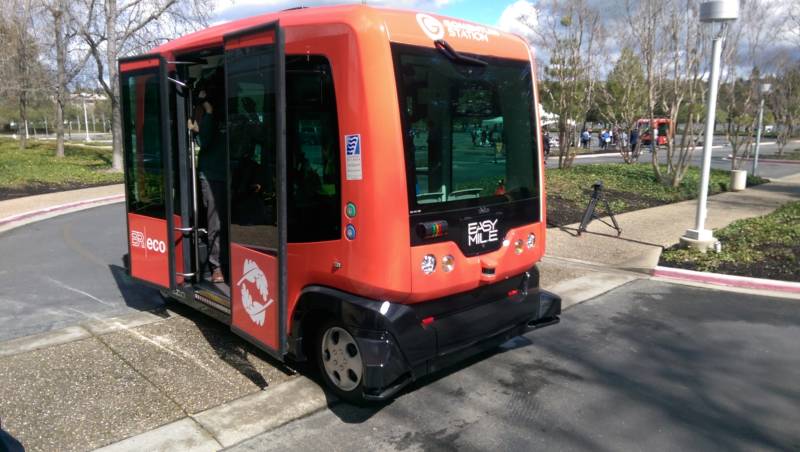
San Ramon, CA, home of the Bishop Ranch office campus has an AV shuttle pilot program that is designed for ferrying office workers.  The AV shuttle became a local celebrity when it was featured as the grand marshal of the Concord, CA, July 4th paradeEasyMile shuttle vehicles are being used.

Apple is floating the idea of an AV shuttle for employees. No word on timing or which company will be supplying the shuttles.

Colorado: Denver's transit system is planning for cute AV shuttles for first and last mile connection to transit. RTD, the transit agency, was testing the EasyMile EZ10 in a giant parking lot. If you watch the video, just note that the snarky New Yorker reaction is that unless this vehicle has a dedicated lane or a built-in "oh no you don't" feature, in a busy city pedestrians will eating this adorable vehicle for lunch. You cannot combine a courteous, safe vehicle with a nasty, walking Brooklynite.

MaaS on the menu - tea leaf of expected profitable service

None other than Ernst & Young (really called EY), a large multinational accounting firm, has developed a Blockchain platform, called Tesseract, for managing fleets of AVs. The firm sees mobility as a service - or MaaS - somewhere on the expected horizon. From what I understand, which is little, about Blockchain, also used for bitcoin transactions, it is nearly unhackable and it is instantaneous. Evidently, EY sees money in this and has confidence that MaaS will emerge with sharing of different types of AVs, and differently-owned vehicles.

People with disabilities: AV transportation equity

Australia, like the US, a country of long distances, has a company about to pilot AV pods for older adults. Called Pod Zero, and manufactured by UK-based company RDM Autonomous, the pilot will only offer transportation on local roads within some elder communities owned by IRT, an Australian company. (For you older New Yorkers or subway history buffs, this company appears to have no relation to IRT train lines, such as the 1, 2, 3, 4, 5, and 6.) According to RDM, Pod Zero "is currently built in two variants – four-seater and eight-seater – and offers an operating speed up to 15 mph, multiple battery options up to eight hours or 50 miles, wheelchair accessibility and air conditioning."

Pod Zero will launch in November at an aging and information technology conference.

Autonomous wheelchairs are being tested and plans so far are for use in hospitals and airports. Though this wheelchair comes out of MIT research, the pilots are in Singapore and Japan.

Fare free for a price

Under the category "you get what you pay for," ideas for how businesses will make money off of AV transportation are growing. One idea floating around is that AV service, perhaps shared-use ridehailining trips, will be free - actually "sponsored" - by a local business, maybe a restaurant that wants your patronage. Other ideas revolve around fare free because transportation will be a cheap perk to deliver in exchange for valuable data. Sorry, forgot to get a link for this.

OMG, can't believe someone just said this - try being in a wheelchair for a few days

Below is a quote from a Mother Jones post that shows how people totally do not get the need for accessibility. It's as if the writer and like-minded individuals assume that all people with disabilities have extra cash to pay for personal service and that they don't deserve transportation equity. I agree with the point of the post, to not let the perfect be the enemy of the good, BUT people with mobility challenges - by they mothers with strollers or grandfathers with wheelchairs or cousins with intellectual disabilities, should not have to continue to be second-class transportation citizens. (I include the mother because so many parents develop back problems during the car-seat years. Why can't we have cars in which you can just roll in a stroller?)
No, we don’t need to deal with the problem of seniors and disabled passengers before it becomes an issue. Why would we? The market will almost certainly take care of this. Maybe companies will spring up that maintain human drivers, or that offer to have a human accompany the car to help you load your luggage or get your wheelchair into the trunk. Maybe driverless taxi companies will include this as an option. Or something. This is a no-brainer. [Emphasis added.]
So if you are an affluent person with a disability, no worries. But if you can't afford to pay twice as much for transportation or if you do not want to permanently be stuck at home, sorry. OMG, bad attitude. Maybe it's time to expand the Americans with Disabilities Act to comprehensively include all for-hire and private vehicle transportation. This just gets too hard for anyone marginalized just because he or she uses a wheelchair.