Showing posts with label Uber. Show all posts

Friday, January 11, 2019

Lots of AV Reports, But Little on Accessibility

Automated vehicle (AV) development is not just about the technology that would allow for driver-free operation. AVs are partly advancing under the assumption that they will be electronic - EVs - and connected - CVs or CAVs. On the other hand, most of the legal studies and policy development is mode neutral and either gives lip service to, or ignores, people with disabilities. Accessibility embedded in the interfaces and the vehicles - whether for the benefit of people with disabilities, people with strollers, or people with luggage and grocery carts - is left out of the equation.

Considering that the touting of AVs highlights how wonderful they would be for current transportation-challenged populations, little ink or anything else has been spilled, so to speak, to guarantee that this promise will be fulfilled.

What do we mean by accessibility?


I will defer to the Consortium for Citizens with Disabilities (CCD) about their standard for accessibility in the context of AVs, taken from the CCD Task Force Autonomous Vehicle Principles.
AVs have the potential to drastically improve access for people with disabilities, including members of the blind and low vision, Deaf and hard of hearing, intellectual, developmental and cognitive disability communities, people with physical disabilities, including wheelchair users, and people with neurological conditions including epilepsy and seizure disorders. However, the promise and safety of AVs will only be realized if the vehicles and the surrounding infrastructure are fully accessible, and the safety elements consider the needs of people with disabilities
The CCD recommendations that particularly pertain to people with disabilities include:
  • Accessibility of human-machine interfaces,
  • AVs with lifts, ramps, and wheelchair securements,
  • No requirement of an operator on board who is licensed,
  • AV transit and pedestrian infrastructure that complies with the "Americans with Disabilities Act (ADA) accessibility requirements must be strictly adhered to in order for cities and states to work towards meeting goals of zero traffic deaths and serious injuries,"
  • An ADA or expansion that mandates "full accessibility for all types of common and public use AVs,"
  • "[L]egislation requiring that, as a matter of civil rights, all new technology incorporate the needs of people with disabilities at the earliest possible point, and 
  • "Congress should require that people with disabilities are part of the design and testing of new technologies in order to ensure the accessibility and usability of the technology." 
There is more, but you get the picture. Unfortunately, little or no mention of this sizable sector of the population and their needs is mentioned in reports about AVs. These reports, whatever they examine, are focused elsewhere.

Statements without supporting details


Two recent reports mention or refer vaguely to people with disabilities, but offer nothing more. These are the Human Factors and Ergonomics Society (HFES) Policy Statement on Autonomous and Semiautonomous Vehicles (Approved Sept. 30, 2018) and the Transportation Research Board (TRB) Forum on Preparing for Automated Vehicles and Shared Mobility (Sept. 2018). The HFES policy statement says: "Fully autonomous vehicles should accomodate people with disabilities." The document, while brief at five pages, mostly looks at safety; accessibility is not one of its main concerns. The TRB forum speaks globally about research needs that go from data to safety to business models for AV deployment, but it never uses the word accessibility. It mentions a research need addressing equity and another addressing "[h]ow best to serve those with special needs."

The Idaho 2018 Report to the Governor (Nov. 2018) from the Autonomous and Connected Vehicle Testing and Deployment Committee, like the Wisconsin Report of theGovernor’s Steering CommitteeonAutonomous and Connected VehicleTesting and Deployment, never uses any version of the word accessibility. The Wisconsin report does mention "underserved populations" and both address all users of the roadway, specifically including bicyclists and pedestrians. The Washington State Transportation Commission Autonomous Vehicle Work Group, like its counterparts in other states, is looking at AV developments from such a mode-neutral perspective that there is no weighing or consideration of how to steer AVs to serve everyone better and how to include people with disabilities in the next iteration of our transportation system.

State and other AV-related task forces typically examine insurance, licensing, registration, definitions, liability, and responsibility for maintenance. Maybe they consider policing and roadway management.

A whole different approach comes from the Scottish Law Commission, which produced a comprehensive paper - Automated Vehicles: A joint preliminary consultation paper (Nov. 8, 2018). It discusses both fully and partially AVs in terms of operations, reaching minimal risk condition, and liability. It explores different ways transportation is and could be delivered, including Mobility as a Service (MaaS). BUT, in terms of accessibility and providing an equitable transportation system to people with disabilities, nothing in the report goes beyond bare statements. We are talking lip service.

And the private sector?


The private sector is not rushing to provide accessibility - with the exception of Local Motors and others that aim to provide transit shuttle vehicles. And that would be current ADA accessibility that is not self-enforcing (as many lawsuits to enforce it demonstrate). But for taxi-like ridehailing service, no one is jumping up with any promises. Take Uber; in its report, A Principle Approach to Safety (Nov. 2, 2018), the only words related to transportation-challenged populations were these.
More equitable than existing transportation options 
Shared, automated mobility can work to extend the reach of public transit and bridge the first/last mile gap in areas typically underserved by transit systems, and for certain populations like people with disabilities, youth, and seniors. 
Aspirational, yes, but, as my mother used to say, that and (now) $2.75 will get you on the subway. $3 if you buy a single ride ticket. Referring, of course, to NYC, my mother's sole frame of reference.

Anxiety, of course, because lip service is not enough


My worry, and certainly the fear of the disability community (and some in the older adult community), is that lack of a mandate and/or concerted effort to embed accessibility now - during development of AVs and infrastructure (virtual and real) to support them - will put us in the same situation we were in, and in some respects continue to inhabit, which is attempting to retrofit a very inaccessible transportation system for people who are not the norm. The Americans with Disabilities Act (ADA) was a good first step almost 30 years ago, but, in any place without fabulous transit and even there (think elevators to subways in New York City and San Fransisco), people with disabilities continue to be second-class transportation citizens.

With the current House, Senate, and Administration, no one is pushing for ADA 2.0. If anything, there is fear of accessibility retrenchment. At three weeks into a government shutdown, one begins to wonder whether the dream of bipartisan action on infrastructure and transportation can even happen. Any progress is happening in large cities, such as Boston and New York, which are taking to heart transit accessibility concerns and commitments. (Sorry for the lack of links here.)

From the Navy Yard - possible home run hit right before the shutdown


The USDOT building in Washington, DC, is barely a walk away from the DC major league baseball stadium. That US agency building, which spans two large city blocks, was, hours before the government closed up, the site of a hopeful development that AVs will serve everyone. I imagine a government employee, in the dark, hovering over his or her computer in a rush to click "upload" before the shutdown announcement to step away from the building and all government-funded devices.

The Notice of Funding Opportunity - or NOFO, in acronym land - issued from the US Department of Transportation just a few hours before the government shutdown, expresses a commitment to transportation-challenged populations in general and to people with disabilities and older adults in particular. One of the prime goals of the USDOT project - entitled Automated Driving System (ADS) Demonstration Grants - is to "fund projects that test applications with the greatest potential to service transportation-challenged populations, including older adults and individuals with disabilities.” Additionally, "Each demonstration must include input/output user interfaces on the ADS [automated driving system] and related applications that are accessible and allow users with varied abilities to input a new destination or communicate route information and to access information generated by the ADS.”

The deadline for proposed demonstration projects is Mar. 21, 2019 - assuming that the federal government is back to work by then.

Friday, December 14, 2018

AV constants: New Shuttle Pilots and Senate Bill in Play

AV transit on a roll

In the US, more medium-sized cities and suburbs have taken the lead on AV shuttles, notably ones without what this native New Yorker would call robust transit systems. That trend continues.

Providence, RIProvidence will be using cute AV shuttles from May Mobility for its AV pilot program, set to start in the spring of 2019. This is a Rhode Island DOT project. The shuttles will seat six passengers and will travel in a place that does not currently have a fixed route bus "and is being eyed for new development."

Columbus, OH: Columbus, Ohio, a pretty car-centric city with pockets of walkability, is working hard to become and to tout itself as a smart city. Now it has a cute AV shuttle for its downtown, where most people are driving to, that has a fixed route with four stops. This is another May Mobility coup and the vehicle is different than the usual cute shuttle. It looks like a cross between a car, which it is often called, and a shuttle. There's a separate driver area and then a passenger area with four seats that face each other.

True ambition lies elsewhere

Forget limiting AV thoughts to ridehailing and cute shuttle vehicles, Japan is thinking AV transit, as in BRT - bus rapid transit. After all, fixed route seems to make for easier AV programming and operations than even geofenced AV transportation. Also, why limit to 4, 10, or 15 passengers on a route that is better suited for 60 to get on board? Japan's Mobility Innovation Consortium, which includes several partners, the national railway company among them, is ready to test AV buses "to evaluate self-driving technologies for bus transit applications, including automated lane-maintenance control, speed control, parking assist, and alternating passage tests on JR East’s Bus Rapid Transit lines."

It's a long story, but suffice it to say that the 2011 earthquake and tsunami had a role in shifting from a rail line to BRT in the area being discussed.

Proceeding with caution is wise PR move

Yes, Waymo is permitted to send out AVs in Arizona without backup drivers. Instead this AV leader continues to use backup driver/safety engineers even in Arizona.

I've seen criticism of the decision to hold onto backup drivers. What's wrong with proceeding with caution? As a critic of companies that seek to innovate without taking responsibility for safety, I am glad to see Waymo continue to take baby steps.

Now in California, where Waymo is the only company allowed to operate AVs without a backup driver, Waymo has hosted public meetings in Silicon Valley, where it plans to expand testing of its AV cars. People with disabilities are showing up, actually the blind community, and so are seemingly affluent neighbors, some of whom are supportive of the technology and the company, while others remain skeptical. Honestly, it is difficult to tell from the news coverage where the local public opinion percentages fall on the spectrum from support to total NIMBY (not in my backyard).

Senate still mulling over recipe for safety vs innovation, as if they are opposite sides of the coin

An Uber internal memo warned of insufficient safety training, procedures, incentives, and enforcement right before the Arizona crash that killed Elaine Herzberg. The Uber employee who penned the memo sent it to top Uber executives and company lawyers. Perhaps a complaint to the bar of whatever states where those lawyers are licensed to practice law is in order. [Editor's note: Since I do not pay for The Information, which published the Uber memo, I have not read the actual words about the Uber employee's concerns.]

This leads me to chat for a moment about the AV START Act negotiations to make the bill palatable to its longtime opponents so that it can quickly pass by the end of the month, when the current Congress finishes its session. A major theme of the opposition is that government's role - in this case NHTSA - is to create an even and safe playing field for partially and fully AV technology. Proponents of the legislation do not want laws or regulations standing in the way of corporate and startup innovation.

Tell that to the family of Elaine Herzberg and the people who have perished in their expensive Teslas. The fact that Elon Musk can get away with his misleading statements about what is required of drivers operating one of his Autopilot cars is beyond me. Lawyers take note: That 60 Minutes interview of Musk is just one good piece of evidence against Tesla.

Watch at 12 minutes, 30 seconds into the interview to see Musk in the driver's seat - his hands are not on the wheel. He's having a conversation and his hands are resting in his lap.

Tesla and Elon Musk represent a perfect example of why we need government regulation. No one wants a corporation testing them in a potentially deadly game that involves a machine not designed to comport with human nature. Tesla owners might be willing to be test subjects, but not the rest of us. After the fact is too late, no matter how big the settlement. I much prefer having a government that makes sure that safety is assessed prior to sale and operation on public roads. We can't guarantee safety, but we can do way better than the roadway violence numbers we see on roads around the world.

Friday, May 25, 2018

In the Weeds on NTSB Uber Report and House Hearing

What I Learned This Week


We may be a society of social media images, tweets, and sound bytes BUT there is much to be learned when you get into the weeds of something that most people, even professionals, do not have time for. On today's menu is the NTSB preliminary report on THE Uber crash and the Congressional hearing about insurance and business models for autonomous vehicles (AVs).

Drumroll please for the preliminary - meaning "don't quote us quite yet" - NTSB report on THE Uber crash that killed Elaine Herzberg in Tempe, AZ., on Sunday, Mar. 18, 2018.

As background, let us remember that Arizona Gov. Doug Ducey signed an executive order in August 2015 putting out the welcome mat for driverless vehicles to operate in the hot and sunny state without a person present, though with a licensed driver, either physically present or remotely able to take over operation (though, to be fair, that latter part was not explicitly stated).  THE Uber crash could have occurred elsewhere, but Gov. Ducey was the unlucky AV proponent for whom the fates aligned to get mud on his face for pushing a developing technology, failing to provide oversight, and shouting out loud about getting out of the way of the inherently innovative private sector, and, in particular, a company such as Uber, which has made a name for itself by harassing women and treating laws and regulations as pesky and irrelevant. Gov. Ducey thus somewhat arbitrarily received the punishment of media attention for being the governor of the state where the first pedestrian - meaning innocent person who did not assume the risk of engaging with what was said to be an AV - was killed by a technology that was supposed to see and brake for people.

Well, turns out, and I would bet the Governor and others, including me, were not quite aware,  the automated operating system responsible for hitting and killing Ms. Elaine Herzberg was not quite autonomous. That technology was unable to operate the vehicle without human assistance. In fact, the car was outfitted with a system that was more auto assist, similar to the Tesla Autopilot system, than AV. But let's allow the National Transportation Safety Board (NTSB) preliminary report to speak for itself.

As one twitter person said, and I forget who, NTSB employs the rather outdated word "accident" instead of "crash," thus undermining the hard work of many transportation writers and professionals to acknowledge that roads designed for speed and lack of pedestrian access are inherently and foreseeably dangerous places where crashes will occur.

Key quotes
The vehicle was factory equipped with several advanced driver assistance functions by Volvo Cars, the original manufacturer. The systems included a collision avoidance function with automatic emergency braking, known as City Safety, as well as functions for detecting driver alertness and road sign information. All these Volvo functions are disabled when the test vehicle is operated in computer control but are operational when the vehicle is operated in manual control. ...
As the vehicle and pedestrian paths converged, the self-driving system software classified the pedestrian as an unknown object, as a vehicle, and then as a bicycle with varying expectations of future travel path. At 1.3 seconds before impact, the self-driving system determined that an emergency braking maneuver was needed to mitigate a collision (see figure 2). 2 According to Uber, emergency braking maneuvers are not enabled while the vehicle is under computer control, to reduce the potential for erratic vehicle behavior. The vehicle operator is relied on to intervene and take action. The system is not designed to alert the operator.  ...
The inward-facing video shows the vehicle operator glancing down toward the center of the vehicle several times before the crash. In a postcrash interview with NTSB investigators, the vehicle operator stated that she had been monitoring the self-driving system interface. The operator further stated that although her personal and business phones were in the vehicle, neither was in use until after the crash, when she called 911. The NTSB continues to gather information on the Uber self-driving system, the vehicle interface, and the driver’s personal and business cell phones. 
Those quotes do not make me feel better, rather I feel like the Governor dropped the ball and Uber basically lied to the people of Arizona as well as the broader public and maybe even the driver/operators - who are now, by the way, out of their jobs - about what kind of vehicle was actually being operated on public roads.

NTSB does not address the inequitable and unsafe situation of Ms. Herzberg, who, like people all across America every day, walked across a road without benefit of a stop sign or traffic signal. Instead NTSB leaves for others to consider the prioritization of motor vehicles above other road users and the dangerous design of roads where 100-plus pound people walk and two-ton machines speed.

House hearing shows lots of bipartisan and public, private consensus and concern

Looking for a House of Representatives subcommittee hearing that carefully considers the future, displays bipartisan respect, and demonstrates concerns that cross not only the aisle between Democrats and Republicans, but also between public interest organizations and private companies? Look no further than this week's Housing and Insurance Subcommittee Hearing Entitled “TheImpact of Autonomous Vehicles on the Future of Insurance.” If you are interested in this topic, the approximately one-hour hearing is fascinating. (Don't be put off that the video says it is approximately two hours. The first hour is dead air and the actual start at about one hour begins with apology for the delay.)

Presiding was Wisconsin Congressman Sean Duffy, Chairman of the Financial Services Subcommittee on Housing and Insurance. He is a Republican from a rural district, but, like many in his historically progressive state, Rep. Duffy clearly sees the future and the significant role that regulation will play. He even said right out during the hearing that most of his staff doesn't even own a car and that the shared mobility/transit lifestyle is the wave of the future.

Highlights taken from my twitter coverage during my day-late viewing of the video:
One congressman suggested federal regulation of insurance and declared truth that ridehailing will control vehicle market when AVs come - greatly changing insurance industry. 
Insurance companies continue to back state regulation insurance business. They are accustomed to that. 
House hearing on AV insurance not mentioning transit or AV shuttles, how these are already on roads. Talking as much about partial automation as complete automation. Much on data needed.

Wow moment at 1 hr, 28 min into House hearing. @StateFarm insurance rep tells how tech, auto companies are resisting even talk of states requiring AVs with event data recorders (EDRs).
There was lots more, with the Congressional questioners, the insurance industry representatives, and the lone representative of the world of safety public interest advocates concurring about the necessary role of insurers and the changes inherent in combining operation of the vehicle with the vehicle itself. Like much of the public and media reports, there was much conflation of partial and full AV technology.

And here's another twitter tidbit, this one demonstrating my shock about the NTSB preliminary Uber report: OMG, NTSB prelim rpt says Uber was testing equivalent of Tesla autopilot, calling it full AV (lulling human driver/backup into complacency?) and killing an innocent pedestrian on road ≠ #completestreets. Don't blame the pedestrian.

Thursday, March 22, 2018

Not Writing About Uber AV Killing - okay just a little rant

Responsibility for road deaths and injuries goes way beyond Uber, but that doesn't mean that Uber is not responsible when the evidence is showing that at 10 p.m. in Tempe, AZ, Elaine Herzberg was in full view of the Uber autonomous vehicle (AV). Certainly Uber should feel the pain if it indeed placed any driver or vehicle on the road that were incapable of safe operation on a public road.

But there is plenty of room for responsibility - blame, actually - to go around.

Streets designed for death

We have streets that are designed for speeds exceeding the speed limit. Almost every otherwise law-abiding person who drives does so at rates above the legal speed limit. From early reports, Uber's software had learned or been taught to replicate this unfortunate and unsafe human practice.

And deaths and injuries are so completely foreseeable because they happen every day some place in the US and around the globe. We are all responsible because as a society, we Americans have not pushed for a truly safe and multimodal transportation system and we have acted as if roadway deaths are a routine cost of living.

Pedestrians unsafe almost everywhere

Our outrage over the Uber killing should extend to ALL pedestrian deaths, most of which garner little or no news coverage. People walk, bike, and roll wheelchairs on the side of roads or across roads - without any or adequate traffic signals or intersection or mid-block crosswalks - because there is no option if one travels in most US communities without a car or light truck.

We have prioritized one mode of travel and one skill for operating one kind of machinery to such an extent that there is almost no other choice in most places, whether for transit, intercity bus, walking, biking, or ridehailing.

And it's crappier for people with disabilities

Imagine what it must be like to be blind, cognitively impaired, or to rely on a wheelchair in a country where, for the most part, outside of a limited number of neighborhoods in major cities, one is a second or third-class citizen in terms of accessing jobs, education, and even medical care, if one does not drive or have family with the resources and the flexibility to play chauffeur.

I do not know anything about the deceased Elaine Herzberg or how she came to be homeless and walking on an Arizona road late at night with her bicycle and other belongings, but I do know that like people walking, biking, or rolling wheelchairs along other other roads across the US, Ms. Herzberg found herself on a road in Tempe, AZ, that was not made for walking or any other mode except one.

Sun shows through clouds and music begins

I hope and I advocate that as part of the safety improvement AVs will bring with its transportation revolution and its billions in investment that we will spend some money on ensuring that our roads are safe for all modes and that we create a transportation network that is much more accessible to non-vehicle owners and drivers than it is now.

End of rant - for today.

Monday, March 12, 2018

AV Trucking at a Highway Near You

Dear truck drivers,

The argument truck manufacturers and tech companies are making in favor of autonomous vehicle technology driving trucks - and to replace your jobs - are that it is impossible to hire and retain enough drivers and that truck driving is the most dangerous job in America, so AV technology will save lives - unemployed lives.

Read below and get working on Plan B because that big rig job might not be there in a few years.

Already happening

Uber has been sending AV trucks on Arizona roads for the past few months. Why it has taken this long to hit the airwaves, don't ask me. Arizona has been completely off hands, no pun intended, on AVs from the beginning.  I am listing two articles that give details. about the trucking testing, again on regular roads.

  1. https://www.engadget.com/2018/03/06/uber-self-driving-trucks-deliveries-arizona/ and 
  2. https://www.usnews.com/news/technology/articles/2018-03-06/ubers-self-driving-trucks-haul-cargo-on-arizona-highways

Ford - Miami by 2021

Ford is going for colorful, loud Miami to test its AVs and pilot its "business model with human-driven vehicles doing things like delivering Domino’s pizza and Postmates."

Japan could beat bad pizza to the punch. This week, Japan has a pilot of AV delivery trucks on public roads for its post office company. Actual service is planned for 2020.

Starsky without Hutch

Just a little bad 70s humor there with Starsky and Hutch. I'm not talking 70s TV, but autonomous trucks. Starsky Robotics, a startup AV trucking technology company, is not really producing AV tech, though it is enabling driverless trucking. According to a good article in the San Fransisco Chronicle, Starsky has produced a system for remote-control - by humans - operation of trucks.

This is really partially autonomous, Tesla-autopilot with a remote driver hired to take care of those driving situations that the technology is not up to at the moment. "Starsky’s plan: Hire truck drivers to sit in a remote control center, using video-game-like controls to navigate trucks from distribution centers to highways and vice versa. The remote operators would also oversee the long-haul part of the trip, helping with lane merges and navigating between different roads, for instance."

Yes, now I am compelled to put in the intro video from the TV show.


Wednesday, March 7, 2018

AV Ridehailing = 70s Brooklyn

The future has already happened and it is 1970s Brooklyn. Imagine a world with a subway system, lots of transit buses, taxis and car services. Car services were (maybe still are) these businesses that voila! produced a car - with a driver - within five minutes of when you called. No one ever had to drive.

Dads of high school students loved this because they did not have to get out of bed at some late hour to retrieve their kids. Of course, since we thought the drivers were creepy, we usually ended up sleeping over at friends' houses so that no one had to be the last kid in the car with the driver. My grandmother and her friends used the buses and car services to go everywhere.

Now the world is catching up. Soon everyone can achieve the nirvana of my hometown - except that it will not be so heavenly with a few big competitors and the permanent travails of lack of transit funding likely to continue. Here are some players that have announced on-the-street AV service to launch within the next few years.

Caveats - No word from any car manufacturer or AV technology company about AV ridehailing that will be accessible for people with disabilities. And that's another thing, these companies are all talking about cities, but no one is volunteering to serve rural communities or people with disabilities. Maybe we still are in the 1970s.

Uber is not waiting

Uber is already on the streets of San Francisco providing AV rides - but only for its self-driving staff. I wonder if there's a clause in the employee manual about relinquishing the right to sue. The rides, by the way, are free, so I'm not sure about applicability of federal or state laws or regulations when no money is changing hands and the ride is kind of, sort of, part of the job. Don't get too excited.
As is true for all self-driving vehicles on California public roads, the cars will have backup drivers. The Department of Motor Vehicles recently created a system for companies to test self-driving cars without backup drivers but has not yet issued permits for it.
No doubt Uber will be ready to submit one of those no-human-backup-driver permits.

Happening in China and Japan

Pony.ai is starting an AV ridehailing service in China. "its fleet is running a nearly two-mile route in Nansha, Guangzhou, where its China HQ is located."

Meanwhile in Japan, "Nissan and Japanese telecom company DeNA [started] a field test of driverless Easy Ride taxis ... on March 5, offering rides to passengers along a fixed 2.7-mile route between the Nissan headquarters and the Yokohama World Porters shopping center." The ridehailing service that is planned is not expected to be in operation until at least 2020.

Waymo  in 2019

Okay, the date is unspecified, but it looks like Arizona and California will see completely no-human-driver AV ridehailing service first. Waymo has partnered with MADD - Mothers Against Drunk Drivers - and groups representing seniors and people who are blind to join in an advertising campaign about the benefits of AV transportation.

Waymo's application to remove the human driver as backup has already been submitted in Arizona - and approved. Word is that ridehailing will begin in 2019. No date or locations have been announced.

GM date uncertain for heading to the big apple

News of GM bringing AV ridehailing to lower Manhattan in New York City is the product of good journalist digging. Tribeca Citizen, a neighborhood news source, looked into GM's leasing of office space and discovered that the party named in the lease is none other than "GM Cruise LLC, commonly referred to as Cruise or Cruise Automation." This follows Gov. Cuomo's announcement in October that GM will be doing testing in Manhattan at some unspecified 2018 date.

May Mobility goes for quick trip - shouldn't you walk? - market

May Mobility also scored a big win by getting Tampa's transit agency on board for a pilot with this newcomer AV producer's shuttle. Testing began this week and the pilot for regular riders will commence later in 2018.

Toyota and BMW are funding some May Mobility activity involving "plans to use the seed money to expand in Texas and Florida — states that don’t require a safety driver." This involves some one kilometer routes. Am I missing something or isn't that a short walk - unless we are talking inclement weather? Really inclement weather.

Monday, January 22, 2018

AV Ridehailing - Some Actual Announcements, Some Not

Ever since New Year's there's been a deluge of autonomous vehicle (AV) news. Between the broken arm (was a bummer, but not too bad) and the ton of news, it's taken me a while to read through everything and I have yet to sift through the legislative and other developments at the state level.

See my post about the details of the requests for comments from FTA, FHWA, and NHTSA. Submit early and often.  You have until early March to share your thoughts with these agencies and to contribute to the public record.

AV ridehailing shifting to actual AVs and to more cities

Yes, Uber, Lyft, and Waymo have been testing and piloting AVs for a long time. Now announcements are fast and furious that the driver - also known as the AV engineer or attendant - will be ditched altogether for some ridehailing trips in particular locations.

There's also lots of news about geographic expansions to Atlanta, Boston and unnamed cities.

Waymo is heading to Atlanta to supply rides in a car-oriented, congested city with good weather. No word on ditching the drivers - yet. According to the TechCrunch post, Atlanta is thrilled and touting its bona fides as a city with lots of smart people to work for hi-tech firms. Waymo is already in the Phoenix area - the first car-oriented, congested city with good weather to see AVs.

In December, Boston saw more activity with the Lyft-nuTonomy announcement of AV ridehailing, though with a driver in the car. AV rides will only be available in the South Street Seaport area for now. This month Lyft also pushed forward with a partnership with Aptiv to bring AV ridehailing to the CES conference in Las Vegas, the experiment being continued beyond the conference. This partnership is flirting with us by way of a statement about expanding to another city, as yet unnamed.

What? When?

Boston will soon add another AV operation: Optimus Ride has received approval to transport passengers in AVs and will soon do so in the Marine Park area. Optimus Ride is a local startup out of MIT. Date unspecified and actual type of operation unspecified as well.
“There are places people definitely need to go, and there’s definitely a first- and last-mile problem,” said Ryan Chin, chief executive officer of Optimus Ride. “The Silver Line isn’t really cutting it at many times of the day. I think there’s an opportunity to rethink that.”
No hands, no feet, no human, no dates

Uber announced it is nearing - no date declared - AV ridehailing "without human backup drivers." Really like a pre-engagment: Are you intending to marry, in which case you are actually engaged, or are you just thinking about  it? The same Denver Post article reported that GM made the same vague statement, also without a clue of a date or location.

Waymo, however, is already testing - sans driver - in the Phoenix area. Apparently Waymo has been operating without a human in some AVs since October. At an as yet unspecified date, the company will invite normal people to ride.

Friday, February 10, 2017

Long Post: Georgia, Florida, Singapore, Etc Legislation

Singapore, which is already hosting a driverless pilot, is moving ahead in the legal realm as well. A new law in Singapore will allow for testing of autonomous vehicles on public roads. This paves the way, no pun intended, for the Land Transport Authority (quite roughly translated as a department of transportation) to regulate the where, when, design, and required data, among other aspects, of testing initiatives. Companies doing the testing - and the humans inside the testing vehicles - would be exempt from the road safety law that applies to conventional vehicles and their human drivers.

The new law will remain in effect for five years to reflect the reality that the fast pace of this emerging industry will require legal changes. Though the law contemplates the possibility of no human being present in the vehicle, if and only if certain ducks are lined up in a row, until then violation-free, licensed humans must be on board to monitor and take over control if necessary.

Elsewhere in Asia

Okay, presume my knowledge of geography is limited to the five boroughs of New York City and then sketchy for the US, Canada, and Western Europe. It's not quite there for Asia at all. So, elsewhere in Asia, this time in South Korea (the Korea without the crazy person at the helm) there is a new law applicable to driverless vehicles testing. The Korea Automobile Management Act permits testing on public roads and does away with the two-human requirement for vehicles being tested. "Safety zones" are exempt. I'm wondering if that's analogous to the US drug-free and reduced speed limits near schools, but I have not one iota of South Korean legal knowledge except for this bit of information. (The linked article from Forbes goes into much more detail about driverless developments in this country.)

No need for person with a license ...
and US regulatory options to ponder

I read what turned out to be somewhat old article - a few months in the past - about California's revised draft regulation that self-driving vehicles deemed sufficiently capable and safe (licensed?) by the federal government - through NHTSA? - will not require the presence of a human licensed driver when these vehicles are operating on public roads. Despite the timing of the article, it offers a thoughtful exploration of the need for uniformity among US states and the possibility of federal preemption. 

For all of you who are not constitutional scholars and who have not attended law school, preemption refers to those matters on which the US Constitution allows for national law to govern and even to, shall I say it, trump (overrule) state laws. Interstate commerce is the most prominent subject of preemption in action, but often, instead of preemption, we see state cooperation in the adoption of uniform laws, the most famous of which is the Uniform Commercial Code. Translation: There is more than one regulatory option for achieving a seamless national driverless transportation network.


Commercial interruption: Driverless Chevy Bolt called Albatross on streets of San Fransisco. No Michael Douglas or Karl Malden and that's a weird name for a car. Yes, here is the opening for the 70s TV show.


Georgia on my mind

A Georgia legislator has introduced a bill that would govern autonomous vehicles and would not require the presence of a human driver. HR 248 (click further for full text) considers the "manufacturer" to be the driver when the vehicle is in automated mode. It also contemplates vehicles being in self-driving mode or being operated at times by a human person - as opposed to US Supreme Court decisions that define "person" to include corporations. 

The Georgia bill assumes a leading role, as other state laws do, for NHTSA (the National Highway Traffic Safety Administration) for submission of equipment and software documentation. Automated vehicle testing in Georgia would be allowed, but manufacturers would be required to submit an annual report about crashes and vehicle failures. When crashes or failures occur, systems are required that would automatically generate a report to a local police department. There would be no obligation for the automated vehicle itself to communicate with the owner of another vehicle or damaged property. Local police will use forms generated at the state Department of Transportation for crash and failure reporting.

Automated car = automated crash reporting

What does this mean? Georgia would require that automated vehicles be equipped with crash reporting technology and a data recording system. Oh, and if you are driving a vehicle made before 1965, you do not have to wear a seatbelt in Georgia. I'll tell my parents to get back their red '57 Chevy. (Yes, they actually had one and drove it for 11 years. We were the only family with such an old car.) Occupants of automated vehicles will be required to wear seat belts.

For a passenger, and, presumably, for an employee of the company testing the vehicle, there would be a waiver of the right to privacy in data generated. Towns, cities, counties, or other jurisdictions below the Georgia state level would not be empowered to impose fees or restrictions on testing or testing companies relating to testing in their jurisdictions. The Georgia bill also contains a bunch of provisions meant to decrease distracted driving - by humans - and to penalize driving away without paying for gas.

This article explains the considerations at play in the Peach State and why legislators are acting quickly.

Florida tries to say ahead on law

A state legislator in Florida introduced HB 725, a driverless bill, this week. The bill would deem the "autonomous technology" to be the vehicle operator and a human would not be required to be physically present in a vehicle or to be licensed in connection with the operation of an autonomous vehicle. In contrast to Georgia, in terms of reporting any crashes or other incidents, Florida puts the responsibility in human hands for reporting. Georgia is assuming that technology can and will take care of that task.

Florida's legislation would require the vehicle technology to alert humans, licensed or not, that failure is imminent and the bill would mandate that the vehicle safely be be equipped to travel to a safe spot where it will shut off. However, the bill also contemplates that a licensed human could take over operation in the situation of such a failure. The bill's text has details.

Tennessee bill introduced

Another piece of proposed legislation in a US state that contemplates vehicles without any licensed humans, or any humans, aboard. The legislation, HB 1131, was introduced this week in Tennessee. Like bills in other states, compliance with vehicle safety laws and some kind of getting-out-of-trouble mode would be required so that the driverless vehicle would quietly transport itself to a safe space before wreaking havoc in the middle of a road. Similar to Florida, when in automated mode, the autonomous technology will be deemed the driver. As you can see, when it comes to legislation, plagarism is allowed and desirable so that one can cross state lines without problems.

To protect the automotive industry, the bill would exempt car companies from liability if vehicles were retrofitted with equipment and software that transforms it into a self-driving vehicle. Therefore, even if the company knows or should know that people are right and left dramatically altering their conventional vehicles, the auto manufacturers would win a lawsuit automatically.

Likewise for software manufacturers whose code is edited by anyone other than the company without its consent. 

New Zealand ambition for driverless transit

From the land where the Lord of the Rings trilogy was filmed comes an ambitious local representative on a regional council who sees the transformative power of driverless public transit for Tauranga, a city down in New Zealand. Transit there is not currently attracting much ridership, but Andrew von Dadelszen is pushing his region to plan now for the inevitable transportation revolution. There is a cost-conscious angle at work here: von Dadelszen sees driverless buses as being a cheap and effective alternative to light rail, which takes years of planning and lots of money to put into place. 

Driverless candy

Uber and others are investing in flying driverless commuter transportation. Just hired for the ride hailing behemoth - still waiting to make a profit - is a former NASA aircraft engineer. The trips envisioned are distances of 50 to 100 miles. So, in New York terms, think longer than Greenwich, CT, and more in the neighborhood of Southampton, Long Island to the City. This luxury will, presumably, not help the commutes of babysitters, nurse's aides, or fast food workers.

Not only cars and aircraft will be driverless, there will be massive autonomous container ships with no one at the helm. That's a Rolls Royce venture.

Thursday, February 2, 2017

Irritated by Confusion: Totally Driverless Is NOT Partly Human Driven

The cute transit-like driverless shuttle in the video is autonomous, as in there is no human operator or need for a human driver on board. There is no driver to say hello, goodbye, or thank you, or supply directions (not that you need any because why would you ever ask a person such a question when you have your phone). This is a completely driverless Navya shuttle being tested - and actually in operation elsewhere - at Heathrow Airport as promotion of a first-mile/last-mile solution.


Not all vehicles that are called driverless, self-driving, or autonomous actually are. News organizations, or should I say "media," every darn day confuse semi-autonomous, which are most cars being sold that take over particular driving tasks or part of the trip and actual, completely driverless vehicles. I would be a rich woman if I had a dollar for every instance of mislabeling or confusion. A Tesla with autopilot and similar contraptions being sold by mainstream automakers are NOT, repeat NOT, driverless; they are partially driverless, semi-autonomous vehicles that require a human on board, licensed, in the driver's seat, attentive, and ready to take over the driving function. 

Who cares?

You should care because some idiot in the driver's seat next to you in the right lane might not really believe that his or her car only sometimes drives itself and it might, without much warning, need some attention NOW. Oh yes, warnings are given, but on the 89th drive to work in that car when the "driver" has become accustomed to watching videos or closing eyes during the podcast, are you sure that "driver" is paying any attention to the road? You know, the road your kids or your mom or your sweetheart are on.

Rant over.

Uber-Volvo vs. Uber-Mercedes is like a one-night stand compared with meeting the parents and talking about moving in together

Uber's deal with Volvo involves Uber driverless technology on Volvos. There is no commitment to stay together or for anything permanent. Uber's deal with Daimler, which owns Mercedes-Benz, mixes the driverless technology developed or acquired by both companies. I have been searching and there's not too many details. This sounds much more complicated and integrated than the Volvo deal. It will also, if it lasts, involve manufacturing, which is something Uber would need help with.  

Friday, December 9, 2016

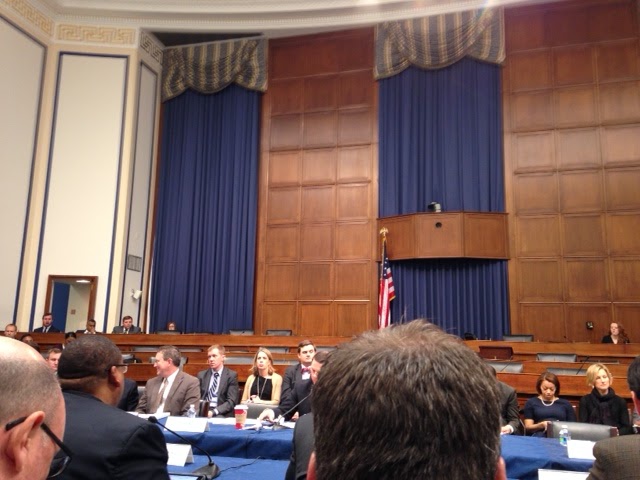
Congress Members of the Roundtable

I went to a roundtable discussion on Monday hosted by the US House of Representatives, Subcommittee on Highways and Transit, where six Congressional representatives from the left to the right and various industry and other stakeholders all agreed that innovation is good and stymying autonomous vehicle development and implementation would be bad. The room was packed even though no food, drinks, or particularly new information were served. The members of Congress were guest star Chairman of the House Transportation Committee Bill Schuster (R-PA), subcommittee Chairman Sam Graves (R-MO), Eleanor Holmes Norton (D-DC), Thomas Massie (R-KY), Daniel Webster (R-FL), and Daniel Lipinski (D-IL). I hope I did not leave out anyone. (Information in the parentheses refers to party, Democrat or Republican, and state.)

The subcommittee's informal conversation - NOT a Congressional hearing - was with:
  • Mr. Chris Spear, President and CEO, American Trucking Associations (ATA),
  • Hon. David Strickland, Counsel and Spokesperson, Self-driving Coalition for Safer Streets (and former NHTSA Administrator during the Obama Administration),
  • Mr. David Zuby, Executive Vice President and Chief Research Officer, Insurance Institute for Highway Safety, and
  • Mr. Kevin Acklin, Chief of Staff and Chief Development Officer, City of Pittsburgh


Keeping a straight face award goes to ...

The representative from the American Trucking Associations said - without laughing - that no jobs will be lost and that it will take decades for driverless technology to roll out. However, without turning his head completely around, he also said that trucking fleets would transition to driverless much more quickly than passenger vehicles because these are business vehicles and are operated as fleets. Mr. Spear also said that truck driver jobs are difficult to fill, so, presumably, the never-get-tired driverless technology will be a better bet than humans.

On the other hand, the Pittsburgh representative and David Strickland were much more jolly and upbeat about the prospect of autonomous vehicles, what they can accomplish for society, and the improvement in quality of life for older adults and people with disabilities.

Eyes on safety and commerce

Safety was a topic on everyone's lips with the significant uptick in fatalities on US roads in 2015 and 2016. Mr. Strickland emphasized this and it was also noted by the representative of the Insurance Institute, Mr. Zuby. Mr. Zuby was first runner up for the straight face award because he managed to express a belief in innovation and risk while also suggesting that the insurance industry needs complete proof. But insurance is a follower and not a leader in this field.

One aspect of safety that the members of Congress hung on to was the question of safety during the expected three decades - not my expectation - when "legacy" and fully autonomous vehicles will be sharing the road.

The other significant topic discussed was commerce with no one enjoying the prospect of 50 states with differing regulations governing driverless operations. The Commerce Clause of the US Constitution allows Congress to pass legislation that affects any related issue and to preempt state laws and regulations that interfere with interstate commerce. The representatives present at the roundtable discussion referred to their Constitutional authority. It was mentioned (I think by Strickland) that the California regulations go beyond the traditional self-certification model that NHTSA generally uses. 

What does "driverless" mean exactly?

Like people off the street, participants on both sides of what was a long rectangular table with Congress members on one side and the invited guests on the other, talked about both partially autonomous and fully autonomous vehicles. The guests were generally better at articulating these distinctions.

Really not any news here. Just interesting to see alignment among unusual Congressional bedfellows. No one mentioned the elephant in the room - what will happen when a completely different kind of Administration fills the offices of the government on January 20 and beyond.

Thursday, September 15, 2016

Is Google Behind? Ride in an Uber, a Volvo, Soon a Ford

If you follow driverless news each day, you already know that Google invented something for its software that alerts its self-driving cute cars to yield to emergency vehicles. Here's a random article. There's also Volvo, which promoted with fanfare its assembly line roll-out of its driverless cars. Swedish drivers will be testing those. New York drivers would be better, but I say go for the lunatics on this one.

Back to Google: Is it only me who thinks this, someone who does not have a clue how to develop the simplest software and never looks under the hood of a car, or are the AI (artificial intelligence) folks are already past this one-small-situation-one-bandaid approach to driverless software? That's the whole point of AI isn't it? You teach it through accumulated experience. By way of analogy, by the time your kid is learning to drive, he or she does not need to be taught specifically what to do in every little situation. Part of what we want from driverless is what we want from humans - judgment in unusual circumstances. We also want the capacity to pay close attention in endlessly boring situations, something humans are not good at.

Where's the Google ride?

So I ask if Google has slipped? Why weren't they before Uber or all of these transit and taxipod pilots in introducing their cute pod cars to the general public? Has Google become a prudent, risk-averse, large, conventional corporation where innovation gets lip service but not real support? I don't know. I'd have to ask the 20-somethings I know who work there. 

Speaking of Uber, okay, yes, I'll be the 50th or 100th site to post one of the videos of giddy journalists who trekked to Pittsburgh taking a driverless Uber ride. Well, with a driver and an engineer and lots of explaining. I'm sure there's a million of these videos already. Here's the one from Wired. It's cute, but not on youtube.

Relax in the self-driving Uber backseat

Here's a six-minute video from the PBS NewsHour. (Yes, even years later, I still think of the show as the MacNeil-Lehrer Report. MacNeil co-wrote an entertaining history of the English language, by the way. Quite readable. There's a companion series that aired on, where else, PBS.)


Ford is there, but more prudent?

Ford is testing and showing off driverless rides to journalists and using testing grounds. 

Already with ride hailing (Uber, Lyft, etc.), micro-transit (Chariot, Brid), shared rides (UberPool, LyftLine, Via, Split), and even bikeshare, our larger cities beyond the five boroughs are changing into places where one does not need a car, or where going car-lite is entirely feasible.

But outside of the relatively few places where transit works well - usually with rail, a few with BRT (bus rapid transit) - will the driverless revolution be the last nail in the coffin for transit viability in places large and small where there is, using a technical term here, crappy transit? Ford thinks so; the company is buying Chariot, a San Francisco micro-transit operation.

Thursday, September 8, 2016

Volvo Gets Interesting

Too many articles to keep track of that say the same thing about the basics of the deal between Volvo and Autoliv. Both are located in Sweden, though Volvo is owned by the Chinese. The photo of the Volvo and Autoliv chief executives looks like the beginning of a Ingmar Bergman movie about upper class angst in Scandanavia, with beautiful white kitchens in which there is no screaming or Italian food.

I'm just going to list a few articles; there are so many more. The reports all pretty much cover the same material facts.
Wall Street Journal article
Endgadget.com post - also information about the Volvo/Uber deal
The Detroit Bureau (an automotive industry publication) - has the aforementioned photo

Question

Lingering in my mind is the question of whether Volvo is already behind the curve on a path that Nvidia, Drive.ai, and Comma.ai are well in the midst of paving? Perhaps Volvo believes it is technologically ahead; perhaps the company believes and indeed can bank on its credibility and its acumen to surge ahead; perhaps there is something of the Jackson Pollock style of painting here - throw something and see if it sticks. (Apologies to Pollock and modern art enthusiasts, but I'm not a big fan of the artist's work.)

Something new in the Swedish water?

Volvo has been a busy bee of late. In addition to the Uber deal and the Autoliv deal, Volvo is testing other driverless vehicles. It is showing off a driverless vehicle in New Zealand as well as testing a driverless truck in an underground mine. According to wikimapia, "[t]he mine consists of polymetallic ore containing zinc, copper, lead, gold and silver, as well as copper ore and gold ore. Around 80% of the ore mined at Kristineberg is extracted using the cut-and-fill method." Correctly assume that I have no idea what that means or how environmentally responsible such mining practices are.

And there's more with Uber and Volvo partnering on driverless Volvo trucks that are currently tooling around the San Francisco Bay area. These are already on the highway.

One can assume that the B2B market of trucking will be, no pun intended, a gold mine. One can assume that Daimler and Volvo will be big competitors, as past reports have shown.

Friday, August 19, 2016

Uber or Jetsons Flying Taxi?

By now, you and the entire world know about the Uber driverless announcement and all of you are contemplating a trip to Pittsburgh, not to go on a tour of Carnegie Mellon or Pitt (University of Pittsburgh) with your high schooler, but to take a ride in downtown Pittsburgh in an Uber driverless taxibot - well, with a driver, steering wheel, and brakes. 

It's like the Google car, but not as cute. But Uber has now officially won at least a preliminary foot race in the competition to bring about the driverless revolution by being the first to charge fares for taxi-like, ride hailing, services in the US in exchange for a ride in a vehicle that is not being operated by a human being.

I am considering the trip. But I am considering flying to a country I have no curiosity to visit just to ride on a driverless vehicle. Wait, Uber will only be offering the driverless perk to an undisclosed number of existing customers. C'est la vie. The linked article also has a description of the Uber-Volvo deal. Here's one more article with background on the Uber-Volvo partnership (nothing new). 

Uber joins the game of acquisition musical chairs

Uber is also acquiring a self-driving truck start up that is a Google-spin-off; maybe traitor is a better word. The company was started by two ex-Google-car engineers. Called Otto, the company was initially promising partially autonomous trucks. Otto's full name, by the way, is Ottomotto. 
Uber plans to open a 180,000-square-foot facility in Palo Alto, Calif., to house Otto, which will operate as a stand-alone company focused specifically on upending the long-distance trucking industry. Otto engineers will also work out of offices in San Francisco and Pittsburgh.
Forget surface transportation, take the pilot-less Jetson helicopter 

Airbus is working on a transportation option that it hopes will make the Uber driverless service look like the Model T - pilot-less helicopters. Do not hold your breath. There is no projected date for this service. 
A key goal of the project is alleviating traffic congestion expected to accompany the growing populations of the world's cities. But like the self-driving cars currently undergoing testing, one of the major obstacles to the launch of the self-flying taxi is the lack of a reliable sense-and-avoid technology that allows airborne vehicles to avoid crashing into buildings.  
"That's one of the bigger challenges we aim to resolve as early as possible," Lyasoff says.
 No kidding. I am glad that a company that has not worked out such a significant kink is hesitating before placing a product on the market. 

Articles are referencing the Jetsons' flying contraption, which required a pilot, but not his or her full attention. Enjoy the 1960s' white-washed and sexist introduction to the famous cartoon show.


Wednesday, August 17, 2016

Shared Use: Get on the Driverless Bus or Taxi

Update on shared use driverless

From my Aug. 17 post, which was mostly about state-level activities in Pennsylvania and Arizona to attract driverless testing. It's not just testing anymore.
Uber will be the first, passing Google, Ford, GM, and others in the rear mirror - to bring driverless shared-use service to the public - only in Pittsburgh.
There will be drivers in the car, a la the drivers in the Google cars, but with paying passengers.
Quote from Bloomberg article: Starting later this month, Uber will allow customers in downtown Pittsburgh to summon self-driving cars from their phones, crossing an important milestone that no automotive or technology company has yet achieved. 
There will be drivers in the car, a la the drivers in the Google cars, but with paying passengers.
New bus in Europe


Driverless testing in Europe has been and continues to be transit friendly. A German-made driverless bus is being tested in Amsterdam. The autonomous system is called CityPilot; it is produced by Daimler.

Forget testing; call the taxibot

Ford is being bold with an announcement that it will have a driverless ride hailing operation in 2021 with vehicles that lack steering wheels and brakes. Ford is putting its money where its mouth is in terms of investment in small companies that will get the company further ahead in terms of LIDAR technology and machine vision technology. One of those is SAIPS, an Israeli company that is involved in AI and technology to help people who are visually impaired.

Like Google, Ford eschews the idea of partially self-driving vehicle development on the way to completely autonomous operations. It considers fully driverless to be safer than a partial system in which the driver is expected to be bored, but aware at all times.

Beyond Michigan - States Vying for Driverless Testing

A few US states, though behind the curve, are trying in their own auto-centered ways to catch up to the 21st century. Arizona and Pennsylvania are attempting to become more testing-friendly to driverless vehicle companies. 

William Pitt would be proud

Pennsylvania is planning for testing on actual roads, with the help of the corporate representation of Uber on its Autonomous Vehicles Testing Policy Task Force, which has been meeting recently, according to reports in the press. Despite reports that GM is represented on the committee, the June 2016 PennDOT press release about the committee does not indicate that is so. In fact, Uber is the only company represented. There are also task force members from AAA and the trucking and insurance industries. 

Article from govtech.com
Article from The Morning Call

Pennsylvania is contemplating driver-free - no driver required in the vehicle - testing. The state is concerned that Carnegie Mellon, especially, maintains a good position in the driverless race. Uber, Carnegie Mellon, and Pittsburgh are heavily invested and represented on the task force.

Get a driverless Uber in September - that's 2016

Uber will be the first, passing Google, Ford, GM, and others in the rear mirror - to bring driverless shared-use service to the public - only in Pittsburgh.
Starting later this month, Uber will allow customers in downtown Pittsburgh to summon self-driving cars from their phones, crossing an important milestone that no automotive or technology company has yet achieved. 
There will be drivers in the car, a la the drivers in the Google cars, but with paying passengers.

Arizona on the road

Arizona is not exactly known as a progressive state and it is quite auto centered. Try walking in Phoenix or staying the weekend downtown car-free, let alone anywhere else in the state.

But Arizona's governor is bullish on driverless testing. An oversight committee of state officials met this week to discuss the encouragement of encouraging more driverless testing in the state. 

Google is expanding testing to Chandler, AZ. It has been mapping the streets and it held an open house with residents last week. 

GM is also testing in Arizona, in Scottsdale. AZDOT, the state's department of transportation, seems very relaxed about this, with statements that nothing prevents driverless marketing in the state