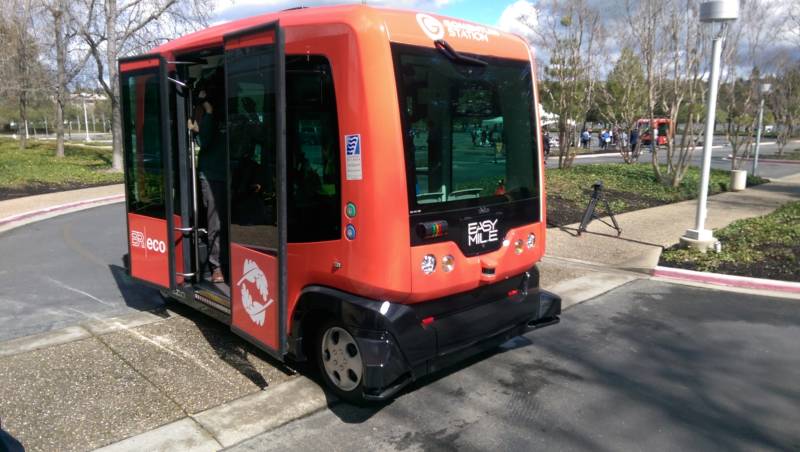
Reading the news on autonomous vehicles (AVs), everyday I am seeing more shared-use, transit, and transit-like AVs. These pilot programs are spreading quickly. Slow, fixed-route - or limited radius - AV shuttles have captured the imagination of places in the United States that are (1) NOT our major cities, meaning places without strong transit unions, and (2) NOT transit rich. Indeed, in at least one spot, AV shuttles will used to ferry people to and from parking lots.
Most of the AV shuttles are manufactured by
Navya and
EasyMile, though there are other companies in the game and some homegrown, usually university-developed, shuttle vehicles.
Down under, over to Far East, and towards the West
 Perth, Australia
 has an
AV transit shuttle service - open to the public - that just turned one year old. The
Navya shuttle, called Arma, operates on public roads. The shuttle reads signs and turns right. Unlike human drivers, it regularly improves due to software upgrades. [See photo.]
Singapore will have
AV ridehailing in mid-2018 via a partnership with
nuTonomy. Unknown is whether a local ride hailing company will be involved. This city-state is already ahead of the curve on AV testing and is currently well in the lead in terms of
AV-related urban planning. (Lots more on that topic in a blog post soon.)
Helsinki, Finland has an
AV shuttle as a regular service - NOT a pilot project. Finland's pilots have used the
EasyMile EZ10 for AV service and that tradition continues with the Helsinki shuttle.
Tallinn, Estonia recently saw the end of a
month-long AV transit shuttle pilot that was open to the public. This project also used
EasyMile vehicles. There are already plans to bring the AV transit option back to Estonia, but next time to a different city and not until next summer. A leading Estonian transportation official is pushing for
Estonia to move forward with AVs generally.
Go west young shuttle
Michigan: Ann Arbor, home of Big Ten school University of Michigan (UM) and the
MCity AV testing facility (and not far from the
American Center for Mobility testing facility in Ypsilanti, Michagan) is about to host an
AV shuttle on a two-mile route between engineering buildings at UM's North Campus. The shuttle vehicles are manufactured by
Navya and they carry up to 15 passengers. Rides will be fare free and the AV shuttle will operate during the university's business hours (not intended for late-night studying or as a drunk bus).
Texas
Texas A&M has a homegrown AV shuttle on campus for Howdy Week. The plan is to have 15 of these shuttles in operation by the end of the spring semester, meaning by May.
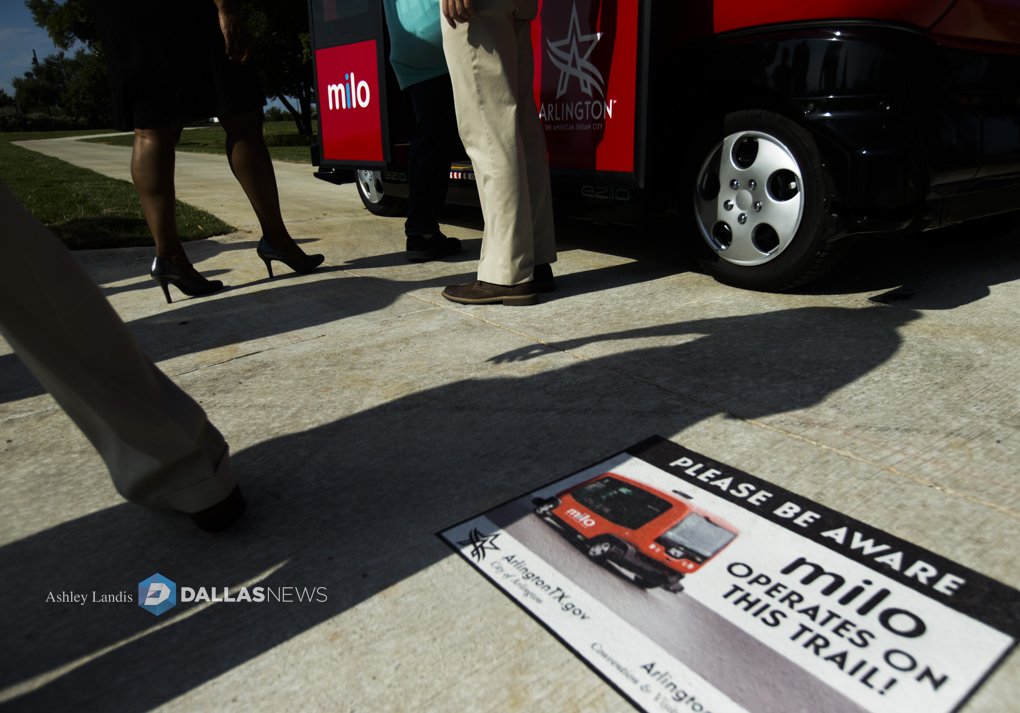
Arlington, Texas has a pilot AV shuttle program that began on Aug. 26 and will continue through mid-2018. The shuttle will provide
AV transportation around the Arlington entertainment district and to Texas Rangers and Dallas Cowboys games on game days and when concerts and other events are held.
EasyMile shuttle vehicles will be used. Arlington is already considering expanding the use of AV transit shuttles beyond the pilot project. The vehicles hold
12 passengers, according to one enthusiastic report.
California
San Jose Airport is testing an EasyMile shuttle vehicle and hopes to use it for ferrying travelers and workers around the airport. The wish list includes an AV shuttle to transit and a dedicated lane on public roads. A
local article about the project does a nice job of explaining the huge quality-of-life implications for people with disabilities and older adults.
San Ramon, CA, home of the
Bishop Ranch office campus has an
AV shuttle pilot program that is designed for ferrying office workers. The
AV shuttle became a local celebrity when it was
featured as the grand marshal of the Concord, CA, July 4th parade.
EasyMile shuttle vehicles are being used.
Apple is floating the idea of an AV shuttle for employees. No word on timing or which company will be supplying the shuttles.
Colorado: Denver's transit system is planning for cute AV shuttles for
first and last mile connection to transit. RTD, the transit agency, was testing the
EasyMile EZ10 in a giant parking lot. If you watch the video, just note that the snarky New Yorker reaction is that unless this vehicle has a dedicated lane or a built-in "oh no you don't" feature, in a busy city pedestrians will eating this adorable vehicle for lunch. You cannot combine a courteous, safe vehicle with a nasty, walking Brooklynite.
MaaS on the menu - tea leaf of expected profitable service
None other than
Ernst & Young (really called EY), a large multinational accounting firm, has developed a
Blockchain platform, called Tesseract, for managing fleets of AVs. The firm sees mobility as a service - or MaaS - somewhere on the expected horizon. From what I understand, which is little, about Blockchain, also used for bitcoin transactions, it is nearly unhackable and it is instantaneous. Evidently, EY sees money in this and has confidence that MaaS will emerge with sharing of different types of AVs, and differently-owned vehicles.
People with disabilities: AV transportation equity
Australia, like the US, a country of long distances, has a company about to pilot AV pods for older adults. Called
Pod Zero, and manufactured by UK-based company RDM Autonomous, the pilot will only offer transportation on local roads within some elder communities owned by
IRT, an Australian company. (For you older New Yorkers or subway history buffs, this company appears to have no relation to IRT train lines, such as the 1, 2, 3, 4, 5, and 6.)
According to RDM, Pod Zero "is currently built in two variants – four-seater and eight-seater – and offers an operating speed up to 15 mph, multiple battery options up to eight hours or 50 miles, wheelchair accessibility and air conditioning."
Pod Zero will launch in November at an
aging and information technology conference.
Autonomous wheelchairs are being tested and plans so far are for use in hospitals and airports. Though this wheelchair comes out of MIT research, the pilots are in Singapore and Japan.
Fare free for a price
Under the category "you get what you pay for," ideas for how businesses will make money off of AV transportation are growing. One idea floating around is that AV service, perhaps shared-use ridehailining trips, will be free - actually "sponsored" - by a local business, maybe a restaurant that wants your patronage. Other ideas revolve around fare free because transportation will be a cheap perk to deliver in exchange for valuable data. Sorry, forgot to get a link for this.
OMG, can't believe someone just said this - try being in a wheelchair for a few days
Below is a quote from a
Mother Jones post that shows how people totally do not get the need for accessibility. It's as if the writer and like-minded individuals assume that all people with disabilities have extra cash to pay for personal service and that they don't deserve transportation equity. I agree with the point of the post, to not let the perfect be the enemy of the good, BUT people with mobility challenges - by they mothers with strollers or grandfathers with wheelchairs or cousins with intellectual disabilities, should not have to continue to be second-class transportation citizens. (I include the mother because so many parents develop back problems during the car-seat years. Why can't we have cars in which you can just roll in a stroller?)
No, we don’t need to deal with the problem of seniors and disabled passengers before it becomes an issue. Why would we? The market will almost certainly take care of this. Maybe companies will spring up that maintain human drivers, or that offer to have a human accompany the car to help you load your luggage or get your wheelchair into the trunk. Maybe driverless taxi companies will include this as an option. Or something. This is a no-brainer. [Emphasis added.]
So if you are an affluent person with a disability, no worries. But if you can't afford to pay twice as much for transportation or if you do not want to permanently be stuck at home, sorry. OMG, bad attitude. Maybe it's time to expand the Americans with Disabilities Act to comprehensively include all for-hire and private vehicle transportation. This just gets too hard for anyone marginalized just because he or she uses a wheelchair.

:format(webp)/cdn.vox-cdn.com/uploads/chorus_image/image/50589169/self-driving-bus-vehicles-Finland-Helsinki-transportation-1.0.jpg)