Showing posts with label Shared use. Show all posts

Thursday, January 28, 2021

Panda videos and lots of AV comment opportunities, reports, events

All those months when nothing came from the Federal Register about autonomous vehicles (AVs) are in the rear view mirror and a few weeks ago the outgoing US Department of Transportation (USDOT) leadership released a flurry of documents - and thereby opened comment periods - charting a course for a road to accessible AVs. 

My small brain has been having a hard time keeping this all straight, so I am making the virtual effort of straightening out the piles, the dates, and the entities involved. To keep sane and smiling, enjoy the three panda cub videos sprinkled among the AV info.

Best in-a-nutshell AV resource 

Before we get to all that good stuff that has popped up in the Federal Register, here is a big treat: Eric Dennis of the Center for Automotive Research has just updated his excellent table of AV state laws. Warning - Not all of the laws within each category are the same, so this is not a deep dive, but it is a fabulous snapshot and an excellent resource. Also note that sources of regulations for a given state might be a law or an executive order of a governor. Dennis also maintains maps of state laws. Follow him on Twitter @EricPaulDennis for notices of his updates.

A database of state AV legislation and laws is available from the National Conference of State Legislatures. Dennis also maintains his own resource.

You didn't have to - lots of AV comment opportunities

Really, Elaine (Chao), you did not have to feel the need to leave so many parting gifts and all with open comment periods. I am sure this work will be helpful to USDOT staff, and I mean that sincerely, but it is also a gift to all of us who care about expanding transportation access and equity because the Chao USDOT made clear where exactly we are and how much we can expect if we do not alter the current public-private transportation divide. Of course, the staff who will be tasked with reading, interpreting, classifying, and preparing a document in response to each document might not be so happy.

  • Framework for Automated Driving System Safety - The National Highway Transportation Safety Administration (NHTSA) seeks comments about various aspects of AV safety, testing, and standards development in terms of NHTSA's role. There are over 20 specific questions posed. The comment deadline has been extended to Apr. 1, 2021. This is an Advance Notice of Proposed Rule Making (ANPRM). I have several posts about comments submitted, though, as of today the number is well north of 613 and I am just at the beginning of reading all of those. 😟  Now well over 500 behind. 🤔 Maybe time to clone myself.
  • Request for Information: Inclusive Design Reference Hub - The Office of the Secretary (OST) at the USDOT issued this request for information (RFI), which seeks ideas for collating inclusive design research with the goal to "establish a library of resources for accessibility in automation, and work with outside experts to study voluntary best practices for ensuring accessibility in automated vehicles." An RFI is not a commitment; it's a much less formal counterpart to a request for proposals. The comment period ends Feb. 19, 2021. The original comment period, which ended on Jan. 20, 2021, was officially extended. Thus far, there are seven comments and these are summarized in previous posts.*
  • Draft Strategic Plan on Accessible Transportation - The USDOT is seeking comments on its draft plan, which aims toward "mak[ing] America's transportation system accessible to all travelers." That is a tall order and I am just beginning to read this document. (Nothing thus far about requirements or legislation that mandate production of accessible vehicles.) Comments are due on or before Feb. 16, 2021. Six comments submitted so far.
  • See safety and cybersecurity section below for one more open comment period.

* Please note that as of the publication date that the USDOT website is not making available an OST page.

Events

Inclusive Design of Autonomous Vehicles - Mar. 10 - Apr. 21, 2021, every two weeks. Hosted by the US Access Board.

A four-part series of public forums to discuss different aspects of accessibility and the transportation needs posed by particular groups of disabilities. Links to the forum are not posted yet.

African American Conference on Disabilities - Sessions throughout February 2021. Hosted by the  Arizona Center for Disability Law and the Arizona Center for African American Resources.

This is an event with speakers from across the US. There are no transportation panels; the conference focuses on housing, accommodations, education and the effects of the pandemic. 

Plea to AV report writers: Take a vacation

To make it worse, on top of trying to keep abreast of AV work at the USDOT, I am also trying to keep track of and read all of the excellent AV reports that have been issued recently. There's a list below. I have to admit a certain personal conundrum of figuring out what exactly I want to read and focus on these days. I am supposed to be starting a podcast and a book, but, instead, I am treading through virtual piles of AV reading just to remain up to date. 🏊  (That's a swimmer emoji, in case it's not obvious. No frantic, treading water emojis were available.)

  • Inspiring Autonomy: How Auto Insurers Will Lead Through Changing Risks - This is an updated 2018 report from Travelers Insurance about AV developments, how the auto insurance industry should continue as AVs roll out, and the best strategy for quickly compensating crash victims. 
  • Autonomous Vehicles and the Future of Auto Insurance - This is a report from RAND Corporation, which has done excellent research and reports on AVs. It explores different AV ownership and insurance regulation possibilities, with recommendations to investigate international models and public-private collaboration.
  • Low-Speed Automated Vehicles (LSAVs) in Public Transportation - This report is from the Transit Cooperative Research Program (TCRP) (within the Transportation Research Board (TRB)). It provides an overview of slow-speed AV shuttles, where they have been used, and factors that contribute to success. This is a practical report, with checklists for procurement, evaluation, and monitoring, among others. There are also a few detailed case studies provided.
  • Automated Vehicle and Shared Mobility Forum (AVSM Forum) - This TRB website hosts a library of brief reports of research summaries and discussion workshops with invited speakers and forum members, an A-list of AV and shared-use mobility thinkers (with professionals from state, local, and federal agencies, the private and non-profit sectors, and academia). The issues covered are wide ranging, but often in the form of articulating research needs and concerns around data, equity, and accessibility, among others. 

Goodies for safety and cybersecurity experts

  • Cybersecurity Best Practices for the Safety of Modern Vehicles - This is NHTSA's draft update of its 2016 (Obama administration) cybersecurity document. Comments are due on or before Mar. 15, 2021.
  • Notice Regarding the Applicability of NHTSA FMVSS Test Procedures to Certifying Manufacturers - The comment period is closed. This document essentially reverses (using judicial terminology) the 2016 statement of the Obama-era USDOT that required AV compliance with the NHTSA-issued federal motor vehicle safety standards (FMVSS). This document basically declares that FMVSS are not themselves performance standards. I am not a safety engineer, so I will offer a quote here. "While the manufacturer of a motor vehicle must produce vehicles that comply with all applicable FMVSS and must exercise reasonable care in certifying compliance, the Safety Act does not require that a manufacturer ensure that NHTSA can validate the manufacturer's certification through the FMVSS test conditions and procedures when it certifies the vehicle." This document has nothing directly to do with accessibility. There were 12 comments submitted and it will be interesting to read these as major organizations and businesses are among those who responded to the notice.
  • Safe Enough: Approaches to Assessing Acceptable Safety for Automated Vehicles - This RAND report is a dive into different ways to measure safety. 
For more panda time, visit the Giant Panda Cam

Request to Congress: Please concentrate on other topics until I am up to date, maybe in four months, before you all circle back to AVs. Thank you. 

Since I am not on the top of anyone's list for that magical vaccine, I can stay home and read official documents and comments.

Tuesday, November 14, 2017

No Human, Fare Free and In Traffic

Headlines from the past week:

Waymo in Phoenix - hands free and engineer in back seat

Las Vegas AV shuttle begins with a glitch

Tampa AV shuttle to start public transit service in January 2018

and from Miami - Mayor with a big bus dream

What do these headlines have in common? Autonomous vehicles (AVs) that are shared - for transit or for pooled taxi-like rides - are moving ahead, well in front of the sale of fully autonomous private cars.

And, for now,  the rides are free though, we have yet to hear whether Waymo's Phoenix-area rides - with the engineer in the back seat - will be free or discounted. The Miami dream is way too far away to talk about fares.

In regular traffic and then an all-too-human driver ...

Here is a video with a reporter who was on the Law Vegas shuttle. The report includes "real people" concerns that the passengers expressed in the wake of the mishap of a very minor crash with a truck in the shuttle's first couple of hours of operation. The crash, by the way, was the fault of the human truck driver, not the AV technology. The shuttle was manufactured by Navya.

Florida shuttle coming after New Year's

The Tampa AV shuttle is being shown off this week at an AV summit. The cute AV will be in regular operation come January. The shuttle manufacturer is Coast Autonomous and the vehicle will seat 14 passengers and fit a total of 20. And the AV shuttle will be fare free.

The transit agency will operate the AV shuttle. This is actually Tampa's second experience with AV service. There was an AV giving rides at a science museum. That demonstration project started way back in 2015.


Miami mayor wants big driverless bus

The mayor of Miami has gotten cold feet for a large rail project. These come with scary price tags. Instead, the mayor is proposing a newly developed autonomous bus - a really big bus - that is touted as a train on wheels. It's like the AV shuttles on steroids with room for 300 passengers. Miami already has dedicated bus lanes. 

Now to read all of the articles, legislative bills, etc. starting to pile up this week.

Friday, October 6, 2017

Shared Ride Roundup


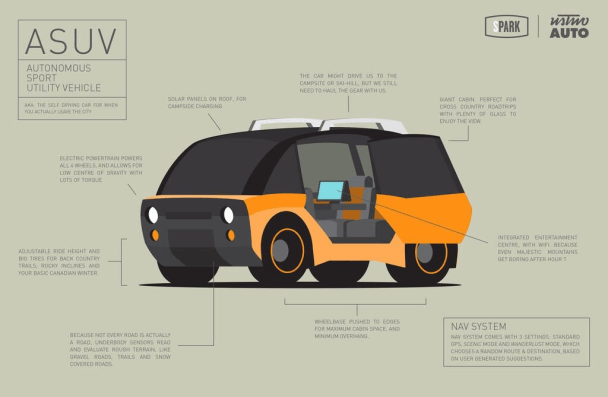
Love this: Artist renderings that are much closer to my imaginings of rethinking vehicle design for AVs than we are seeing from the auto companies. Definitely take a look at those! Image #6 is my personal favorite. Images posted here are all from those renderings.

Shared ride options for all getting closer

GM in California - more than doubles fleet of Cruise Automation vehicles. Now at 100 AVs.

Lyft partnerships with car companies to open up AV ridesourcing services.

Waymo full-scale AV ridesourcing operations to start in Phoenix area by early 2018.

AV ridesourcing for affluent older adults happening now in California. Voyage, a startup, is using Ford cars, to do just that in a gated senior community. Lots of opportunities in this market. More on the Voyage pilot.

Public shared-ride AV pilots

Publicly-funded A-Taxi, an AV shuttle ridesourcing pilot, is being planned for Greenville, SC (isn't that a state that does not believe in taxes?) with FHWA funds. The intent is to use these shuttles for commuter transportation for "to improve access to transportation for disadvantaged and mobility-impaired residents." That's why the public dollars. How progressive for South Carolina. Impressive. [Image source: muxxi]

Another publicly-funded experiment with AV shared-ride service will take place in Britain in Greenwich, with Ford and Transport for London (TfL) among a broader partnership. However, this project will only be planning a business model, with the assumption being that one-third of London trips in 2025 will be by AV.

Stuff you can do, but maybe shouldn't, in an AV - if allowed

If you own your AV, you will have more leeway, but if you are a shared-use or transit AV person in the future, I imagine rules against:
  • Drinking too much alcohol - or any - while on board
  • Being obnoxiously drunk on a shared vehicle
  • Sex or even making out (tacky, though fun at the time)
  • Eating
  • Drinking anything but water (our rule in the station wagon when the kids were young)
  • Vomiting - try not to and use a bag
  • Watching or listening to anything without earphones or earbuds
  • Screaming
  • Singing, unless there is a 0-5 year old involved (in which case, I recommend singing Wheels on the Bus)
Stuff that should be allowed to roll right onto AVs when they are universally designed
  • Wheelchairs and other mobility devices
  • Strollers, even double ones
  • Personal shopping carts
  • Luggage
I make this list with the assumption that only the wealthy will have personal attendants and that the rest of us will be in the same sorry position we are in as airline passengers, forced to deal with and lift heavy items instead of receiving personal service. [Image source: Ustwo]

Personal dream

AV tiny house to cruise across the country in style. 💚

Wednesday, June 21, 2017

AV Transit Shown Off in Nevada as Law Passes

Nevada's push for an autonomous vehicle law has succeeded, but part of the public relations effort associated with the legislation was the week-long operation of a shuttle in Las Vegas. Add media coverage and delighted passengers to produce a sweet picture of a rosy and uncomplicated future. Image is as important as reality.

The Nevada bill that became law on June 16 is quite broad and allows for the operation of autonomous vehicles. →No human is required to be present in an AV or ready to operate or test the vehicle.

The law provides for:
  • Platooning, if in compliance with state law,
  • Operation and testing of autonomous vehicles,
  • Pre-emption of local laws, taxes, and fees,
  • Partially and completely AV, and
  • Lack of liability for post-purchase third-party conversion to AV.
Unusual is:
  • Ten-business-day window for reporting crashes,
  • Explicit adoption of SAE International terminology regarding levels of automation,
  • Tax on AV rides from a company operating as a transportation network company (TNC), otherwise known as ride hailing,
at the rate of 3 percent of the total fare charged for transportation services, which must include, without limitation, all fees, surcharges, technology fees, convenience charges for the use of a credit or debit card and any other amount that is part of the fare. The Department shall charge and collect from each autonomous vehicle network company the excise tax imposed by this subsection.
New acronym warning

The law coins a new term here - "autonomous vehicle network company" (AVTC). The meaning is obvious, but the definition articulated is "an entity that, for compensation, connects a passenger to a fully autonomous vehicle which can provide transportation services to the passenger." The law provides for an application process for AVTCs.

Pretty much a taxi/TNC/AV law

The AVTC section of the law provides:
  • Prospective passengers of AVTCs will be entitled to a fare estimate before embarking on a trip.
  • At least an annual inspection of AVTC vehicles.
  • Receipts for passengers and what they must contain. 
  • Explicit exemption from the meaning of AVTC are human services transportation, motor carrier transportation, and carpool matching services. But later on the law allows for AV human services transportation, taxi, and motor carrier transportation. 
  • Production and retention of trip records, vehicle inspection records, annual reports to the state, and on and on, blah, blah, blah.
  • Ban on release of personally identifiable information about passengers - without consent or unless disclosure relates to "protect[ing] or defend[ing] the terms of use of the services or to investigate violations of those terms of use." Nice use of legalese.
  • Submission of crash reports.
  • Localities are permitted to regulate AVTC business licenses and permit, certification, and/or fee to operate at an airport.
There's more, but suffice it to say that this law is basically a set of AVTC regulations that some parties wanted to ensure were set pretty much in stone instead of being left to the predilection of whichever administrator is in charge.

Friday, September 30, 2016

Car Makers Plans and Business Models

Just a round up today because I'm super busy.

Volvo

Volvo announcement and its other driverless plans:
Testing in 2018, production and sales in 2021, working with Uber
Will produce private cars and fleets
Volvo joins club of opening Mountain View facility

As GM goes ...

GM-owned Cruise Automation grows to 100 employees as it tests cars in California

Business models

Car companies are planning for different possible business models or a combination thereof: Ride sharing/hailing versus private ownership (a/k/a a car or two or three in every driveway). This is explored in a report from the Center for Automotive Research, which mostly explains how shared-use modes work and their value for the customer, particularly where and at what levels of miles traveled.