Companies and cities, sometimes countries, are announcing that AVs, whether shuttles or conventional passenger cars, are coming and they will arrive by a date certain. Those dates differ, but still, such certainty makes one wonder whether the technology is essentially ready or whether engineers are being encouraged to improve the technology fast enough to lend credence to the hype.
Tough, but sweet, outdoor cat taking a break from mouse patrol.
A snarky person like me could wonder whether these bold declarations might encourage companies to suppress, a la Lion Air and Uber (with Herzberg killing), any safety concerns. Perhaps an AV "drivers test" and/or continuous performance monitoring might be in order. After all, auto companies will be combining the driver with the vehicle, and recalls show that those vehicles have sometimes been far from perfectly safe.
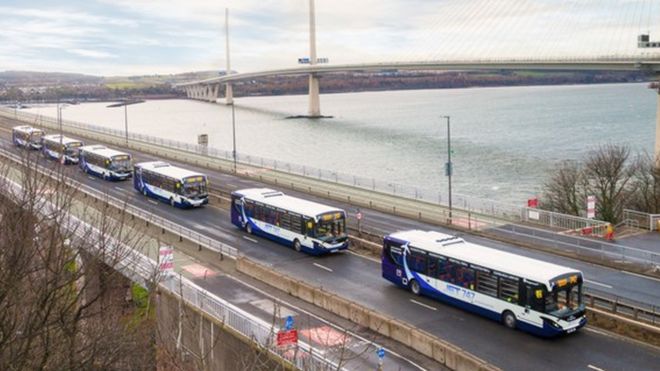
Edinburgh, Scotland - AV full-size transit buses will be piloted on a 14-mile route between a commuter parking lot in Fife and a commuter train station . The buses will use the "the dedicated public transportation corridor across the Forth Road Bridge that also allows buses and taxis."
Across a landmass and over water
Japan - Though Japanese automaker Toyota has been relatively quiet about its AV activities, the plan declared a few years ago, and which continues to be repeated, is that AV service will be available for the 2020 Olympics. So where are we?
Plans are also moving ahead for AV robotaxis to ferry visitors around in Tokyo during the Olympics. Reports from the summer stated that AV vans were being tested as a step toward service during the Olympics. Partners are a Japanese taxi company and a Japanese AV tech company. Toyota is also an investor.
In contrast to bravado or openness?
Miami, Florida - Ford has invited journalists to ride along on trips in its AVs in the traffic mess of Miami (though what US city is not a traffic mess?). These rides are taking place on actual busy streets with bikers and pedestrians and other drivers, all who arbitrarily violate the law and otherwise act in unexpected ways on a regular basis. Ford is basically using the city traffic as a test bed, though with careful backup drivers. The carmaker has a clear goal - AV ridehailing service on the street in Miami and Dade County in 2021.
I thank Ford Motor Company for its practical approach. Ford has been working on this for years and it is currently testing its pedestrian-message signals in Pittsburgh. Is Ford patting itself on the back? Fine, whatever.
All about public acceptance
Ford understands the value of public trust. This desire for trust is a major reason why AV pilot programs - whether shuttles or car based - have low speeds and human monitors. The recent report, M City Driverless Shuttle - A Case Study, states: "Driverless shuttles have a future only if they are trusted and used by riders, and trusted and accepted by other road users." (p. 6) In fact, M City basically acknowledges that it was not technological advancement that prompted the pilot, but rather - apart from being cool and somewhat in the forefront - "understanding passenger and road user behavior while ensuring a safe deployment."
What about pedestrian-to-AV communications?
My question to AV manufacturers and tech engineers is what to do with the humans who will continue to be in the mix. To use a crass example, when I yell out "you jerk!" to a driver, with body language commensurate to such a message, the driver comprehends what I am saying without having to actually hear me. He or she might not like the message, but it is understood. What if I find myself in an emergency and I wave for an AV to stop? Will the AV - possibly without a human passenger inside - comprehend my loud shouting and gestures?
Are companies also working with the recognition that communication must be more than one way?
Disclaimer: I owned a Ford station wagon for several years. I loved that car; indeed the only car I have ever loved and I have avoided driving and owning a car for much of my life. That station wagon had two great features:
Could be seen from anywhere in any parking lot - The station wagon was an unusual shade of blue and it had weird-shaped side back windows. The odd look of this vehicle was a distinct advantage and every single time I am in a parking lot with a sea of similarly shaped black/dark grey sedans, I think of our former blue beauty;
The station wagon had a large back window with its own windshield wiper. I miss this whenever I have to drive our supposed more luxury car (that my spouse felt was needed when the kids grew up and which I have thus far lobbied unsuccessfully to sell because why do we need a car anyway).
One more for extra: Not a fancy vehicle, so you never felt you had to avoid bringing the dog, eating something, or otherwise relaxing. I even slept in it once during a particularly rainy camping trip. FYI: Never take me on a camping trip because the chance of rain will skyrocket to 90 percent.
Terminology use that I like -
Saying ridehailing instead of ridesourcing or TNCs (transportation network companies),
Saying self-driving, driverless, autonomous vehicle (AV) as referring to only fully AVs.
Using "the term driver-assist
technology to describe features that assist drivers with convenience or safety benefits, but they are not autonomous because they require the human driver
to always remain engaged and available to take control of the vehicle. These features are defined by SAE International as Levels 0-2 of Automation and leverage
technology to augment a human driver but not replace them." The report also states that Ford will not use terms such as "blind spot monitoring, lane keeping assist and adaptive cruise control ... [as] “self-driving” or “autonomous” – and we’ll never refer to them as such – because they require the driver to supervise and maintain control of the vehicle."
Ford going for different business model possibilities - shared use that is fleet-based for human passengers and then otherwise for deliveries.
Ford is touting its street cred on service for people with disabilities, or, at least, for taking such individuals to healthcare appointments. I therefore hope that Ford will lend its support when I draft and start advocating for the All American Accessibility Act that will require every passenger vehicle to be accessible by a date certain (though I have not yet picked the date).
Smiley face on decision not to directly sell to consumers AVs - 😁
You had me at hello
Wow on the way stuff is explained on a for-dummies level without feeling condescending. This person or group should win an award. I am feeling satisfied as a transportation nerd who has a very pro-transit, pro-shared-use, pro-walking-and-biking perspective. Is there a drug coming to me from this report, has Ford learned to talk the talk, and perhaps even learned to walk the walk?
As for the movie Jerry Maguire, from which the clip is taken, I never bought the sudden I love you realization at the end of the movie. Just had to add that. Back to Ford report:
I didn't know that Argo AI is in Cranberry, NJ. Cranberry is quite close to a bunch of gated retirement communities. I am not proud to say that I know people - very nice people - who made the mistake of leaving Brooklyn to live in one of those retirement communities.
ArgoAI is also in Pittsburgh, as the photo shows.
I even got to see one of those AVs recently on a trip to Pittsburgh, which, by the way, is a neat place and rivals Boston with its pretty bridges.
What I don't like
No car company should be talking safety as if it is proud of its record. I am sure that Ford is well represented among the millions of roadway fatalities and injuries over the past several decades. In my opinion, as along as a car company has not capped its products' capability to speed, among other things, it should not engage in the pretense that it has produced a safe machine. I am also sure that Ford advertising has shown its vehicles on the open road operating at high speeds.
I found the human interface section insufficient. Nothing was mentioned about people with disabilities, about varying levels of cognition, people who speak different languages, children or older adults riding alone, or just people who happen to differ. Nothing about people without the ability to see or hear. Nothing about people who might not see or hear because they are watching a movie, listening to a podcast, or are engrossed with binge watching of Elisabeth Moss TV shows. One could be totally fixated on something like Mad Men or the Handmaid's Tale. Just as examples.
One should not brag, or even mention, being part of a project intended to deliver bad pizza to anyone at any time. I would leave out the collaboration with Dominoes. Really Ford, why not pick a great pizza place, like pretty much any neighborhood place in Brooklyn or even some on Long Island or in New Jersey? There's at least one wonderful option in New Haven as well. You buy up such nice startups, you hire smart people, but you are sad when it comes to pizza.
Notes to Ford
Reminder about the pizza and looking for your support for the All American Accessibility Act.
Not everyone speaks English or is able to hear at all. Make sure to embed interfaces for communication with people with different disabilities, different levels of cognition (as in teenagers who hardly look up when they cross a street), and who might be visiting from a place where people do not routinely learn to speak English fluently. There are people as well who are blind or visually impaired and then there are people like me, who do not pay attention or get distracted by the engaging thoughts running through their minds at any particular moment.
Fine, no problem - or might be a problem, but I do not know enough to judge that
Intended for a mass journalism audience that will get a sound byte or two from the report and briefly summarize it, the report is sometimes a bit of an AV-for-dummies publication.
Though the report might be for dummies, since I have no background in or substantive knowledge of software, vehicle design, or safety testing protocols, I will leave it to others to analyze Ford's language about cybersecurity, reaching a minimal risk condition (a/k/a pulling over to the side of the road or the equivalent), safety testing methods and practice, and crashworthiness.
Best sample from report
Most human drivers have a comfort zone. Some prefer to avoid highways and stick to local roads when possible; others would rather not drive at night or in bad conditions, such as during snow or ice storms. These driving routines and decisions can be considered a comfort zone.
The difference between most drivers and Ford’s self-driving vehicles is that our comfort zone is set in code. Our Virtual Driver System only works within its Operational Design Domain (ODD), which prescribes which areas, streets, speeds, weather and time of day our vehicles can safely operate. Emerging from the requirements generated by our System Safety processes, the ODD defines the vehicle’s area of operation. As the capabilities of our vehicles improve, we expect the ODD will expand in size and scope over time.
Our production-intent self-driving vehicles are being designed to operate at typical speeds for urban streets (e.g. boulevards and collector roads) within strictly mapped geo-fenced areas. The vehicles will be equipped with technology designed to detect and respond to static external environments, such as road structures and features (e.g. curbs, lane markings and barriers), roadside objects (e.g. trees and debris), dynamic objects (e.g. cars, trucks, motorcycles and bicycles) as well as pedestrians, first responders and animals. Our vehicles will operate day and night under a variety of light conditions as well as during precipitation capped at light rain.
That is one wonderful explanation. And, one last time, a portal to the actual report.
Prelude: Thus far, and for the near future, this blog exists in some respect as my personal filing cabinet of topics I follow about autonomous vehicle (AV) business development, models of future service and arrangements, and legal and regulatory issues. At the moment I do not have the time and resources to cover and catalogue these issues as thoroughly and in ways I would like to. Not sure when that will change, but I do feel torn because I want to follow through on my ideas for better resources than currently exist.
That's my reason for why the following is a list and not an analysis or complete coverage of what follows. PLUS - This is not up-to-the-moment. 😦
Read below while considering the "cities-first" approach of an AV planning partnership from the Bloomberg Philanthropies AV Cities project and the National League of Cities. In an American governance framework where cities are often preempted from regulating their street use due to federal or state laws and regulations, it will be interesting to see the planning coming out of the project. So far, these two organizations say there has been a 30 percent jump in cities incorporating AV transportation into their planning.
There's more than a yellow rose in Texas
Texas is growing as far as AV pilot programs. There is Arlington, where the Dallas Cowboys and the Texas Rangers play, which has an AV shuttle operating on game days and around other events. But now:
Houston - An AV shuttle will be operating on campus at Texas Southern University (TSU) shuttle. "The small shuttles, called “university circulators,” will be limited to a mile-long campus pathway and will run at average speeds ranging from 8 to 12 miles per hour."
Frisco, a suburb of Dallas - According to a Dallas News article, Drive.ai will be testing and doing a six-month pilot of an AV ridehailing service that is planned to commence in July. "The service is made possible through a unique public-private partnership among California-based Drive.ai, the city of Frisco, the Denton County Transportation Authority and the private developments for Hall Park, The Star and Frisco Station. They are all part of the newly formed Frisco Transportation Management Association."
The Frisco AV shuttle will serve the general public at an office park near where the Arlington, TX, AV shuttle operates.
Commercial interruption
Florida
Two states with strong conservative tendencies have attracted plenty of AV testing, Arizona and now Florida. Florida, which is a little far from California and does not have that dry heat, has also rolled out the red carpet of no regulation for AV testing, pilots, and operations.
Gainseville, below the Florida Panhandle, but not at all on the water, is getting a cute AV shuttle route for a transit pilot. EasyMile will be supplying four shuttle AVs. Service is expected to begin for regular riders by the fall.
Tampa already has a shuttle and Babcock Ranch, a real estate development creation of a town, has a pilot that is expected to turn public. The town, Babcock Ranch, announced in 2016 as an eco-friendly soon-to-be-developed town the size of Manhattan, is being true to the word of the developers and an AV shuttle is on its streets being tested since January. Some houses are already built.
Viva Las Vegas
Coming this summer to the streets of Vegas to join the cute AV shuttle there will be Lyft AV ridehailing - BUT to run on fixed routes. This partnership of Lyft and Aptiv will build on the January pilot that provided rides during the CES conference in January 2018. Aptiv's Chief Technology Officer says, "Aptiv will work closely with the city to design future mobility solutions, which benefit public transportation and help with urban congestion challenges. The findings in the Las Vegas test run will be deployed in other cities across the world."
While in the Midwest:
FINALLY the University of Michigan MCity AV shuttle makes its debut, after over a year in the works. Ferrying students on North Campus is a cute shuttle vehicle from Navya. Students, staff, and eligible guests are invited to ride for free. Hours are limited to daytime and the shuttle ceases service at 3 pm.
Watch the cool video from Ford about enabling people with visual disabilities to "see" or at least to experience the visual landscape.
The long-running AV shuttle operating in Sion, Switzerland is being taught to cross busy streets and communicate with traffic signals. There will also be testing for making its route more complex with roundabouts as well.
The argument truck manufacturers and tech companies are making in favor of autonomous vehicle technology driving trucks - and to replace your jobs - are that it is impossible to hire and retain enough drivers and that truck driving is the most dangerous job in America, so AV technology will save lives - unemployed lives.
Read below and get working on Plan B because that big rig job might not be there in a few years.
Already happening
Uber has been sending AV trucks on Arizona roads for the past few months. Why it has taken this long to hit the airwaves, don't ask me. Arizona has been completely off hands, no pun intended, on AVs from the beginning. I am listing two articles that give details. about the trucking testing, again on regular roads.
Ford is going for colorful, loud Miami to test its AVs and pilot its "business model with human-driven vehicles doing things like delivering Domino’s pizza and Postmates."
Japan could beat bad pizza to the punch. This week, Japan has a pilot of AV delivery trucks on public roads for its post office company. Actual service is planned for 2020.
Starsky without Hutch
Just a little bad 70s humor there with Starsky and Hutch. I'm not talking 70s TV, but autonomous trucks. Starsky Robotics, a startup AV trucking technology company, is not really producing AV tech, though it is enabling driverless trucking. According to a good article in the San Fransisco Chronicle, Starsky has produced a system for remote-control - by humans - operation of trucks.
This is really partially autonomous, Tesla-autopilot with a remote driver hired to take care of those driving situations that the technology is not up to at the moment. "Starsky’s plan: Hire truck drivers to sit in a remote control center, using video-game-like controls to navigate trucks from distribution centers to highways and vice versa. The remote operators would also oversee the long-haul part of the trip, helping with lane merges and navigating between different roads, for instance."
Yes, now I am compelled to put in the intro video from the TV show.
The future has already happened and it is 1970s Brooklyn. Imagine a world with a subway system, lots of transit buses, taxis and car services. Car services were (maybe still are) these businesses that voila! produced a car - with a driver - within five minutes of when you called. No one ever had to drive.
Dads of high school students loved this because they did not have to get out of bed at some late hour to retrieve their kids. Of course, since we thought the drivers were creepy, we usually ended up sleeping over at friends' houses so that no one had to be the last kid in the car with the driver. My grandmother and her friends used the buses and car services to go everywhere.
Now the world is catching up. Soon everyone can achieve the nirvana of my hometown - except that it will not be so heavenly with a few big competitors and the permanent travails of lack of transit funding likely to continue. Here are some players that have announced on-the-street AV service to launch within the next few years.
Caveats - No word from any car manufacturer or AV technology company about AV ridehailing that will be accessible for people with disabilities. And that's another thing, these companies are all talking about cities, but no one is volunteering to serve rural communities or people with disabilities. Maybe we still are in the 1970s.
Uber is not waiting
Uber is already on the streets of San Francisco providing AV rides - but only for its self-driving staff. I wonder if there's a clause in the employee manual about relinquishing the right to sue. The rides, by the way, are free, so I'm not sure about applicability of federal or state laws or regulations when no money is changing hands and the ride is kind of, sort of, part of the job. Don't get too excited.
As is true for all self-driving vehicles on California public roads, the cars will have backup drivers. The Department of Motor Vehicles recently created a system for companies to test self-driving cars without backup drivers but has not yet issued permits for it.
No doubt Uber will be ready to submit one of those no-human-backup-driver permits.
Happening in China and Japan
Pony.ai is starting an AV ridehailing service in China. "its fleet is running a nearly two-mile route in Nansha, Guangzhou, where its China HQ is located."
News of GM bringing AV ridehailing to lower Manhattan in New York City is the product of good journalist digging. Tribeca Citizen, a neighborhood news source, looked into GM's leasing of office space and discovered that the party named in the lease is none other than "GM Cruise LLC, commonly referred to as Cruise or Cruise Automation." This follows Gov. Cuomo's announcement in October that GM will be doing testing in Manhattan at some unspecified 2018 date.
May Mobility goes for quick trip - shouldn't you walk? - market
May Mobility also scored a big win by getting Tampa's transit agency on board for a pilot with this newcomer AV producer's shuttle. Testing began this week and the pilot for regular riders will commence later in 2018.
Toyota and BMW are funding some May Mobility activity involving "plans to use the seed money to expand in Texas and Florida — states that don’t require a safety driver." This involves some one kilometer routes. Am I missing something or isn't that a short walk - unless we are talking inclement weather? Really inclement weather.
Elaine Chao, the US Secretary of Transportation, is saying exactly what other DOT staff and the private sector are saying, that people with disabilities and older adults are going to be big winners with autonomous vehicles (AVs) because it won't matter if they are unable to drive. Hooray for these good intentions, but until now, no one was talking about accessibility and the work to get there. I'm including Ford's big announcement yesterday in this post because shared use, transit, and accessibility go hand in hand to provide independence for those with transportation challenges. Transportation equity advances
The new Olli autonomous shuttle is as much an achievement as the process that led to the universal design of this AV and its interfaces - designed with and for people with disabilities as much as for the general public. Not only were people with disabilities invited in, listened to, and asked questions, but even more amazing is that the Olli team designed for accessibility for a range of different types of disabilities. Yes! People who use wheelchairs were included, but so were people with visual disabilities and more.
Kudos to Local Motors, the company that manufactures the Olli, for taking the time to find out what people need and want and feels comfortable and actively engaging with people with disabilities, who, for the most part, continue to suffer from terrible transportation challenges even with our best transit systems. (I may be involved with this field professionally, but it was a lesson when I needed to use the DC Metro elevators recently. Not easy to experience a normal trip even when elevators are working, but that is impossible most of the time due to constant elevator breakdowns and maintenance work. It's like SafeTrack all the time for anyone who is unable to use the escalators.)
Ford finds cities to be wonderful towns - where people don't want to drive
It's as if the executives of the Ford Motor Company watched this classic movie snippet, which is very multimodal, by the way, and got religion - the religion of transit, shared use, and mobility as a service (MaaS), and decided to go right for it. They've hung up the 1950s ethos of Detroit and gotten the 2018 bug of Brooklyn, Portland, and San Francisco.
In an amazing display of Ford's commitment to its new philosophy, the company announced yesterday that it is (1) buying - acquiring - TransLoc, a microtransit platform and transit routing software company, which builds upon the acquisition and expansion of Chariot into more cities; (2) acquiring Autonomic (which sounds like a cross between auto technology and off-the-shelf medicine), which can simply be described as a cloud-based MaaS platform; and (3) getting heavily into shared-use modes, MaaS, and non-emergency medical transportation. It's as if Ford is saying it will get into and replace all transit and shared-use modes except for the urban rail systems.
There's more: Because this is corporate America, a reorganization goes along with the news. Seems like Ford's Smart Mobility program is greatly expanding to include a mobility business group, and to integrate the almost-within-reach dream of AVs.
Now that's a big day for AVs. Maybe Ford will acquire Local Motors, the Olli company. Ford seems to be on a buying spree.
As a native New Yorker, I'm outraged. Should I start an advocacy effort or PR campaign to halt the spread of bad pizza? And what is it anyway with bad pizza and autonomous vehicles (AVs) for delivery? Doesn't everyone know a local dive with a good oven is where you get decent pizza?
But your typical neighborhood pizzeria doesn't have big bucks for AV investment. In the city - by which I mean Manhattan, Brooklyn, and parts of Queens - your local pizza place has a bicycle or a delivery person with a bike. Beyond the Island, New Haven and New Jersey, there is some, but little, good pizza, Sorry, that's reality.
2. Back to AVs and pizza
Dominoes and Pizza Hut are investing in AVs, presumably to get rid of delivery gig workers, who, I'm guessing, show as much loyalty to those companies as these companies show to them. But these deals demonstrate a new round of musical chairs, with large retail and food corporations lining up to integrate service and get rid of drivers - and vehicle manufacturers playing both producer of AVs and future fleet managers,
Ford’s early partners for its AV service platform include Domino’s, Lyft, and, as of today, Postmates. The idea is that Ford will eventually launch and operate its fleet of autonomous vehicles, and that partners including those listed above will be able to essentially plug into the fleet and use it as they would their current delivery drivers and vehicles, with communications protocols and intelligent dispatch built into Ford’s vehicle management system.
Only Postmates is a new partner. Ford is touting the technology as a universal operating system as well as bragging about the impressive partnerships. The legacy auto manufacturer is wisely making its bets to diversify its car-(or truck)-in-every-driveway business model.
Toyota's technology is not out in front, but I like the design idea. I actually had this idea, but it was coffee talk. Toyota introduced the AV design of the empty vessel that can be tailored for different purposes. "Called e-Palette, the concept vehicle has no windshield and no fixed seats but is designed for use as a passenger-carrying minivan, a parcel-delivery truck, or even a mobile office or hotel room."
Getting close to my personal AV tiny house fantasy.
More than pizza
Screenshot from Udelv.com
A California start up is working on the first-mile/last-mile piece for deliveries. "Udelv plans to unveil Jan. 30. Its self-driving van will bring consumers food and kitchen goods from the high-end Draeger’s Market chain in the Bay Area city of San Mateo."
One can ask why. Who can beat Amazon in this space? Amazon is investing big time. Chutzpah and a wish to cash in when Amazon or some other company snatches it up?
As a Trucks.com post wisely points out, no word on the delivery vehicle-to-front-door piece. The whole point of ordering delivery of bad pizza is to not go outside one's door. More so for deliveries of consumer goods. No one even wants to be home for that.
A collection of interesting news as I try to work my way through work crunch time. Stuff is too exciting to ignore, though I will let others cover the neat US developments this week in both the House and the Senate. It's quite jarring, actually, to see bipartisan consensus on any issue. Watch out - Samantha Bee's brain might explode. Consensus is here, though details are not set on legislation and job-loss ramifications of driverless transportation have yet to hit the inner sanctum of Donald Administration.
Subaru gets driverless permit in California. Unknown when exactly the company plans to put self-driving vehicles on the road.
Following up on Super Bowl mobility ad
Ford is spending $1 BILLION for Argo to proceed with driverless AI. Investing in same musical chairs game, same kind of AI partner as GM/Cruise deal. This rounds out Ford's perfect choice to go for MaaS - Mobility as a Service - with investment in Chariot, a micro-transit service that started in San Fransisco. That was a mere $65 million acquisition. Chump change apparently. More here on Ford/Argo deal.
Drive.AI video from Mountain View: Driving in the rain at night - no problem. Don't they believe in pedestrians? Walking? Warning: Very annoying music. Credit to TechCrunch for a good article and the video.
Today's post is brought to you by the acronym of the day, CBI. Since DC is a town of acronyms, here is one that does not stand for the name of an agency, but instead means confidential business information. This is a post about yesterday's public meeting held by NHTSA. I do not believe a video of the event will be made available because there was not a live feed. So much for transparency.
Good outreach does not equal posting one announcement on one government webpage, okay?
Here's my take on yesterday's NHTSA public meeting and it begins before the meeting took place. First, before getting to the meeting, let me say that the outreach was terrible and limited. I'm sorry, but an official announcement with just a few days open for registering to attend the meeting - which was not even held at the US Department of Transportation building - displays an impression that you only want people in the know, an inner circle, to attend. In the age of Twitter, Facebook, and tons of social media outlets, that is poor and inadequate outreach and public engagement. Second, my bad, I am ditzy and inattentive (which is why I really want driverless transportation), but I failed to read the fine print that the event was being held at the GSA (General Services Administration) building, which is in an entirely different part of town than DOT. Fortunately, both agencies are only a couple of Metro stops away from each other on the same Metro line.
I attended even though mid-level NHTSA employees hosted the meeting at an obscure location. The DOT building is quite large, so I am not sure why the meeting was not held there.
It is so weird for me to be in a room with the likes of Google, Ford, Toyota, GM, and Zoox. The one interesting misfit, besides me, was the guy (did not catch his name) from the Commercial Vehicle Training Association (CVTA), a group doing its best to keep drivers at the wheel and attending their member driving schools. Unlike the American Trucking Associations (that is a singular entity, by the way), which has a big interest in cheap, efficient trucking operations sans drivers, CVTA is a voice for delay and roadblocks to thwart a driverless trucking industry.
Points of agreement from those actually in the no-decor government auditorium
Except for the CVTA guy, who has diametrically opposed fish to fry than anyone else who was in the room (a truly boring, small auditorium with no windows or interesting decor), everyone - tech and car companies and public advocates alike - wants clarity and safety. Most want flexibility to support innovation. I say most because I do not get that feeling from one public safety organization, Consumer Watchdog, which has one particular representative at every NHTSA driverless event.
In terms of public advocacy groups speaking out there was Consumers Union, which is the policy and action division of Consumer Reports; the Future of Privacy Forum, which advances "principled data practices" and self-regulation (more on that oxymoron later) because the pace of technology development is inconsistent with the speed and constraints on the process of regulatory change; and Advocates for Highway and Auto Safety, which has worked for decades on auto safety issues.
Car companies with representatives who spoke were Ford, General Motors, Toyota, and Hyundai. Tech companies with representatives who made statements were Google, Zoox, Lyft, and Bosch. Industry associations and representatives were the Center for Automotive Research (the one housed at Stanford) and the Association of Global Automakers. An interesting missing person was David Strickland of the Self-Driving Coalition for Safer Streets, but I came late due to other obligations, so it is possible that I missed him as well as representatives for people with disabilities, who have been active and enthusiastic driverless proponents.
The public comment period is open until Nov. 22 and every single representative who spoke yesterday stated that his or her company or organization will be submitting written comments. To submit comments in response to the proposed NHTSA guidelines, officially known as the Federal Automated Vehicles Policy, visit the Federal Rulemaking Portal (sounds very Harry Potter) and type in NHTSA-2016-0090. Or go straight to this comment page for the docket number. Much easier.
Where's that acronym already? (Say that with a Bernie Sanders voice.)
I will refrain from sharing my notes and instead concentrate on writing a quick summary about agreement and disagreement in the room, while pointing out what I find ridiculous. Being an outsider gives me a possibly less informed, but, perhaps, less biased and bureaucratic perspective.
A major concern of both the tech and the car industries is the protection of - here is today's acronym - CBI, or confidential business information. No one wants their trade secrets, more touchingly known as intellectual property, to become common knowledge. But an acronym is great because you have to be in the know to get it, though this one was easy to figure out. I was not the only one in the room who had not heard that particular acronym before, according to public remarks made.
Agreement List
I'm barely mentioning and not even listing this: Everyone except the CVTA guy loves driverless. What produces agreement and disagreement are the many details. It was a driverless, bureaucratic, mostly dark-suited love fest.
1. Preventing CBI from being disclosed. Every player producing, developing, or hoping to make tons of money on driverless vehicles wants to protect the CBI of themselves and their partners. Knowledge is power and no one wants to share a potentially superior and cheaper algorithm, sensor, AI software (okay, my tech expertise is non-existent). I did just watch the Imitation Game last night and I'm thinking of AI as a kind of Turing machine.
The balance of public disclosure versus CBI: Though there was, at the very least, lip service paid to transparency and the idea of information available to the public, there was broad agreement for the idea that as much information as possible be made public. That said, once details were touched upon, corporate interests expressed discomfort with any intellectual property - CBI- being open to scrutiny.
2. Trigger for new assessment letter or update - Should be a significant change, such as a change in the level of automation. There's not complete unanimity, but broad agreement. Otherwise the regulatory burden will become unbearable.
3. A little less agreement, though there was some consensus that for purposes of regulation and paperwork there should be a point person or company. Where several companies contribute equipment, software, and hardware to a driverless vehicle, who answers to and must file documents with a regulatory agency? You see where this gets into the weeds very quickly. The consensus was to have one entity per vehicle type (that's my language) be responsible so that every vehicle does not require massive paperwork from many companies. OMG, there will not be sufficient agency staff to do an adequate job in that reality.
4. The Safety Assessment Letter - get ready for it, because a new acronym is about to hit your brain, SAL - should have a cover or summary page up front. Basic contact and other information, probably a summary, should be on page one. Now while the details are not clear, the concept attracted a broad consensus.
5. Government should be supportive of corporate innovation, flexibility, and driverless in general.
6. Clarity, clarity, clarity on everything, but specifically the scope of the guidelines, and timing of required documentation to be submitted.
7. Quick response to SAL that it is complete or incomplete - and, if incomplete, how so. GM suggested that a response come from NHTSA's general counsel. Suggestions of 30 days were made, but there were others.
8. Template or templates for SALs were requested by several speakers. This will help both the parties preparing these documents and those analyzing them, whether inside or outside of government.
Disagreement and open questions list
1. Self-regulation or actual enforceable, mandatory regulations? This breaks down along predictable lines of tech and auto industry players versus safety advocates. With a new and completely different kind administration coming to Washington so soon, NHTSA under the Obama Administration will lose its chance to answer this question. The hearing provided an opportunity for public comment, but this game has just begun.
2. Triggers: Trigger level for regulation as an autonomous vehicle and for safety assessment letter: Is SAE level 2 the trigger? Level 3? Are the levels in practice actually clearly distinct? There are lots of opinions on this issue.
In fact, the whole issue of what constitutes a significant update triggering an update of an SAL is far from clear. Very in the weeds and I await a spectrum of comments from those far more conversant with automotive policy and government regulation. And may I say that this is where the average person needs experienced and knowledgeable players in government because the gobbledegook of regulatory details is a foreign language that one must be learned about to participate effectively.
3. Testing versus vehicles sold or in operation: There was disagreement or at least divergent opinions expressed about how testing should be regulated, particularly testing on public roads - like next to your car - versus how to regulate an industry that will be selling, leasing, and likely providing the contemporary equivalents of taxi, jitney, and transit service.
I thought it was interesting the mentions of consumer information because they harken to the 20th century model of individually-owned cars and light trucks versus the distinct possibility for driverless of substantial shared-use services, particularly in dense urban areas and suburbs. Does anyone look at vehicle or airplane safety information when they get into an Uber or onto a plane? That's not happening.
4. Timing of required filing of SAL - using that acronym already. Should the filing deadline be three or four months before an update or new equipment is put on the road? More? One suggestion was made of a mandated annual update for each letter. That was Lyft, but the word "mandate" is mine and perhaps I am misreading the statement made.
Singular points raised
Since industries sometimes cover up health and safety risks - not only the tobacco and football powerhouses - it is relevant whether there will be whistleblower protection and a safe space for companies to reveal unsafe conditions and things that need to be fixed. This raised the issue of tort liability in case of accidents, which is a deterrent to releasing information that admits of or suggests imperfect hardware, software, and equipment. A fear raised at the hearing was that safety data mandated for disclosure to NHTSA (or, presumably, to state regulators) would set companies up for liability in case of accidents.
Me to industry - Just take the lead of Volvo and the few others that are taking my advice, or, more likely, coming to the conclusion on their own to take the airline industry model of effective strict liability and promoting a safety culture. Pay out some money and forget about the who is actually liable. There will be accidents and the public appreciates assumption of responsibility rather than obfuscation. We all hope that driverless will be way safer than human-operated vehicles, but nothing is completely safe.
The Future of Privacy Forum (FPF) speaker was interesting for advocacy for protections of privacy, but not for a government mandate to protect personal data, or, in privacy-speak, requirements for deidentification of data. FPF dreams of a world where companies voluntarily adhere to standards, which effectively are agreed-upon, crowdsourced regulation or industry-wide standard practices, all embraced by the public. I'm on the fence.
Remember when a Blackberry was the cool phone to have? I'm sure Blackberry does and that was only eight or nine years ago. Well, once the entire world started its heated affair with the Apple iphone, Blackberry was left alone to lick its wounds. Even government employees get iphones instead of the Blackberry, but now the company is a player in the driverless business and it still has to deal with Apple. Stealing away employees Apple has a driverless software operation in Canada, near Ottawa, where Apple is poaching engineering and management talent from Blackberry subsidiary QNX. Lots of talent. Ouch and Apple is way far from its Silicon Valley home. What exactly does it even have going on in the frozen north? Supposedly Apple will be developing an operating system for driverless vehicles. Model T taxibot? While Apple is pissing off Blackberry, Ford is making a partner. The car company, I mean mobility company, will be expanding use of Blackberry's secure operating system for driverless cars. (Here's another article; this one has more of a smartphone focus.) Ford is planning on rolling out driverless cars for sale and shared use taxibot services in 2021 and the company wasting no time in preparing. Ford just hired a vice president of autonomous vehicle solutions, Laura Merling, to serve under the company's smart mobility chairman. Current count in the Golden State Is the count now 19 or 20 for companies with California permits to do driverless testing? NextEV is being added to the list and opening an 85,000 square foot facility that will have 400 employees. Lots of investment. NextEV is based in China and is called the Chinese Tesla counterpart. There is tons of Chinese money coming to the US for driverless development, both in Silicon Valley and in Michigan.
When the music stops, who is sitting on whose lap as shakeups and pairings continue in the race for developing and bringing driverless vehicles and services to market? Some pairings are partnerships and others are financial investments.
nuTonomy is searching for additional funding. The MIT-based company has found willing partners in the government of Singapore, where the start up has a pilot driverless taxipod program currently in operation, and in a venture capital firm co-founded by Ford Motor Company, as well as other backers.
If you follow driverless news each day, you already know that Google invented something for its software that alerts its self-driving cute cars to yield to emergency vehicles. Here's a random article. There's also Volvo, which promoted with fanfare its assembly line roll-out of its driverless cars. Swedish drivers will be testing those. New York drivers would be better, but I say go for the lunatics on this one. Back to Google: Is it only me who thinks this, someone who does not have a clue how to develop the simplest software and never looks under the hood of a car, or are the AI (artificial intelligence) folks are already past this one-small-situation-one-bandaid approach to driverless software? That's the whole point of AI isn't it? You teach it through accumulated experience. By way of analogy, by the time your kid is learning to drive, he or she does not need to be taught specifically what to do in every little situation. Part of what we want from driverless is what we want from humans - judgment in unusual circumstances. We also want the capacity to pay close attention in endlessly boring situations, something humans are not good at. Where's the Google ride? So I ask if Google has slipped? Why weren't they before Uber or all of these transit and taxipod pilots in introducing their cute pod cars to the general public? Has Google become a prudent, risk-averse, large, conventional corporation where innovation gets lip service but not real support? I don't know. I'd have to ask the 20-somethings I know who work there. Speaking of Uber, okay, yes, I'll be the 50th or 100th site to post one of the videos of giddy journalists who trekked to Pittsburgh taking a driverless Uber ride. Well, with a driver and an engineer and lots of explaining. I'm sure there's a million of these videos already. Here's the one from Wired. It's cute, but not on youtube. Relax in the self-driving Uber backseat Here's a six-minute video from the PBS NewsHour. (Yes, even years later, I still think of the show as the MacNeil-Lehrer Report. MacNeil co-wrote an entertaining history of the English language, by the way. Quite readable. There's a companion series that aired on, where else, PBS.)
Already with ride hailing (Uber, Lyft, etc.), micro-transit (Chariot, Brid), shared rides (UberPool, LyftLine, Via, Split), and even bikeshare, our larger cities beyond the five boroughs are changing into places where one does not need a car, or where going car-lite is entirely feasible. But outside of the relatively few places where transit works well - usually with rail, a few with BRT (bus rapid transit) - will the driverless revolution be the last nail in the coffin for transit viability in places large and small where there is, using a technical term here, crappy transit? Ford thinks so; the company is buying Chariot, a San Francisco micro-transit operation.
Update on shared use driverless From my Aug. 17 post, which was mostly about state-level activities in Pennsylvania and Arizona to attract driverless testing. It's not just testing anymore.
Uber will be the first, passing Google, Ford, GM, and others in the rear mirror - to bring driverless shared-use service to the public - only in Pittsburgh. There will be drivers in the car, a la the drivers in the Google cars, but with paying passengers.
Quote from Bloomberg article: Starting later this month, Uber will allow customers in downtown Pittsburgh to summon self-driving cars from their phones, crossing an important milestone that no automotive or technology company has yet achieved.
There will be drivers in the car, a la the drivers in the Google cars, but with paying passengers.
New bus in Europe
Driverless testing in Europe has been and continues to be transit friendly. A German-made driverless bus is being tested in Amsterdam. The autonomous system is called CityPilot; it is produced by Daimler. Forget testing; call the taxibot Ford is being bold with an announcement that it will have a driverless ride hailing operation in 2021 with vehicles that lack steering wheels and brakes. Ford is putting its money where its mouth is in terms of investment in small companies that will get the company further ahead in terms of LIDAR technology and machine vision technology. One of those is SAIPS, an Israeli company that is involved in AI and technology to help people who are visually impaired. Like Google, Ford eschews the idea of partially self-driving vehicle development on the way to completely autonomous operations. It considers fully driverless to be safer than a partial system in which the driver is expected to be bored, but aware at all times.
I do indeed feel like Lucy and Ethel on the chocolate wrapping factory assembly line. The news is speeding up with driverless in terms of old and new players. Bright minds see dollar, yen, euro and other signs on the horizon and they are forming startups to capitalize on and realize the driverless reality. Unlike Lucy and Ethel, I don't have a factory uniform where I can stuff all those candies that are coming too fast to wrap. It is one of the top five I Love Lucy episodes (not that I am at all an expert here).
Actual news - knowledgable maps Reports are all around about the startup funding and partnerships of Civil Maps. The company has raised over $6 million. Its mapping service combines AI with 3D location-based mapping. Civil Maps is hiring and located in Berkeley, California. Capital is coming from Ford, a Yahoo founder, and venture capital firms. Civil Maps has one approach to minimizing the potentially incredible amounts of data that LIDAR produces as a driverless vehicle rides down the road with lots of stuff to see, interpret, or ignore. Across the pond Oxbotica, a startup out of Oxford University, looks like it has adopted the Comma.AI model of creating a driverless tech package that can be used on existing, conventional vehicles. Better than Comma.AI, however, Oxbotica can work beyond highways - vehicle-only environments - and on regular streets where there are people and other moving stuff. Basically, Oxbotica has the capability to "learn" from its human driver. As long as the human driver is good and experienced, that's a positive. The company says "Oxbotica is the nominated provider of the autonomous control system for two of the UK’s three Driverless Car Challenges taking place over the next few years in Milton Keynes, Coventry, Greenwich and Bristol." This information is available on the Oxbotica website. There's four in the bed and the little one said - roll over, roll over So there's Comma.AI, Cruise Automation, Civil Maps, nuTononomy, ... Seems like a nice bubble for these AI start ups. Get rich quick with a good AI or other high-tech addition to driverless technology. The car companies, especially, are investing in these competitors. By investing, these companies are essentially seeding their own fields and racing around the bend to get to the driverless starting gate.
In a straggler comment to the NHTSA concerning upcoming guidance or regulations regarding driverless vehicles, the Ford Motor Company has spouted text that says absolutely nothing and submitted an attachment of several pages, all of them marked "ENTIRE PAGE BUSINESS CONFIDENTIAL." So much for public comments. I realize there is confidential proprietary information that companies are entitled to keep under wraps, however, it would be good PR for Ford to release at least a redacted document. More troubling is the friendly tete a tete at the NHTSA hearings between the Ford representative and others in the industry and on the NHTSA dais. This is a familiarity that concerned citizens, representatives of people with disabilities, and others can never match. It is not impropriety, but there is the appearance, if not the distinct smell, of it. I say this even though I admire Ford's forward thinking re-interpretation of itself as a mobility company rather than a mere purveyor of vehicles.
At a session I put on yesterday at a national community transportation conference, there were attendees from rural and small city areas across the United States and Canada. Everyone is interested in driverless and many in community transportation are afraid. They are afraid that their passengers who are elderly or disabled will not have a friendly driver on board - whether a car, a van, or a bus - to give assistance. They are afraid of interfaces that do not work for people with cognitive disabilities. Some are excited about the opportunities driverless transportation will bring, while others would prefer to hold on to the present, despite its inefficiencies and inequities. This is an exciting time; possibilities are not set in stone. Now is the time and it is the role now for advocates and educators - national associations and others - to make sure that manufacturers, tech companies, and elected officials understand the importance of equity, not only in large cities, but in rural areas, suburbs, and small urban areas. Transit and community transportation in many places is often the only link that enables older adults, people with disabilities, and people with low incomes to remain independent, to work, and to travel. Rural areas present a unique challenge, with long distances and low population densities. If such places and such people are not to be left in the rear view mirror, then solutions must be developed and voices heard by the powers that be. Congestion is not the problem in many places; less dense cities and regions have significant equity issues that the Americans with Disabilities Act (ADA) has just touched the surface of. Driverless has the potential for vast improvements on this score. That's my rant for the week. Scant update I have hardly paid attention to driverless news in the past week, so here is a summary, just so I jot down what I think is important. For anyone out there who concentrates on this stuff, much is this will be old news to you. Follow the money Ford putting its money where its mouth is, both working on and investing in the shared-use driverless business model. The venture capital firm founded by Bill Ford, Jr. has put real money into nuTonomy, the company doing the robo-taxis in Singapore. Intel buying up start-up companies so that it can go full speed ahead in the driverless race. The latest buzz focuses on Intel's purchase of Itseez, a San Francisco company. One could think that hanging out at SF coffee places is the way to get get intelligence on start-ups to invest in or purchase for driverless and other tech races. Everybody's making sausages Nice state legislation update, especially regarding New York and Michigan. New York wants to clear a path for sale of driverless vehicles and shared-use driverless transportation. The legislation will also trash the requirement that a driver have a hand on the steering wheel at all times - because there might not be a steering wheel. UK government talking legislation that will make manufacturers of driverless vehicles and technology liable in case of crashes and other incidents. Hints of Tesla going from partially autonomous vehicles to fully autonomous? Reports that updates could be coming before late 2017. On the roads now and soon in ... Driverless vehicles soon to be tested on roads in Australia. Japan unveils robo-taxi for G7 summit. Have recent tests in Europe of driverless - or almost driverless - connected vehicle (CV) convoys of trucks inspired the hungry state of Michigan? Hungry, that is, for keeping all things vehicular manufacturing and development in the Motor State. Michigan roads will soon see CV convoys. Right now, these will be convoys operating for testing purposes only. Interesting - it will be the US Army doing the testing.
Beverly Hills is jumping on the bandwagon - before there is one - to bring driverless transit shuttles to the pretty, enormously wealthy, city, really an enclave of Los Angeles. With its tall trees and pretty, oh-so-expensive houses, can't you see zipping around in a driverless shuttle while sipping a latte? (I take mine with actual dairy cream, but in Beverly Hills, you are probably talking a soy or almond latte crowd.) Canada was first - but quietly Toronto is already a year and a half into a two-year planning exercise to get ready for the driverless future and envision what it will look like. But where Beverly Hills differs is its proclamation to bring on the future now. The Beverly Hills city council voted unanimously in favor of the transit shuttle. Maybe the city should contact George Hotz at Comma.ai, which just received more than $3 million in venture capital. Hotz, an arrogant and brilliant former hacker, whom Tesla tried to hire, is vowing that by the end of the year - that's 2016 - he will be selling a self-driving kit or $1000 or less. So for $999 (and the jitsu knife for free?), Hotz will sell the camera, sensors, and software. Unlike the piece-by-piece, rule-by-rule approach to driverless technology improvement, Hotz is "teaching" the vehicle. The software learns and accumulates knowledge. Here's yesterday's Bloomberg news interview with Hotz. Nocturnal, too? I don't know whether Hotz's car is ready for night-time driving, but Ford is letting it be known that it's driverless cars can "see" at night. In fact, they don't need lights because of the LIDAR technology. Here's the best video news coverage I have seen. Velodyne is the manufacturer of the in-the-dark technology. And in a land far away, ... A 2000 mile driverless journey has already started with its first mile in China. The car will drive on highways and, I think, in city traffic in several cities, including Beijing. The wording of the article is somewhat unclear when it comes to urban streets. The company is not Baidu, but Chang'an Automobile. This is a state-owned, no-frills, company. Since I'm reporting on ambitious plans today, I'll add that Chang'an plans to begin selling driverless cars in 2018. Okay that's my interpretation of the words "put into commercial use." Maybe they are thinking more in terms of taxi pods. Not sure.



:format(webp)/cdn.vox-cdn.com/uploads/chorus_image/image/58247515/01_e_Palette_Concept.0.jpg)
