T
he chief of the British mail service has caught quite a bit of flack for her excitement about driverless trucks and drones. Labor responded harshly, not with actual facts about such technology, or with complaints about loss of jobs, but with brouhaha about the many challenges before driverless vehicles will be ready to roam the streets.
Personally, I think labor would be better off directly expressing its deep concern about jobs than attacking a high-ranking civil servant. Like the trains and cars of the last two centuries, the driverless industry will vastly impact the next one. Labor should best concentrate on education and retraining for new jobs rather than vitriol.
Sensory limitations of driverless "eyesight"
The New York Times has a nice article that simply explains current obstacles to the widespread use of self-driving vehicles. Specifically, the article discusses what a vehicles "eyes" or sensors must "see" and be programmed to respond to. And, as the article points out, there will be surprises - and accidents - no matter how refined the technology. Most likely, far fewer accidents than with human drivers.
The article has an artistic focus as well, but, to be frank, it did not inspire me.
Now here is art
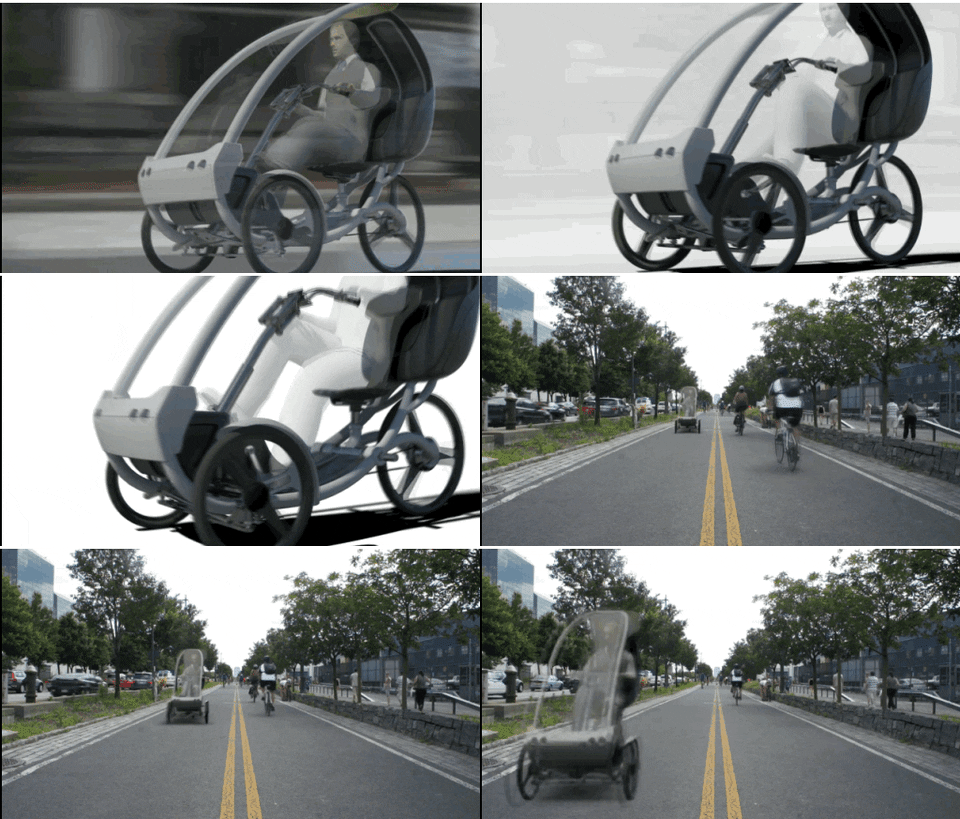
I happen to like the look of cute rounded-rectangular driverless pods or bots or whatever you want to call the emerging class of self-driving vehicles, but there is a new shape on the horizon. A triangle, specifically a triangular self-driving bike that requires a human to pedal, but not to navigate. I'm thinking reading or watching a movie while pedaling and the techno-gizmo part of the tricycle decides where to turn and where to stop. Oh, and these are meant for bikeshare programs.
Very cool.
Pretty design counts
Google has a fun side and it is currently being expressed on the sides of its driverless cars. Cute designs resulted from a contest in California. Skyline, nature, people. So un-boring.
Outside design is not the only part of the driverless future that inspires. One writer talks of living in a driverless Winnebago, roaming around, sleeping while in traffic, not needing to be place specific. We can return to the nomadic lifestyle, but with our house vehicles always with us.
So what did people expect when a car came on the road that allows for hands-free driving on the highway - but only highways with clear lane markings - and a warning that hands should remain - doing nothing - on the wheel? Turns out, those hands are not remaining on the Tesla steering wheels, Some "drivers" are climbing into their Tesla backseats or engaging in other unauthorized, not-good-driver behavior. Oh, and the car can't "read" weather, stop signs, traffic signals, or other common road situations.
I don't have the time, but apparently these mischievous Tesla owners are posting their videos all over the place.
Apparently, I'm not the only person concerned that semi-autonomous vehicles present real dangers. State driving regulators in California are pondering this issue. They were taking their time, but will they hurry up now that the semi-autonomous Teslas are out there driving themselves on highways throughout the state? According to a Silicon Valley article, linked to above in this paragraph, all eyes are on California to issue regulations and set the model for what other states and countries should document, restrict, and allow.
And ... Tesla cars, with those hands-free drivers, perhaps some of them napping or watching videos while behind the wheel, are not considered self-driving according to current California rules. That will be one fun lawsuit when the first accident occurs because the driver did not become instantly attentive when the car alerted him or her.
California might start first driverless community
Planners developing a Southern California community to be pedestrian friendly and have supermarkets and other services within a 10-minute walk of each residence, is considering becoming the first driverless community in the U.S. as well. The idea is that when a car is needed, it can be shared and driverless.
The name is Lilac Hills Ranch, for those wanting to delve deeper.
Florida embracing driverless
Why pay to build a road twice? Florida is resolving this possible problem before it becomes a problem. The sunshine state is planning to build roads that can be adjusted in some way for the day when connected and/or driverless vehicles begin traveling up and down its roads.
Meanwhile, on the roads of Greece, completely driverless gets a chance
Personally, I think a completely driverless vehicle is safer than a partially autonomous one. One city in Greece won the highly competitive spot to try real driverless transit on local roads - with dogs, pedestrians, bicycles, and angry human drivers - on a 1.5 mile stretch. I reported on this before the pilot program started; now the vehicles are in operation. No reports of passengers yet. There is a human monitoring the situation in a control center. He or she will be able to remotely take over the controls if need be, but the little bus is designed to travel without human control of any kind.
That article provides very good coverage of the difference between the Greek CityMobil2 project and earlier ones.
University of Arizona is joining the Uber team to do research on driverless optics mapping,and safety. And the governor of the state could not be happier. Gov. Ducey would like to see Tuscon's streets with driverless vehicles being tested and more people in his states employed on innovative technology projects. Governor Ducey also signed an executive order that allows for the testing and operation of driverless vehicles in Arizona, (Sources: University of Arizona and the Tucson Weekly.)
In the category of what about pedestrians? comes a story form the University of Texas about how our intersections might operate with driverless vehicles. They might be reserving, or cuing up in some way, for permission or a slot to cross an intersection - all happening effortlessly because slow human brains will not be involved. This is all hunky dory for highway management, but it leaves walkers, bikers, and people in wheelchairs dependent on technology to cross a street. Yes, they are in many places currently dependent on traffic signal technology, but that is pretty simply managed. The UT-conceived system would be highly individualized for vehicles. Would non-vehicular travelers need to wear a signal to be able to cue up to cross the street?
I am skeptical. The words used in the article all refer to vehicles. News flash: "traffic flow" also includes zero-emission modes.
Also in Texas
Google will soon be testing its fully self-driving cars - no human driver - on the streets of Austin. Stay weird. Unlike many human drivers, these vehicles can "see" a football field away.
And more on mixing modes
Traffic mixing of human-operated vehicles and driverless ones will be a reality for several years. Driverless software is "teaching" driverless vehicles to predict and, thus, effectively interact with humans. Turns out, humans are rather predictable - 92 percent of the time in how they behave on the highways in the behavior they demonstrate before changing lanes. What humans need from the driverless vehicles are visual indicators, similar to eye contact, when making decisions about navigation on the road.