Companies and cities, sometimes countries, are announcing that AVs, whether shuttles or conventional passenger cars, are coming and they will arrive by a date certain. Those dates differ, but still, such certainty makes one wonder whether the technology is essentially ready or whether engineers are being encouraged to improve the technology fast enough to lend credence to the hype.
Tough, but sweet, outdoor cat taking a break from mouse patrol.
A snarky person like me could wonder whether these bold declarations might encourage companies to suppress, a la Lion Air and Uber (with Herzberg killing), any safety concerns. Perhaps an AV "drivers test" and/or continuous performance monitoring might be in order. After all, auto companies will be combining the driver with the vehicle, and recalls show that those vehicles have sometimes been far from perfectly safe.
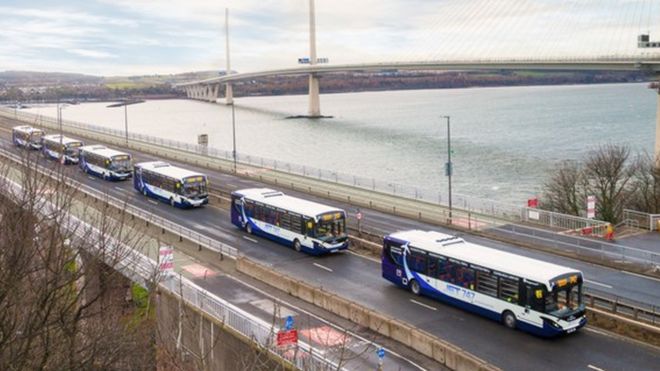
Edinburgh, Scotland - AV full-size transit buses will be piloted on a 14-mile route between a commuter parking lot in Fife and a commuter train station . The buses will use the "the dedicated public transportation corridor across the Forth Road Bridge that also allows buses and taxis."
Across a landmass and over water
Japan - Though Japanese automaker Toyota has been relatively quiet about its AV activities, the plan declared a few years ago, and which continues to be repeated, is that AV service will be available for the 2020 Olympics. So where are we?
Plans are also moving ahead for AV robotaxis to ferry visitors around in Tokyo during the Olympics. Reports from the summer stated that AV vans were being tested as a step toward service during the Olympics. Partners are a Japanese taxi company and a Japanese AV tech company. Toyota is also an investor.
In contrast to bravado or openness?
Miami, Florida - Ford has invited journalists to ride along on trips in its AVs in the traffic mess of Miami (though what US city is not a traffic mess?). These rides are taking place on actual busy streets with bikers and pedestrians and other drivers, all who arbitrarily violate the law and otherwise act in unexpected ways on a regular basis. Ford is basically using the city traffic as a test bed, though with careful backup drivers. The carmaker has a clear goal - AV ridehailing service on the street in Miami and Dade County in 2021.
The future has already happened and it is 1970s Brooklyn. Imagine a world with a subway system, lots of transit buses, taxis and car services. Car services were (maybe still are) these businesses that voila! produced a car - with a driver - within five minutes of when you called. No one ever had to drive.
Dads of high school students loved this because they did not have to get out of bed at some late hour to retrieve their kids. Of course, since we thought the drivers were creepy, we usually ended up sleeping over at friends' houses so that no one had to be the last kid in the car with the driver. My grandmother and her friends used the buses and car services to go everywhere.
Now the world is catching up. Soon everyone can achieve the nirvana of my hometown - except that it will not be so heavenly with a few big competitors and the permanent travails of lack of transit funding likely to continue. Here are some players that have announced on-the-street AV service to launch within the next few years.
Caveats - No word from any car manufacturer or AV technology company about AV ridehailing that will be accessible for people with disabilities. And that's another thing, these companies are all talking about cities, but no one is volunteering to serve rural communities or people with disabilities. Maybe we still are in the 1970s.
Uber is not waiting
Uber is already on the streets of San Francisco providing AV rides - but only for its self-driving staff. I wonder if there's a clause in the employee manual about relinquishing the right to sue. The rides, by the way, are free, so I'm not sure about applicability of federal or state laws or regulations when no money is changing hands and the ride is kind of, sort of, part of the job. Don't get too excited.
As is true for all self-driving vehicles on California public roads, the cars will have backup drivers. The Department of Motor Vehicles recently created a system for companies to test self-driving cars without backup drivers but has not yet issued permits for it.
No doubt Uber will be ready to submit one of those no-human-backup-driver permits.
Happening in China and Japan
Pony.ai is starting an AV ridehailing service in China. "its fleet is running a nearly two-mile route in Nansha, Guangzhou, where its China HQ is located."
News of GM bringing AV ridehailing to lower Manhattan in New York City is the product of good journalist digging. Tribeca Citizen, a neighborhood news source, looked into GM's leasing of office space and discovered that the party named in the lease is none other than "GM Cruise LLC, commonly referred to as Cruise or Cruise Automation." This follows Gov. Cuomo's announcement in October that GM will be doing testing in Manhattan at some unspecified 2018 date.
May Mobility goes for quick trip - shouldn't you walk? - market
May Mobility also scored a big win by getting Tampa's transit agency on board for a pilot with this newcomer AV producer's shuttle. Testing began this week and the pilot for regular riders will commence later in 2018.
Toyota and BMW are funding some May Mobility activity involving "plans to use the seed money to expand in Texas and Florida — states that don’t require a safety driver." This involves some one kilometer routes. Am I missing something or isn't that a short walk - unless we are talking inclement weather? Really inclement weather.
As a native New Yorker, I'm outraged. Should I start an advocacy effort or PR campaign to halt the spread of bad pizza? And what is it anyway with bad pizza and autonomous vehicles (AVs) for delivery? Doesn't everyone know a local dive with a good oven is where you get decent pizza?
But your typical neighborhood pizzeria doesn't have big bucks for AV investment. In the city - by which I mean Manhattan, Brooklyn, and parts of Queens - your local pizza place has a bicycle or a delivery person with a bike. Beyond the Island, New Haven and New Jersey, there is some, but little, good pizza, Sorry, that's reality.
2. Back to AVs and pizza
Dominoes and Pizza Hut are investing in AVs, presumably to get rid of delivery gig workers, who, I'm guessing, show as much loyalty to those companies as these companies show to them. But these deals demonstrate a new round of musical chairs, with large retail and food corporations lining up to integrate service and get rid of drivers - and vehicle manufacturers playing both producer of AVs and future fleet managers,
Ford’s early partners for its AV service platform include Domino’s, Lyft, and, as of today, Postmates. The idea is that Ford will eventually launch and operate its fleet of autonomous vehicles, and that partners including those listed above will be able to essentially plug into the fleet and use it as they would their current delivery drivers and vehicles, with communications protocols and intelligent dispatch built into Ford’s vehicle management system.
Only Postmates is a new partner. Ford is touting the technology as a universal operating system as well as bragging about the impressive partnerships. The legacy auto manufacturer is wisely making its bets to diversify its car-(or truck)-in-every-driveway business model.
Toyota's technology is not out in front, but I like the design idea. I actually had this idea, but it was coffee talk. Toyota introduced the AV design of the empty vessel that can be tailored for different purposes. "Called e-Palette, the concept vehicle has no windshield and no fixed seats but is designed for use as a passenger-carrying minivan, a parcel-delivery truck, or even a mobile office or hotel room."
Getting close to my personal AV tiny house fantasy.
More than pizza
Screenshot from Udelv.com
A California start up is working on the first-mile/last-mile piece for deliveries. "Udelv plans to unveil Jan. 30. Its self-driving van will bring consumers food and kitchen goods from the high-end Draeger’s Market chain in the Bay Area city of San Mateo."
One can ask why. Who can beat Amazon in this space? Amazon is investing big time. Chutzpah and a wish to cash in when Amazon or some other company snatches it up?
As a Trucks.com post wisely points out, no word on the delivery vehicle-to-front-door piece. The whole point of ordering delivery of bad pizza is to not go outside one's door. More so for deliveries of consumer goods. No one even wants to be home for that.
Today's post is brought to you by the acronym of the day, CBI. Since DC is a town of acronyms, here is one that does not stand for the name of an agency, but instead means confidential business information. This is a post about yesterday's public meeting held by NHTSA. I do not believe a video of the event will be made available because there was not a live feed. So much for transparency.
Good outreach does not equal posting one announcement on one government webpage, okay?
Here's my take on yesterday's NHTSA public meeting and it begins before the meeting took place. First, before getting to the meeting, let me say that the outreach was terrible and limited. I'm sorry, but an official announcement with just a few days open for registering to attend the meeting - which was not even held at the US Department of Transportation building - displays an impression that you only want people in the know, an inner circle, to attend. In the age of Twitter, Facebook, and tons of social media outlets, that is poor and inadequate outreach and public engagement. Second, my bad, I am ditzy and inattentive (which is why I really want driverless transportation), but I failed to read the fine print that the event was being held at the GSA (General Services Administration) building, which is in an entirely different part of town than DOT. Fortunately, both agencies are only a couple of Metro stops away from each other on the same Metro line.
I attended even though mid-level NHTSA employees hosted the meeting at an obscure location. The DOT building is quite large, so I am not sure why the meeting was not held there.
It is so weird for me to be in a room with the likes of Google, Ford, Toyota, GM, and Zoox. The one interesting misfit, besides me, was the guy (did not catch his name) from the Commercial Vehicle Training Association (CVTA), a group doing its best to keep drivers at the wheel and attending their member driving schools. Unlike the American Trucking Associations (that is a singular entity, by the way), which has a big interest in cheap, efficient trucking operations sans drivers, CVTA is a voice for delay and roadblocks to thwart a driverless trucking industry.
Points of agreement from those actually in the no-decor government auditorium
Except for the CVTA guy, who has diametrically opposed fish to fry than anyone else who was in the room (a truly boring, small auditorium with no windows or interesting decor), everyone - tech and car companies and public advocates alike - wants clarity and safety. Most want flexibility to support innovation. I say most because I do not get that feeling from one public safety organization, Consumer Watchdog, which has one particular representative at every NHTSA driverless event.
In terms of public advocacy groups speaking out there was Consumers Union, which is the policy and action division of Consumer Reports; the Future of Privacy Forum, which advances "principled data practices" and self-regulation (more on that oxymoron later) because the pace of technology development is inconsistent with the speed and constraints on the process of regulatory change; and Advocates for Highway and Auto Safety, which has worked for decades on auto safety issues.
Car companies with representatives who spoke were Ford, General Motors, Toyota, and Hyundai. Tech companies with representatives who made statements were Google, Zoox, Lyft, and Bosch. Industry associations and representatives were the Center for Automotive Research (the one housed at Stanford) and the Association of Global Automakers. An interesting missing person was David Strickland of the Self-Driving Coalition for Safer Streets, but I came late due to other obligations, so it is possible that I missed him as well as representatives for people with disabilities, who have been active and enthusiastic driverless proponents.
The public comment period is open until Nov. 22 and every single representative who spoke yesterday stated that his or her company or organization will be submitting written comments. To submit comments in response to the proposed NHTSA guidelines, officially known as the Federal Automated Vehicles Policy, visit the Federal Rulemaking Portal (sounds very Harry Potter) and type in NHTSA-2016-0090. Or go straight to this comment page for the docket number. Much easier.
Where's that acronym already? (Say that with a Bernie Sanders voice.)
I will refrain from sharing my notes and instead concentrate on writing a quick summary about agreement and disagreement in the room, while pointing out what I find ridiculous. Being an outsider gives me a possibly less informed, but, perhaps, less biased and bureaucratic perspective.
A major concern of both the tech and the car industries is the protection of - here is today's acronym - CBI, or confidential business information. No one wants their trade secrets, more touchingly known as intellectual property, to become common knowledge. But an acronym is great because you have to be in the know to get it, though this one was easy to figure out. I was not the only one in the room who had not heard that particular acronym before, according to public remarks made.
Agreement List
I'm barely mentioning and not even listing this: Everyone except the CVTA guy loves driverless. What produces agreement and disagreement are the many details. It was a driverless, bureaucratic, mostly dark-suited love fest.
1. Preventing CBI from being disclosed. Every player producing, developing, or hoping to make tons of money on driverless vehicles wants to protect the CBI of themselves and their partners. Knowledge is power and no one wants to share a potentially superior and cheaper algorithm, sensor, AI software (okay, my tech expertise is non-existent). I did just watch the Imitation Game last night and I'm thinking of AI as a kind of Turing machine.
The balance of public disclosure versus CBI: Though there was, at the very least, lip service paid to transparency and the idea of information available to the public, there was broad agreement for the idea that as much information as possible be made public. That said, once details were touched upon, corporate interests expressed discomfort with any intellectual property - CBI- being open to scrutiny.
2. Trigger for new assessment letter or update - Should be a significant change, such as a change in the level of automation. There's not complete unanimity, but broad agreement. Otherwise the regulatory burden will become unbearable.
3. A little less agreement, though there was some consensus that for purposes of regulation and paperwork there should be a point person or company. Where several companies contribute equipment, software, and hardware to a driverless vehicle, who answers to and must file documents with a regulatory agency? You see where this gets into the weeds very quickly. The consensus was to have one entity per vehicle type (that's my language) be responsible so that every vehicle does not require massive paperwork from many companies. OMG, there will not be sufficient agency staff to do an adequate job in that reality.
4. The Safety Assessment Letter - get ready for it, because a new acronym is about to hit your brain, SAL - should have a cover or summary page up front. Basic contact and other information, probably a summary, should be on page one. Now while the details are not clear, the concept attracted a broad consensus.
5. Government should be supportive of corporate innovation, flexibility, and driverless in general.
6. Clarity, clarity, clarity on everything, but specifically the scope of the guidelines, and timing of required documentation to be submitted.
7. Quick response to SAL that it is complete or incomplete - and, if incomplete, how so. GM suggested that a response come from NHTSA's general counsel. Suggestions of 30 days were made, but there were others.
8. Template or templates for SALs were requested by several speakers. This will help both the parties preparing these documents and those analyzing them, whether inside or outside of government.
Disagreement and open questions list
1. Self-regulation or actual enforceable, mandatory regulations? This breaks down along predictable lines of tech and auto industry players versus safety advocates. With a new and completely different kind administration coming to Washington so soon, NHTSA under the Obama Administration will lose its chance to answer this question. The hearing provided an opportunity for public comment, but this game has just begun.
2. Triggers: Trigger level for regulation as an autonomous vehicle and for safety assessment letter: Is SAE level 2 the trigger? Level 3? Are the levels in practice actually clearly distinct? There are lots of opinions on this issue.
In fact, the whole issue of what constitutes a significant update triggering an update of an SAL is far from clear. Very in the weeds and I await a spectrum of comments from those far more conversant with automotive policy and government regulation. And may I say that this is where the average person needs experienced and knowledgeable players in government because the gobbledegook of regulatory details is a foreign language that one must be learned about to participate effectively.
3. Testing versus vehicles sold or in operation: There was disagreement or at least divergent opinions expressed about how testing should be regulated, particularly testing on public roads - like next to your car - versus how to regulate an industry that will be selling, leasing, and likely providing the contemporary equivalents of taxi, jitney, and transit service.
I thought it was interesting the mentions of consumer information because they harken to the 20th century model of individually-owned cars and light trucks versus the distinct possibility for driverless of substantial shared-use services, particularly in dense urban areas and suburbs. Does anyone look at vehicle or airplane safety information when they get into an Uber or onto a plane? That's not happening.
4. Timing of required filing of SAL - using that acronym already. Should the filing deadline be three or four months before an update or new equipment is put on the road? More? One suggestion was made of a mandated annual update for each letter. That was Lyft, but the word "mandate" is mine and perhaps I am misreading the statement made.
Singular points raised
Since industries sometimes cover up health and safety risks - not only the tobacco and football powerhouses - it is relevant whether there will be whistleblower protection and a safe space for companies to reveal unsafe conditions and things that need to be fixed. This raised the issue of tort liability in case of accidents, which is a deterrent to releasing information that admits of or suggests imperfect hardware, software, and equipment. A fear raised at the hearing was that safety data mandated for disclosure to NHTSA (or, presumably, to state regulators) would set companies up for liability in case of accidents.
Me to industry - Just take the lead of Volvo and the few others that are taking my advice, or, more likely, coming to the conclusion on their own to take the airline industry model of effective strict liability and promoting a safety culture. Pay out some money and forget about the who is actually liable. There will be accidents and the public appreciates assumption of responsibility rather than obfuscation. We all hope that driverless will be way safer than human-operated vehicles, but nothing is completely safe.
The Future of Privacy Forum (FPF) speaker was interesting for advocacy for protections of privacy, but not for a government mandate to protect personal data, or, in privacy-speak, requirements for deidentification of data. FPF dreams of a world where companies voluntarily adhere to standards, which effectively are agreed-upon, crowdsourced regulation or industry-wide standard practices, all embraced by the public. I'm on the fence.
California issued its 18th permit to test driverless vehicles to NextEV, a company that is also receiving millions in tax credits for creating jobs in the state's zero-emission industry. I have read a few sources, but they are repeats of press-release-speak and without real details. Real debate The real news is the bubbles of unhappinessfloating to the surface with California's new proposed driverless regulations and the proposed NHTSA guidelines out of Washington, DC. Toyota is grousing about the possibility of pre-market approval of driverless vehicles and a 15-point safety checklist included in the proposed guidelines. We test 16 year olds before they can go out on the road alone and we inspect vehicles at least once a year (my state does), so perhaps a road-ready inspection system for driverless vehicles is not unreasonable. Total bull that a technology-agnostic testing requirement would necessarily stifle innovation. Like lawsuits are efficient in this regard? Then you have, effectively, regulation by jurors and judges, who know nothing about technology, but generally prefer the little guy defendant. Pre-market approval Right now, the argument is, as legal speak would term this, not yet ripe. It would take an act of Congress to grant pre-market approval authority to NHTSA. NHTSA can talk of this possibility, but it has no power at this time to implement such a process. From a substantive angle, the other side of the argument is that government will take too long, be inefficient, and blah, blah, blah ruin the auto industry or words to that effect. It's not too often the auto industry begs for government regulation, so excuse me for thinking of Toyota's response as pretty much a knee-jerk reaction. Interesting that there has been no public word from David Strickland of the Self-Driving Coalition for Safer Streets and its tech and auto industry players. No doubt they are working behind the scenes. Maybe the auto and tech companies should not fight every government requirement. Makes them look unreasonable to most people, as in people who know little to nothing about the details of driverless technology. FYI: Decided not to post the video of the self-driving tricycle - without a seat - that is able to go around in circles. The trike is being developed at the University of Washington Bothell.
Toyota is investing in the University of Michigan (sorry Buckeyes) to the tune of $22 million for artificial intelligence research that will go into driverless vehicles and many other types of products. The Japanese company is also interested in robotics products that enable older adults to remain independent and to assist people with disabilities. In a move that I perceive as related to autonomous vehicles, but is not technically so, Google has partnered with Israeli company Gett, a ride hailing, app-based, business similar to Uber. (Now I can't help but mention that according to Jewish law a gett is a document related to divorce that a husband must give to the wife - but without any reciprocal requirement - if she is to be free of the marriage.) Cozy linkage The Jerusalem Post reports that
In the deal, Google will offer information and a link to Gett in its popular Maps app when users search for directions, including an estimated fare and travel time. The feature, which previously went live in the UK and as of Wednesday is available in Israel and Russia, lets users seamlessly jump from Maps to Gett to order their cabs, or directs them to the app store to download the app. Google has offered the same feature with Uber for some time ...
The Gett deal is just one of a number of similar deals between Google and ride hailing companies around the globe. The deals demonstrate that Google perceives the ride hailing market as significant. Or perhaps Google is hedging its bets because no one can be sure of the business models for future transportation. These deals put Google into the space that RideScout formerly inhabited, though that app company did not operate on a global scale. In the musical chairs game of transportation app businesses, Moovel, which is owned by Daimler, purchased RideScout in April 2016. From the warehouse to the street? For those who doubt that driverless vehicles are another few decades away or that they will not play nicely with walking humans (otherwise known as pedestrians), this excellent article about the use of self-driving forklifts being employed in factories might give pause. The article does a good job of explaining the technology and operations. Data convinced union leaders to allow these (or not to oppose them). Experience demonstrates that the autonomous forklifts are safer than human-driven ones and that there have been no collisions with walking human factory workers. Oh and they save the factories lots of money as well.
I love this article out of England. There's a project that mixes driverless with transit, technology for people with disabilities, and transportation apps. This is definitely a complete trip perspective. The article discusses a technology firm in Coventry in connection with the University of Warwick Science Park's Venture Centre (which sounds more like the name of a children's museum). The technology to assist people with disabilities is impressive. For instance, there is a whole tactile element for people with visual disabilities. Growing market of older people
Toyota gets this. The Toyota video below sends a clear message and, although the narration is in Japanese, anyone can understand that message, that there is a huge market in serving older people who do not drive or who are - or should be - cutting back on driving or not driving entirely.
Solar tidbit Just for fun, read this piece about an entirely autonomous boat that is traveling across the Atlantic Ocean from Boston to Portugal. The boat is operating solely on solar energy. The guys who built the boat did the work in their spare time. Very neat. You can follow the vessel as well. It is currently approximately 20 percent of the way to its destination.
Michigan and Texas are investing heavily in driverless research facilities and working to lure private companies with big bucks. Driverless advancement is not the only venture contemplated. Robotics and artificial intelligence are also on those lists. Toyota is going to Ann Arbor to team up with the University of Michigan. This is another billion dollar venture and represents Toyota's third research center, the first two being in Palo Alto, CA, at Stanford, and Cambridge, MA, at MIT. I know this has been reported before, but I like the article. Texas A&M, a school I know pretty much nothing about, is taking a big risk and investing in a huge campus expansion,10 miles from its existing campus, to allow for the type of public-private gown/corporate partnership that Toyota is doing in Michigan. But the Texas plan is a "build it and they will come" venture to be built at a World War II-era site. This will be a $150 million investment. Wise investments as the giant is ahead? Meanwhile Google is planning on making driverless minivans with Chrysler. The signatures, however, are not yet on any documents. When the documents are signed, that deal will fuel driverless media speculation for a while.
Warning: This is a long post. The most interesting aspect of this type of public hearing is not generally what people say, but who shows up in the first place. The NHTSA hearing in California, held yesterday at Stanford University, attracted many of the same players as the Apr. 8 hearing held in DC., with quite a few additional speakers. Representatives of people with disabilities were out in force and remain amongst the most enthusiastic supporters of driverless vehicles, with the proviso that those vehicles be designed for full accessibility. Other participants included Google's Chris Urmson, David Strickland of the new Self-Driving Coalition for Safer Streets, and a representative of MADD - Mothers Against Drunk Drivers. General themes A general theme for the day and the one point on which there is complete consensus is that the US should adopt a national framework - whether through a uniform set of state laws or via federal laws and regulations - for the operation of driverless vehicles so that manufacturers, safety advocates, and others do not have to operate with a maze of different, and sometimes conflicting, legal provisions. State-by-state air quality standards were raised as one example where that is the case. An aspect of this call for national standards was something heard as well at the Apr. 8 NHTSA hearing, a plea for technology-neutral standards to allow for flexibility in the development of new technology. One speaker, who was from VQuest and does work for the Department of Defense, used the term "platform agnostic." No one seemed to want driverless vehicles to be tied to any particular technology without ease to advance or change. The VQuest speaker made a related point that we do not want to punish failure; we want to create incentives to experiment and thereby learn from failures. Only if we do so will we promote a willingness to share data and innovate. One more point of consensus is the idea of required black boxes, similar to what is on airplanes, to provide data when crashes occur. Some guy also mentioned white boxes, but I did not catch exactly what that was. I admit that I am willing to spend only so much time on this; not willing to go back to the video of the hearing. A last theme, or, perhaps, more of a common refrain, was the recitation of how everyone, including existing manufacturers of currently non-accessible vehicles, is looking forward to a rosy and accessible future for people with disabilities. A less common refrain, though pretty common, was the mention of benefits to the environment. (FYI: If anyone is looking for a brilliant materials science engineer to work on batteries, I have a daughter who fits the bill. She'll be starting a PhD program in the fall. So proud.) Some safety advocates have selective goggles on - for good and bad Some from the so-called consumer safety community continue to drone on about the need for a human driver as though they never received the mountains of news reports over the last one hundred years that drivers have caused over 90 percent of all motor vehicle crashes, the ones that have killed hundreds of thousands and injured millions more - in the US alone, with many millions affected the world over. One of those casualties last year was someone I knew, a fact that scares me each time one of my daughters drives. What the safety advocates make good points about are needs for (1) real federal standards and not just voluntary compacts among the car companies; 2) required transparency of data about operations of vehicles, interfaces, and crashes and near-crashes; and (3) mandatory alerts for car owners and used car owners, in particular, about vehicle recalls and defects. These advocates paint a picture of traditional car companies manipulating a cushy regulatory environment with lax oversight. Neat speaker shows West Coast vibe One biker dude showed up. I admit that I did not catch his name. He was the only speaker who mentioned something important beyond the actual vehicles, which is the people on streets who will not be inside vehicles, autonomous or otherwise. The biker dude expressed concern that self-driving vehicles be designed to decrease worries on the part of, and actual collisions with, bikers and pedestrians. The MADD representative reminded the panel about human drivers who operate vehicles when they are in no condition to drive. MADD, of course, is most concerned about driving under the influence of alcohol and other inebriating substances, and the representative spouted the scary number 80, which is the average number of times a driver drives drunk before an arrest. The advocacy group looks forward to the day when it no longer has to spout such numbers and be concerned about innocent people harmed because a human in a drunken stupor, or just tired after a drink or two (those are my words), gets behind the wheel. NHTSA panel gets star speakers Two rather prominent individuals in the driverless world appeared at the podium to speak at the NHTSA hearing, Chris Urmson of Google and David Strickland, a former NHTSA Administrator, and now counsel and spokesperson for the newly founded Self-Driving Coalition for Safer Streets. (That name, of course, not suggesting that the coalition has no one behind its metaphoric wheel.) A third speaker with some glamour was the representative of Beverly Hills, California (yes, 90210), Dr. Julian Gold, a member of the city council and former mayor. Urmson is about as relaxed a public speaker as I have ever seen. Unlike the other corporate types at the hearing, Urmson seemed frank and conversational. I also like what he said. It's as if he's been listening to me rant on about driverless vehicles. I'd accuse him of eavesdropping at my office and at my kitchen table, but he has no need. He already knows way more about the technology than I do. Urmson pointed out that we already have unsafe roadways with many, many deaths and injuries. There's no reason, he said, to go slowly and incrementally. He succinctly stated that while everyone agrees that the US needs national standards, there is significant disagreement about the speed of implementing the technology and how to develop it. Testing, Urmson reminded the panel, cannot only be performed on testing courses (and fake roads), but must be done on real roads. He talked about the successful experiences of Google's test vehicles and he rightly stated that accidents involving those vehicles have been minor. He also warned the panel that if the US does not act to provide a national regulatory framework that allows for innovation, testing, and deployment, other countries will pass us by.
Coalition talks - Reminding me of the old EF Hutton commercial Strickland announced his new role on behalf of the new Self-Driving Coalition, made similar remarks to others about safety for all and access for people with disabilities, and then progressed to appropriately calling driverless a "safety game changer" and asking for a broad spectrum of stakeholders. Definitely a DC guy. Anyone outside of DC gets the kooties just hearing that word. But Strickland is correct because that is the way Washington, DC, operates best, with coalitions that represent the full range of - ooh, yes I'm using the word - stakeholders. Strickland, as you can tell, spoke in big tent language, and matter of factly told the panel that driverless operations are "years, not decades, away." Even though anyone with a bit of knowledge knows this, the panel needs to hear it from people like Strickland, who have clout and gravitas. He is about as far from a hipster dude as one can be. Suited, serious, and with credentials that precede him, there is no question that the NHTSA panel took his presence there and his words seriously. Confession: I have been in DC long enough that I hardly wince when I hear the "s" word. That's what you get for spending lots of time in an office two blocks from the White House. Town of palm trees and movie star houses wants driverless transit Beverly Hills is actually the City of Beverly Hills, though it is small and feels more like a neighborhood in the LA area. It is very pretty and wealthy. But it recently pushed itself to the forefront of progressive urbanism by passing a resolution in favor of a plan for driverless transit. Dr. Julian Gold, a former mayor and current council member, talked to the NHTSA panel about first and last-mile challenges once transit rail lines are built and in operation nearby. There will be no new parking garages, so the city is realistically considering options and a driverless transit system seems like a good one. The city plans to host a forum soon as it explores how to go about making this dream a reality. (I can see a logo on the vehicle with nice green and pink hues from the Beverly Hills hotel and a white overlay of a tall palm tree. I'm willing to design it.) Gold also envisions driverless for seniors and people with disabilities who live in his city. He reminded the panel that parking spaces cost about $40,000 a pop. They are not free. Gold was practical in raising issues such as whether children will be allowed to ride with adults (they do on subways and there's no driver or other official in every car), and what roadway and vehicle specifications, if any, will need to be in place. Gold brought the local government perspective, which is an important one in transportation. Local and state governments are responsible for transit and for road maintenance. He informed the panel that these questions need to be answered ASAP. And his city wants the full monty of level five, fully autonomous vehicles. The federal-state division of responsibilities may need to be revisited wholesale instead of globbing on a new layer of regulation onto the old. The Nvidia spokesperson suggested as much in his comments. Truth be told, however, globbing is a traditional DC strategy in a town where consensus is the name of the game. Award for most effective speaker The representative of Self-Driving MN (Minnesota) at yesterday's NHTSA hearing spoke from the heart as he described the hi-jinks of family members and a mix of family and public transportation that provide transportation to work for his brother who is disabled. He spoke eloquently when he wondered aloud how someone with a disability who does not have family close by is able to get to work and to otherwise take care of oneself. The intimate scene that this gentleman allowed everyone watching the hearing to share painted a before and after picture that demonstrated the freedom and equality that autonomous vehicles will represent for many people with disabilities. Another representative of the disability community reminded panel members that blindness and visual impairments are not the only class of disability that will require accessibility to driverless vehicles, a point emphasized in more ways at the Apr. 8 hearing in DC. However, that same speaker, whose name I did not jot down, aptly uttered the mantra of the disability community - nothing about us without us - when calling for universal design to be incorporated in and interfacing with these new vehicles at the outset. Award for speaker who probably knows a thing or two about microbreweries The Zoox speaker was by far the coolest dude in the room, with a sense of humor and a let's-figure-this-out-over-a-beer vibe. He also had on a nice hat and told the story of how his company got started just a stone's throw away from where the NHTSA hearing was taking place. It made me smile. He got to the heart of the matter at hand for NHTSA, which is how to have technology experts and government regulators, who approach their lines of work very differently, to come together for the common good. And he used the word traumatized to describe the experiences of families around the globe who have lost loved ones. A big thank you to the tweeter, Mark Harris (@meharris, published in the Economist, among others), who pointed out that I was wrong with my spelling of Zoox. I was thinking in terms of rhymes with cukes. Usual suspects Traditional car companies showed up as well, including Ford, Honda, Toyota, and GM. No surprises there. No news - with one exception. Toyota is pushing for a transitional period, which, when translated, means, in my opinion, that the company is not ready for prime time on driverless and it does not want anyone else getting out of the gate on this any time soon. Likewise for the speaker from Subaru. (Okay, can we really trust a car company with a dweeb advertising campaign that it's cars are made with love? I thought they were made with robots and non-union labor.) Best corporate speaker award This prize definitely goes to the Volvo speaker, who right off the bat mentioned that she has three children and who managed to humanize the Volvo corporate goals of zero deaths by 2020 and its acceptance of full responsibility - meaning liability - for any crashes involving its driverless vehicles, which, by the way, will be on London roads soon, and, of course, Swedish ones. (Trust me, London can compete with New York for crazy driving, though I believe that New Yorkers are less about following rules and definitely more about shouting out the window in an endless loud back and forth with pedestrians, except above Mitdtown, where there is less and less traffic.) If you would like to watch the Apr. 8 hearing, here is the video. I suspect the video of the Apr. 27 hearing will be available soon.
In case anyone wants more of a say, NHTSA will be accepting public comments until May 9, the day after Mother's Day.
Well, the Dutch. And they are not talking trucks out West, either. Nor are we talking about truckers seeking to fall under the radar of the Man, specifically state troopers. This is a convoy today of partially-driverless vehicles doing a test for a risk-management company to gather data on safety and vehicle spacing in mixed traffic. Though the vehicles were not completely autonomous, the humans left to the cars decisions about acceleration and lane changes, Not an entertaining video. A good group of car companies participated. "The cars making the journey include BMWs, Hyundais, Mercedes, Teslas, Toyotas and Volvos."
You want to see this again. Kris Kristoferson, Ali McGraw, and Ernest Borgnine. Classic grade B movie.
Toyota Toyota is going big for driverless and developing robotic products as well, particularly for older adults. Lots of reports - articles and blog posts are everywhere - that the car company is investing one billion dollars - yes, billion. A new center, the Toyota Research Institute, is being created in Silicon Valley, near Stanford, to do the actual work. Ford Ford is forgoing the head-in-sand/incremental approach of most conventional car companies. Like the driverless-or-bust approach of Google, for example, Ford is declaring that its completely self-driving vehicles will be on the roads in five years - so 2020. I have to say that I'm enjoying that these large companies are coming around to my personal point of view. Maybe I can get a cut. Okay, not likely.
Santa Clara University's three-month driverless shuttle pilot - an intra-campus transit system, from my perspective - will look at which model works best for satisfying travel demand, the choices being (1) the conventional fixed-route transit model, or (2) a demand-response, you-call/we-pick-up model. However, it will be a while before any data is produced because university students will not be allowed to ride the golf-cart vehicles for at least the first month. Something about safety; I'm sure the parents appreciate that.
Driverless bus in China
Yutong Bus, a Chinese transit vehicle manufacturer, has successfully tested a driverless bus. The manufacturer exports to 120 different countries and sells over 60,000 buses a year. This was just one successful drive, but it is nice to see a vehicle manufacturer aiming to bring driverless technology to the transit market.
Google monthly report
Nice tidbits and tea leaves in the Google monthly report on its driverless comings, goings, and progress. Google is emphasizing the safety of its vehicles in California and Texas traffic, doing well by pedestrians, not crashing into deer (or visa versa), and continuing to rack up driverless miles - over two million and counting, according to Google. Next up will be pod cars in Austin (just the old models are there now) and figuring out the venue riders will want use to enter destination information. Smartphones are a likely choice. A question I've not seen Google mention is whether it will produce shared-ride or transit driverless vehicles. Those pods are cute, in a smurf kind of way, but do we really want to exchange current congestion for a sea of adorable pods and endless parking lots with identical G-cars?
Speaking of pods, two-seater, driverless prototype cars will soon be on the road in a city in Germany. The birthplace of Frederick Engels (Karl Marx's pal), Wuppertal, now a down-on-its-heels former rust belt manufacturing center, will host the mini-cars on a test track on a stretch of city street that offers a diversity of driving challenges, including the presence of pedestrians. Laser focus - cheaper and lighter
As with most innovations, the prototypes and early models are expensive. Now, the expensive technology that Google is using as the eyes of its driverless pods, called LIDAR (a mix of light and radar), is being manipulated, if you will (let's be clear: this technology is beyond me and I rely on others to explain it), by other companies and universities.
The University of California at Berkeley has come up with - or worked hard to develop - a cheaper, lighter version of LIDAR technology and hardware. Seems that this team has gotten the cost reduced from about $80k to $10. And they are aiming even lower.
And on the long route
Toyota continues to bank on a slow road to driverless and a long phase of partially autonomous vehicles. The company is putting its money where its mouth is - $50 million of it - by funding MIT and Stanford as joint research centers. An impressive robotics guy, Gill Pratt, has been hired to oversee the effort.



:format(webp)/cdn.vox-cdn.com/uploads/chorus_image/image/58247515/01_e_Palette_Concept.0.jpg)
